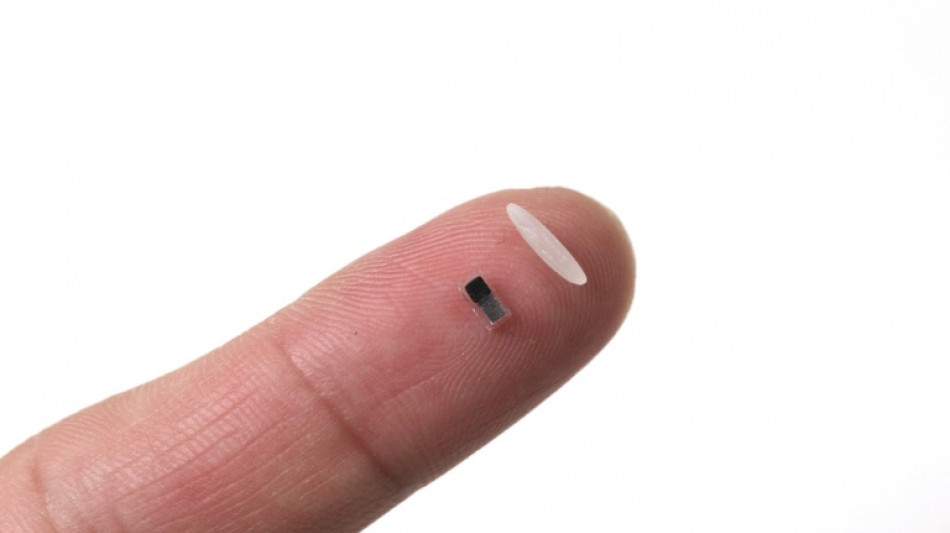
World's tiniest pacemaker is smaller than grain of rice / Photo: John A. Rogers - Northwestern University/AFP

 NASA scan discovers new, 'once in a century' Moon crater

 Most stocks rise as Fed hikes and indicates drive to curb inflation

 UK-Sudanese author pens book to give children 'African history of Africa'

 US Congress passes sweeping Russia sanctions bill

 US stocks fall, dollar gains after Fed lifts interest rates

 US Fed raises rates to tackle 'too high' inflation in move sure to rile Trump

 US Fed raises rates to battle inflation in move likely to rile Trump

 US House faces test on sweeping Russia sanctions bill

 British PM says to make 'difficult decisions' as inflation rises

 Global fuel price demos: a round-up

 Leverate Launches MCP for Traders to Connect AI Assistants With Trading Platforms

 MEXC Launches $1M "Discover Your Wall Street DNA" Campaign to Help Traders Find Their Market Fit

 Stocks edge higher ahead of US Fed rate call

 BASIS.pro Expands On-Chain Infrastructure with XDC Network Partnership and Zypher DAO as Auto Earn Goes Live

 Pickle-flavoured tart? AI inspires Japan's convenience stores

 EU chief hosts Canada's Carney in push to 'deepen' alliance

 Meta chief pushes back on AI slowdown calls

 US Fed to deliver rate decision with markets betting on hike

 i-payout Expands U.S. Money Transmitter Licensing Footprint and Advances European EMI Strategy

 US Senate crypto bill collapses amid partisan deadlock

 OpenAI, Anthropic and Google are working to create an AI standards body

 Protesting shepherds, farmers clash with Romanian police

 Foundation Lets Ledger Users Switch to Open Source Without Starting Over

 EU to propose curbing social media, online games for under 15s

 FX Junction Reaches 40,600 Members and 26 Million Trades

Scientists said Wednesday they have developed the world's tiniest pacemaker, a temporary heartbeat regulator smaller than a grain of rice that can be injected and controlled by light before dissolving.
While still years away from being tested in humans, the wireless pacemaker was hailed as a "transformative breakthrough" that could spur advances in other areas of medicine.
Millions of people across the world have permanent pacemakers, which stimulate hearts with electrical pulses to ensure they beat normally.
The US-led team of researchers behind the new device said they were motivated to help the one percent of children born with congenital heart defects who need a temporary pacemaker in the week after surgery.
The pacemaker could also help adults restore a normal heartbeat as they recover from heart surgery.
Currently, temporary pacemakers require surgery to sew electrodes onto heart muscles, with wires connecting to a powered device on the patient's chest.
When the pacemaker is no longer needed, doctors or nurses pull out the wires, which can sometimes cause damage.
Neil Armstrong, the first person to walk on the Moon, died from internal bleeding after his temporary pacemaker was removed in 2012.
But the newly developed pacemaker is wireless. And at just one millimetre thick and 3.5 millimetres long, it can fit into the tip of a syringe.
It has also been designed to dissolve into the body when no longer needed, sparing patients invasive surgery.
- 'Significant leap forward' -
The pacemaker is paired to a soft patch worn on the patient's chest, according to a study describing the device in the journal Nature.
When the patch detects irregular heartbeats, it automatically flashes light that tells the pacemaker what heartbeat it should stimulate.
The pacemaker is powered by what is called a galvanic cell, which uses the body's fluids to convert chemical energy into electrical pulses that stimulate the heart.
So far, the pacemaker has worked effectively in tests on mice, rats, pigs, dogs and human heart tissue in the lab, according to the study.
Senior study author John Rogers of Northwestern University in the United States told AFP he estimated the pacemaker could be tested in humans in two to three years.
His lab has launched a start-up to pursue this goal, he added.
In the future, the underlying technology could also "create unique and powerful strategies to address societal challenges in human health," Rogers said.
Bozhi Tian, whose lab at the University of Chicago has also developed light-activated pacemakers but was not involved in the latest research, called it a "significant leap forward".
"This new pacemaker is a transformative breakthrough in medical technology," he told AFP.
"It's a paradigm shift in temporary pacing and bioelectronic medicine, opening up possibilities far beyond cardiology -- including nerve regeneration, wound healing and integrated smart implants."
Heart disease is the world's leading cause of death, according to the World Health Organization.
St.Ch.Baker--CPN