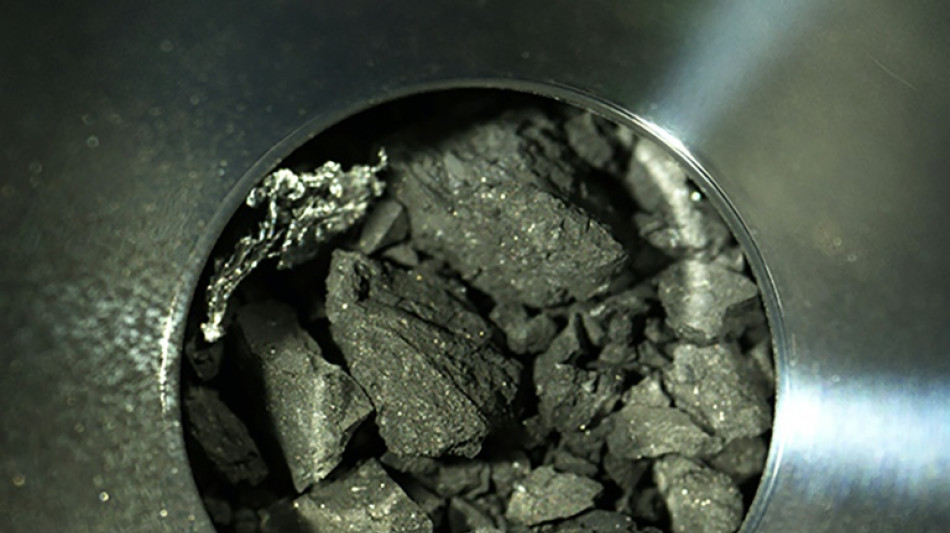
Asteroid samples contain 'clues to origin of life': Japan scientists / Photo: Handout - JAXA/AFP/File

 EU to ban social media for under 13s, curb access until 15

 Wildfires push endangered Sumatran elephants to brink: Indonesian NGO

 Bank of Japan set to raise rates under pressure from inflation, US

 EU chief to unveil social media, gaming curbs for under-15s

 'Resident Evil' film brings video game's ethos to the big screen

 i-payout Expands U.S. Money Transmitter Licensing Footprint and Advances European EMI Strategy

 US Senate crypto bill collapses amid partisan deadlock

 OpenAI, Anthropic and Google are working to create an AI standards body

 Protesting shepherds, farmers clash with Romanian police

 Foundation Lets Ledger Users Switch to Open Source Without Starting Over

 EU to propose curbing social media, online games for under 15s

 FX Junction Reaches 40,600 Members and 26 Million Trades

 'We unleashed the beast': the world's fears and hopes about AI

 Hospitality leaders ask Burnham to halve VAT amid rising costs

 Worcestershire invited to nominate groups for 2027 King’s volunteer award

 Berlin's run-down public spaces at heart of election campaign

 'Widow's Bay' and 'The Pitt' win big at Emmy Awards

 Most markets drop as oil extends gains ahead of expected US rate hike

 Sri Lanka's famed beach shack battles demolition

 Vserv targets ₹1,000 crore revenue by 2030 through AI expansion

 India prohibits bank fees on UPI payments up to ₹2,000

 Brazil's Amazon defender Raoni has cancer

 Trump rejects AI slowdown concerns as UN urges coordinated controls

 Higher wages draw migrant workers to Kashmir despite attacks

 Oil supply concerns and AI warnings weigh on global markets

Asteroid dust collected by a Japanese space probe contains organic material that shows some of the building blocks of life on Earth may have been formed in space, scientists said Friday.
Pristine material from the asteroid Ryugu was brought back to Earth in 2020 after a six-year mission to the celestial body around 300 million kilometres away.
But scientists are only just beginning to discover its secrets in the first studies on small portions of the 5.4 grams (0.2 ounces) of dust and dark, tiny rocks.
In one paper published Friday, a group of researchers led by Okayama University in western Japan said they had discovered "amino acids and other organic matter that could give clues to the origin of life on Earth".
"The discovery of protein-forming amino acids is important, because Ryugu has not been exposed to the Earth's biosphere, like meteorites, and as such their detection proves that at least some of the building blocks of life on Earth could have been formed in space environments," the study said.
The team said they found 23 different types of amino acid while examining the sample collected by Japan's Hayabusa-2 probe in 2019.
The dust and rocks were stirred up when the fridge-sized spacecraft fired an "impactor" into the asteroid.
"The Ryugu sample has the most primitive characteristics of any natural sample available to mankind, including meteorites," the Japan Aerospace Exploration Agency (JAXA) said in a statement.
It is believed that part of the material was created about five million years after the birth of the solar system and has not been heated above 100 degrees Celsius (210 degrees Fahrenheit).
Another study published in the US-based journal "Science" said the material has "a chemical composition that more closely resembles the Sun's photosphere than other natural samples".
Kensei Kobayashi, an astrobiology expert and professor emeritus at Yokohama National University, hailed the discovery.
"Scientists have been questioning how organic matter -- including amino acids -- was created or where it came from, and the fact that amino acids were discovered in the sample offers a reason to think that amino acids were brought to Earth from outer space," he told AFP.
Another mainstream theory about the origin of amino acids is that they were created in Earth's primitive atmosphere through lightning strikes, for example, after Earth cooled down.
M.Mendoza--CPN