James Webb telescope hit by micrometeoroid: NASA / Photo: - - NASA/AFP

 EU to ban social media for under 13s, curb access until 15

 Wildfires push endangered Sumatran elephants to brink: Indonesian NGO

 Bank of Japan set to raise rates under pressure from inflation, US

 EU chief to unveil social media, gaming curbs for under-15s

 'Resident Evil' film brings video game's ethos to the big screen

 i-payout Expands U.S. Money Transmitter Licensing Footprint and Advances European EMI Strategy

 US Senate crypto bill collapses amid partisan deadlock

 OpenAI, Anthropic and Google are working to create an AI standards body

 Protesting shepherds, farmers clash with Romanian police

 Foundation Lets Ledger Users Switch to Open Source Without Starting Over

 EU to propose curbing social media, online games for under 15s

 FX Junction Reaches 40,600 Members and 26 Million Trades

 'We unleashed the beast': the world's fears and hopes about AI

 Hospitality leaders ask Burnham to halve VAT amid rising costs

 Worcestershire invited to nominate groups for 2027 King’s volunteer award

 Berlin's run-down public spaces at heart of election campaign

 'Widow's Bay' and 'The Pitt' win big at Emmy Awards

 Most markets drop as oil extends gains ahead of expected US rate hike

 Sri Lanka's famed beach shack battles demolition
 Vserv targets ₹1,000 crore revenue by 2030 through AI expansion
 India prohibits bank fees on UPI payments up to ₹2,000
 Brazil's Amazon defender Raoni has cancer
 Trump rejects AI slowdown concerns as UN urges coordinated controls
 Higher wages draw migrant workers to Kashmir despite attacks
 Oil supply concerns and AI warnings weigh on global markets
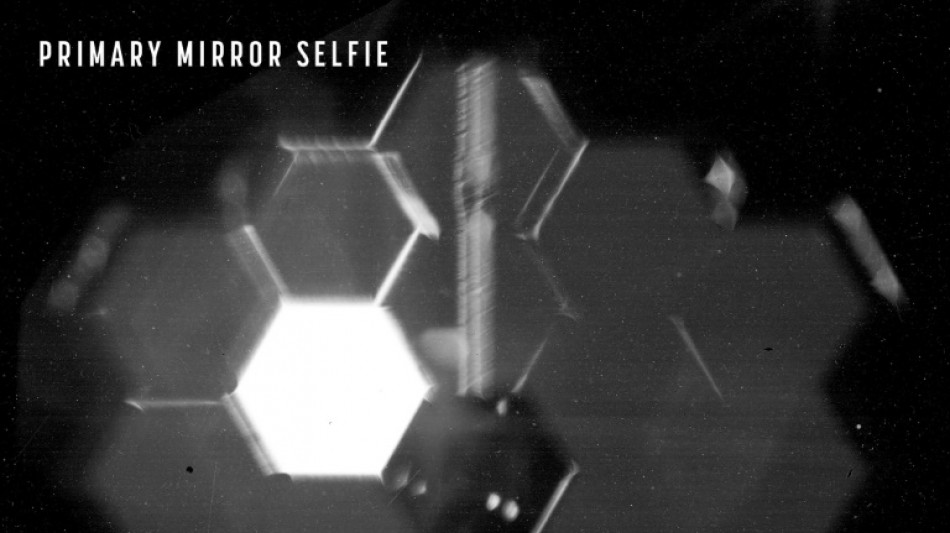
A mirror on the James Webb Space Telescope was struck by a micrometeoroid last month but is expected to continue to function normally, NASA said Thursday.
"After initial assessments, the team found the telescope is still performing at a level that exceeds all mission requirements despite a marginally detectable effect in the data," the US space agency said.
"Webb's beginning-of-life performance is still well above expectations, and the observatory is fully capable of performing the science it was designed to achieve," it added.
One of the space observatory's primary mirror segments suffered an impact from a micrometeoroid, which tend to be smaller than a grain of sand, between May 23 and 25.
The telescope, which is expected to cost NASA nearly $10 billion, is among the most expensive scientific platforms ever built, comparable to its predecessor Hubble, and the Large Hadron Collider at CERN.
Webb's mission includes the study of distant planets, known as exoplanets, to determine their origin, evolution and habitability, and it is expected to produce "spectacular color images" of the cosmos in mid-July.
The telescope has spent the past few months aligning its instruments in preparation for the big reveal.
NASA said micrometeoroid strikes are an "unavoidable aspect of operating any spacecraft" and "were anticipated when building and testing the mirror."
"This most recent impact was larger than was modeled, and beyond what the team could have tested on the ground," it said.
Lee Feinberg, Webb optical telescope element manager at NASA Goddard, said that "with Webb's mirrors exposed to space, we expected that occasional micrometeoroid impacts would gracefully degrade telescope performance over time.
"Since launch, we have had four smaller measurable micrometeoroid strikes that were consistent with expectations," Feinberg said.
NASA said that to protect Webb, flight teams can turn the optics away from known meteor showers.
It said the May micrometeoroid strike was not the result of a meteor shower but an "unavoidable chance event."
St.Ch.Baker--CPN