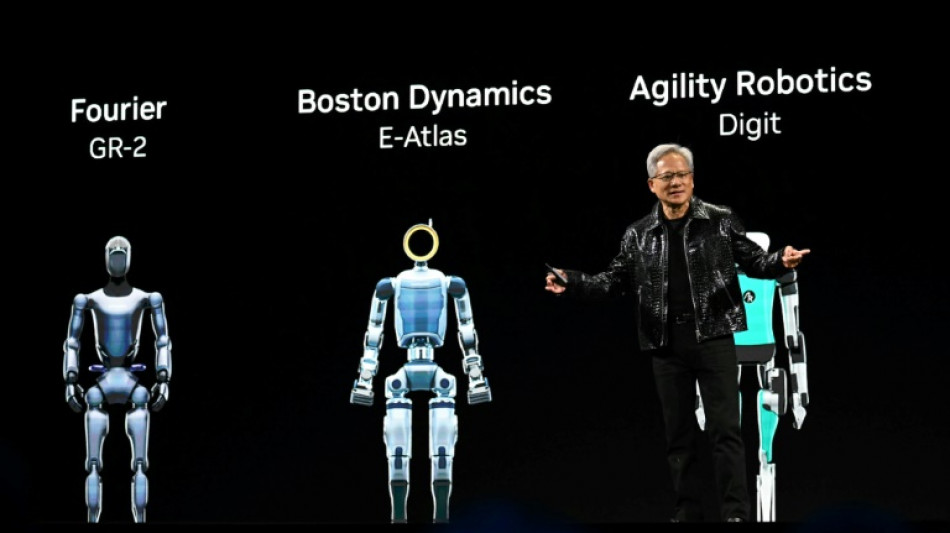
Nvidia showcases new tech at AI 'Super Bowl' / Photo: Patrick T. Fallon - AFP

 NASA scan discovers new, 'once in a century' Moon crater

 Most stocks rise as Fed hikes and indicates drive to curb inflation

 UK-Sudanese author pens book to give children 'African history of Africa'

 US Congress passes sweeping Russia sanctions bill

 US stocks fall, dollar gains after Fed lifts interest rates

 US Fed raises rates to tackle 'too high' inflation in move sure to rile Trump

 US Fed raises rates to battle inflation in move likely to rile Trump

 US House faces test on sweeping Russia sanctions bill

 British PM says to make 'difficult decisions' as inflation rises

 Global fuel price demos: a round-up

 Leverate Launches MCP for Traders to Connect AI Assistants With Trading Platforms

 MEXC Launches $1M "Discover Your Wall Street DNA" Campaign to Help Traders Find Their Market Fit

 Stocks edge higher ahead of US Fed rate call

 BASIS.pro Expands On-Chain Infrastructure with XDC Network Partnership and Zypher DAO as Auto Earn Goes Live

 Pickle-flavoured tart? AI inspires Japan's convenience stores

 EU chief hosts Canada's Carney in push to 'deepen' alliance

 Meta chief pushes back on AI slowdown calls

 US Fed to deliver rate decision with markets betting on hike

 i-payout Expands U.S. Money Transmitter Licensing Footprint and Advances European EMI Strategy

 US Senate crypto bill collapses amid partisan deadlock

 OpenAI, Anthropic and Google are working to create an AI standards body

 Protesting shepherds, farmers clash with Romanian police

 Foundation Lets Ledger Users Switch to Open Source Without Starting Over

 EU to propose curbing social media, online games for under 15s

 FX Junction Reaches 40,600 Members and 26 Million Trades

Nvidia chief Jensen Huang on Tuesday showcased cutting-edge chips for artificial intelligence and new applications for the technology, shrugging off talk of China's DeepSeek disrupting the market and dangers from US President Donald Trump's trade wars.
Huang gave a hotly anticipated keynote presentation at Nvidia's annual developers conference that packed the SAP Center in the Silicon Valley city of San Jose, where the Sharks NHL hockey team plays.
Billing the event as an AI Super Bowl, the Taiwan-born tech titan was greeted by an audience of more than 20,000 who sat through his two-hour-plus address announcing the company's latest updates.
"The difference is that everyone is a winner at this Super Bowl," he said, promoting the universal benefits of AI technology.
Huang used the annual speech to unveil latest developments and tie-ups at the company he co-founded more than three decades ago that saw a stratospheric growth with the AI frenzy stemming largely from the company's core product, graphics processing units (GPUs).
Huang spotlighted the updates to Nvidia's latest Blackwell line of GPUs, as well as new hardware or software for robotics and telecommunications.
The announcements included a partnership with General Motors focused on developing driverless vehicles that would feature an Nvidia-made, in-vehicle computing system that can deliver up to 1,000 trillion operations per second.
He also unveiled a telecoms project, involving T-Mobile and Cisco Systems, where Nvidia will help create AI-ready hardware for wireless 6G networks, the successor to today's 5G.
- Pressure -
The AI boom has propelled Nvidia stock prices to historic levels, though it saw a steep sell-off earlier this year triggered by the sudden success of DeepSeek and the instability of Trump's tariff battles with key trading partners, especially China.
Trump has threatened to slap extra tariffs on imports of computer chips to the United States, which will heap pressure on Nvidia's business that depends on imported components, mainly from Taiwan.
High-end versions of Nvidia's chips meanwhile face US export restrictions to the major market of China, part of Washington's efforts to slow its Asian adversary's advancement in the strategic technology.
Against those headwinds, Nvidia stock, one of the most traded on Wall Street, is down more than 17 percent since Trump took office in January and the release of DeepSeek, an AI model.
China-based DeepSeek shook up the world of generative artificial intelligence with the debut of a low-cost, high-performance model that challenges the hegemony of OpenAI and other big-spending behemoths.
But several countries have questioned DeepSeek's handling of data and risks that it may be subject to the whims and objectives of the Chinese government.
Nvidia high-end GPUs are in hot demand by tech giants building data centers to power artificial intelligence, and some say a low-cost option could weaken the Silicon Valley chip star's business.
But Nvidia and others argue that cheaper AI models will only mean their wider expansion, increasing the needs for computing and Nvidia's technology.
Riding the AI wave, Nvidia has ramped up production of its top-of-the-line Blackwell processors for powering AI, logging billions in sales in just months.
Nvidia reported it finished last year with record high revenue of $130.5 billion, driven by demand for its chips to power AI in data centers.
Nvidia projected revenue of $43 billion in the current fiscal quarter, topping analyst expectations.
H.Meyer--CPN