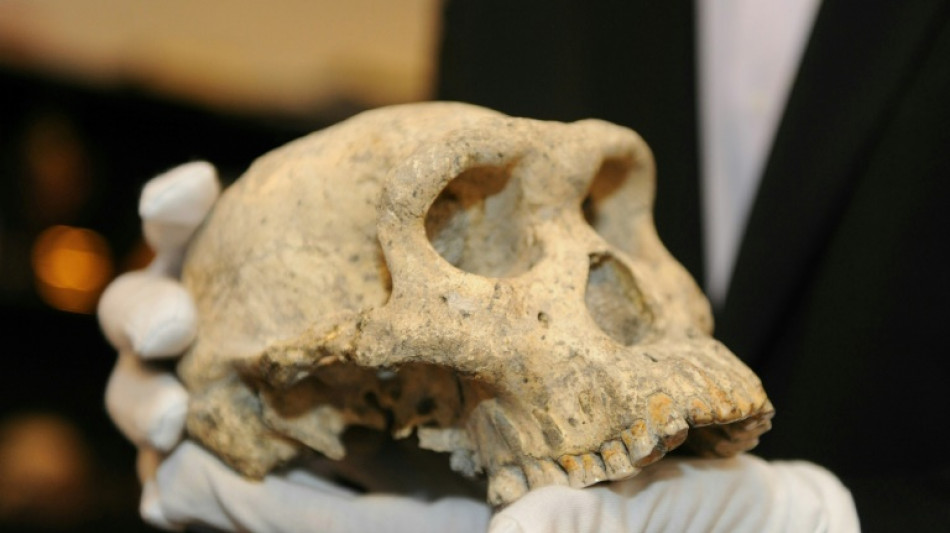
Meet 'Pink', the new face of human evolution in Europe / Photo: VANO SHLAMOV - AFP/File

 NASA scan discovers new, 'once in a century' Moon crater

 Most stocks rise as Fed hikes and indicates drive to curb inflation

 UK-Sudanese author pens book to give children 'African history of Africa'

 US Congress passes sweeping Russia sanctions bill

 US stocks fall, dollar gains after Fed lifts interest rates

 US Fed raises rates to tackle 'too high' inflation in move sure to rile Trump

 US Fed raises rates to battle inflation in move likely to rile Trump

 US House faces test on sweeping Russia sanctions bill

 British PM says to make 'difficult decisions' as inflation rises

 Global fuel price demos: a round-up

 Leverate Launches MCP for Traders to Connect AI Assistants With Trading Platforms

 MEXC Launches $1M "Discover Your Wall Street DNA" Campaign to Help Traders Find Their Market Fit

 Stocks edge higher ahead of US Fed rate call

 BASIS.pro Expands On-Chain Infrastructure with XDC Network Partnership and Zypher DAO as Auto Earn Goes Live

 Pickle-flavoured tart? AI inspires Japan's convenience stores

 EU chief hosts Canada's Carney in push to 'deepen' alliance

 Meta chief pushes back on AI slowdown calls

 US Fed to deliver rate decision with markets betting on hike

 i-payout Expands U.S. Money Transmitter Licensing Footprint and Advances European EMI Strategy

 US Senate crypto bill collapses amid partisan deadlock

 OpenAI, Anthropic and Google are working to create an AI standards body

 Protesting shepherds, farmers clash with Romanian police

 Foundation Lets Ledger Users Switch to Open Source Without Starting Over

 EU to propose curbing social media, online games for under 15s

 FX Junction Reaches 40,600 Members and 26 Million Trades

Western Europe has a new oldest face: the facial bones of an adult nicknamed "Pink" discovered in Spain are from a potential new member of the human family who lived more than 1.1 million years ago, scientists said Wednesday.
Until now, the oldest-known human species in Western Europe was the slender-faced Homo antecessor, dating back around 850,000 years.
But research published in the journal Nature "introduces a new actor in the history of human evolution in Europe", lead study author Rosa Huguet of Spain's University of Rovira i Virgili told a press conference.
The fossilised upper jawbone and partial cheekbone of Pink were discovered at the Atapuerca archaeological site in northern Spain in 2022.
Since then, a team of Spanish scientists have been working to find out more about Pink, whose nickname is a reference to prog rock band Pink Floyd.
The bones were excavated from a layer of silt and red mud 16 metres (52 feet) deep at a site known as Sima del Elefante -- or "elephant pit".
They were found less than 250 metres from where the fossils of Western Europe's previous oldest human, Homo antecessor, were discovered nearly two decades ago.
But the title of oldest human in all of Europe is still held by the Dmanisi people -- also called Homo georgicus -- who lived up to 1.8 million years ago in what is now Georgia.
They were the first members of the human family, or hominins, known to have made it to Europe from Africa, the cradle of humanity.
We modern Homo sapiens first showed up in Africa around 300,000 years ago -- and took our time getting to Europe.
- Face value -
The Spanish researchers used 3D imaging techniques to flesh out Pink's full face.
Homo antecessor had a "very modern" face which is "vertical and flat" similar to our own, said Maria Martinon-Torres, director of Spain's National Research Center on Human Evolution.
But Pink's face is more "projected forward and more robust," the study co-author added.
This means it bears some similarities to the face of Homo erectus -- but not enough that the scientists could confirm that Pink was a member of this important human ancestor.
So the scientists made up a new name for the possible species that Pink could belong to: Homo "affinis" erectus.
"This is the most honest proposal we can make with the evidence we have," Martinon-Torres said.
From just a few face bones, the researchers could not determine Pink's age or gender.
But by analysing small stone tools and animals bones found at the site, they were able to get an idea of the environment Pink lived in.
It was a humid forest landscape, roamed by horses, ancient cattle, monkeys and even some hippos.
The area was a wildlife corridor with plenty of water, making it an "ideal" place for our ancient relatives to settle, Huguet said.
- What happened to them? -
The new discovery supports the hypothesis that early humans settled Europe going from east to west at least 1.4 million years ago, according to the Spanish researchers.
If Pink is a representative of a previously unknown human species, it could have been a bridge between the Dmanisi hominins and Homo antecessors, they added.
But this raises another question: what became of these people?
Spanish paleoanthropologist Jose Maria Bermudez de Castro felt that Pink's people likely did not survive a severe human "bottleneck" nearly 900,000 years ago thought to have been caused by global cooling.
"I think that Homo affinis erectus probably disappeared," the study co-author said.
Future research will aim to shed light on these mysteries. The Spanish team has not yet reached the bottom of the elephant pit -- nor other sites around it.
H.Meyer--CPN