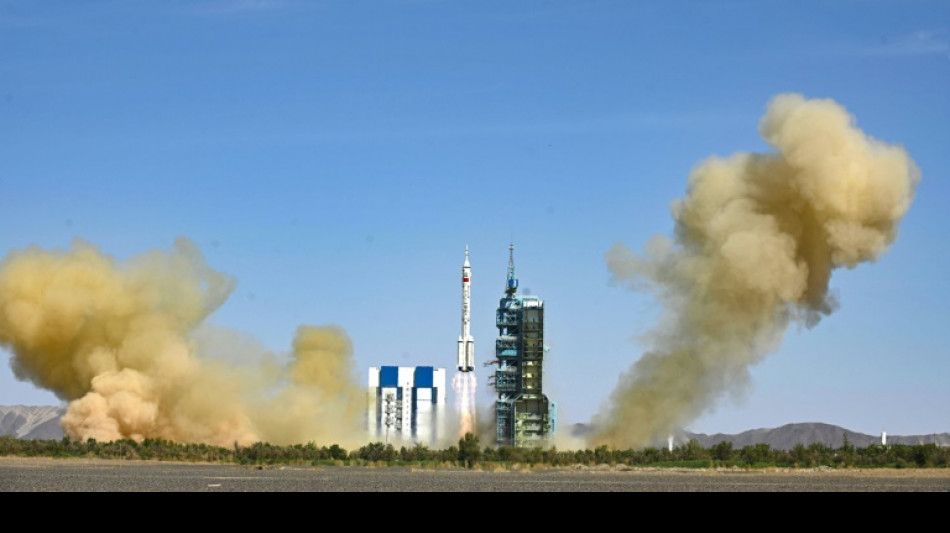
China sends three astronauts to complete space station / Photo: STR - AFP

 EU to ban social media for under 13s, curb access until 15

 Wildfires push endangered Sumatran elephants to brink: Indonesian NGO

 Bank of Japan set to raise rates under pressure from inflation, US

 EU chief to unveil social media, gaming curbs for under-15s

 'Resident Evil' film brings video game's ethos to the big screen

 i-payout Expands U.S. Money Transmitter Licensing Footprint and Advances European EMI Strategy

 US Senate crypto bill collapses amid partisan deadlock

 OpenAI, Anthropic and Google are working to create an AI standards body

 Protesting shepherds, farmers clash with Romanian police

 Foundation Lets Ledger Users Switch to Open Source Without Starting Over

 EU to propose curbing social media, online games for under 15s

 FX Junction Reaches 40,600 Members and 26 Million Trades

 'We unleashed the beast': the world's fears and hopes about AI

 Hospitality leaders ask Burnham to halve VAT amid rising costs

 Worcestershire invited to nominate groups for 2027 King’s volunteer award

 Berlin's run-down public spaces at heart of election campaign
 'Widow's Bay' and 'The Pitt' win big at Emmy Awards

 Most markets drop as oil extends gains ahead of expected US rate hike

 Sri Lanka's famed beach shack battles demolition

 Vserv targets ₹1,000 crore revenue by 2030 through AI expansion

 India prohibits bank fees on UPI payments up to ₹2,000
 Brazil's Amazon defender Raoni has cancer

 Trump rejects AI slowdown concerns as UN urges coordinated controls

 Higher wages draw migrant workers to Kashmir despite attacks

 Oil supply concerns and AI warnings weigh on global markets

China on Sunday launched a rocket carrying three astronauts on a mission to complete construction on its new space station, the latest milestone in Beijing's drive to become a major space power.
The trio blasted off in a Long March-2F rocket at (0244 GMT) from the Jiuquan launch center in northwestern China's Gobi desert, said state broadcaster CCTV, with the team to spend six months expanding the Tiangong space station.
Tiangong, which means "heavenly palace," is expected to become fully operational by the end of the year.
China's heavily promoted space programme has already seen the nation land a rover on Mars and send probes to the Moon.
The Shenzhou-14 crew is tasked with "completing in-orbit assembly and construction of the space station," as well as "commissioning of equipment" and conducting scientific experiments, state-run CGTN said Saturday.
Led by air force pilot Chen Dong, 43, the three-person crew's main challenge will be connecting the station's two lab modules to the main body.
Dong, along with fellow pilots Liu Yang and Cai Xuzhe, will become the second crew to spend six months aboard the Tiangong after the last returned to earth in April following 183 days on the space station.
Tiangong's core module entered orbit earlier last year and is expected to operate for at least a decade.
The completed station will be similar to the Soviet Mir station that orbited Earth from the 1980s until 2001.
- Space ambitions -
The world's second-largest economy has poured billions into its military-run space programme, with hopes of having a permanently crewed space station by 2022 and eventually sending humans to the Moon.
The country has made large strides in catching up with the United States and Russia, whose astronauts and cosmonauts have decades of experience in space exploration.
But under Chinese President Xi Jinping, the country's plans for its heavily promoted "space dream" have been put into overdrive.
In addition to a space station, Beijing is also planning to build a base on the Moon, and the country's National Space Administration said it aims to launch a crewed lunar mission by 2029.
China has been excluded from the International Space Station since 2011, when the United States banned NASA from engaging with the country.
While China does not plan to use its space station for global cooperation on the scale of the ISS, Beijing has said it is open to foreign collaboration.
The ISS is due for retirement after 2024, although NASA has said it could remain functional until 2030.
H.Cho--CPN