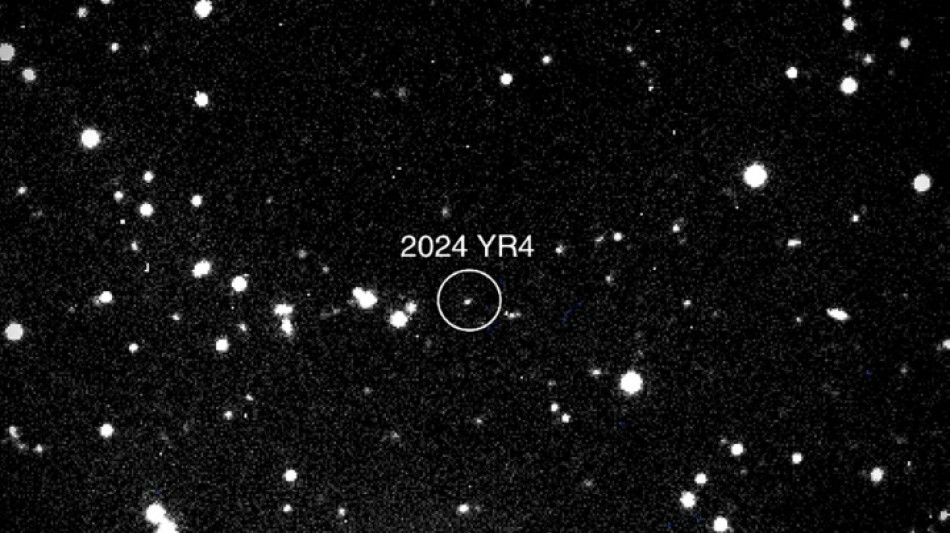
Chance huge asteroid will hit Earth down to 0.001 percent / Photo: Handout - NASA/Magdalena Ridge 2.4m telescope/New Mexico Institute of Technology/Ryan/AFP/File

 NASA scan discovers new, 'once in a century' Moon crater

 Most stocks rise as Fed hikes and indicates drive to curb inflation

 UK-Sudanese author pens book to give children 'African history of Africa'

 US Congress passes sweeping Russia sanctions bill

 US stocks fall, dollar gains after Fed lifts interest rates

 US Fed raises rates to tackle 'too high' inflation in move sure to rile Trump

 US Fed raises rates to battle inflation in move likely to rile Trump

 US House faces test on sweeping Russia sanctions bill

 British PM says to make 'difficult decisions' as inflation rises

 Global fuel price demos: a round-up

 Leverate Launches MCP for Traders to Connect AI Assistants With Trading Platforms

 MEXC Launches $1M "Discover Your Wall Street DNA" Campaign to Help Traders Find Their Market Fit

 Stocks edge higher ahead of US Fed rate call

 BASIS.pro Expands On-Chain Infrastructure with XDC Network Partnership and Zypher DAO as Auto Earn Goes Live

 Pickle-flavoured tart? AI inspires Japan's convenience stores

 EU chief hosts Canada's Carney in push to 'deepen' alliance

 Meta chief pushes back on AI slowdown calls

 US Fed to deliver rate decision with markets betting on hike

 i-payout Expands U.S. Money Transmitter Licensing Footprint and Advances European EMI Strategy

 US Senate crypto bill collapses amid partisan deadlock

 OpenAI, Anthropic and Google are working to create an AI standards body

 Protesting shepherds, farmers clash with Romanian police

 Foundation Lets Ledger Users Switch to Open Source Without Starting Over

 EU to propose curbing social media, online games for under 15s

 FX Junction Reaches 40,600 Members and 26 Million Trades

The chance that a football field-sized asteroid capable of destroying a city will strike Earth in 2032 has fallen to 0.001 percent, the European Space Agency said on Tuesday.
A week ago, the asteroid set a new record for having the highest probability of hitting Earth -- 3.1 percent according to NASA and 2.8 percent according to the ESA. The planetary defence community has been scanning the skies.
However, as had been widely expected, fresh observations from telescopes around the world narrowed the area of uncertainty where the asteroid could strike, increasingly ruling out the odds of a direct hit.
The ESA said the chance was now down to 0.001 percent, adding that the threat level on the Torino Impact Hazard Scale was now at zero -- after hitting level three out of a possible 10 last week.
The asteroid, called 2024 YR4, was discovered in December. It is estimated to be 40-90 metres (130 to 300 feet) wide, which means it has the potential to devastate a city.
The impact date would have been December 22, 2032 -- but it is now extremely likely the asteroid will simply zoom past Earth.
Despite the plummeting risk, the James Webb Space Telescope will still observe the asteroid in the coming months, the ESA said.
Scientists had emphasised that even if the asteroid had been heading our way, Earth is now capable of fighting back. In the first test of our planetary defences, NASA's DART mission successfully altered a harmless asteroid's trajectory in 2022 by smashing a spacecraft into it.
Richard Moissl, head of the ESA's planetary defence office, told AFP that observing the asteroid -- then ruling out a direct hit -- was "a very exciting and educational exercise".
Praising the early detection of the asteroid, he emphasised that "there is still ample room for improvement".
Several new telescopes, such as the Vera Rubin and Flyeye, which are near becoming operational will enable astronomers to spot asteroids more quickly, Moissl said. So will Europe's planned early warning mission NEOMIR, he added.
The last time an asteroid bigger than 30 metres wide posed such a significant risk was Apophis in 2004, when it briefly had a 2.7 percent chance of striking Earth in 2029 -- a possibility also ruled out through additional observations.
H.Meyer--CPN