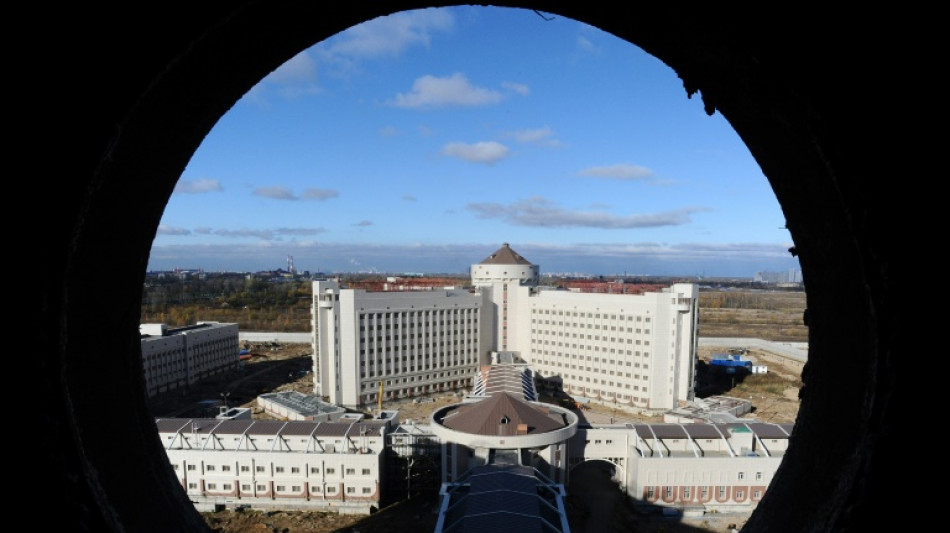
Russia sells famed imperial prison at auction / Photo: OLGA MALTSEVA - AFP

 NASA scan discovers new, 'once in a century' Moon crater

 Most stocks rise as Fed hikes and indicates drive to curb inflation

 UK-Sudanese author pens book to give children 'African history of Africa'

 US Congress passes sweeping Russia sanctions bill

 US stocks fall, dollar gains after Fed lifts interest rates

 US Fed raises rates to tackle 'too high' inflation in move sure to rile Trump

 US Fed raises rates to battle inflation in move likely to rile Trump

 US House faces test on sweeping Russia sanctions bill

 British PM says to make 'difficult decisions' as inflation rises

 Global fuel price demos: a round-up

 Leverate Launches MCP for Traders to Connect AI Assistants With Trading Platforms

 MEXC Launches $1M "Discover Your Wall Street DNA" Campaign to Help Traders Find Their Market Fit

 Stocks edge higher ahead of US Fed rate call

 BASIS.pro Expands On-Chain Infrastructure with XDC Network Partnership and Zypher DAO as Auto Earn Goes Live

 Pickle-flavoured tart? AI inspires Japan's convenience stores

 EU chief hosts Canada's Carney in push to 'deepen' alliance

 Meta chief pushes back on AI slowdown calls

 US Fed to deliver rate decision with markets betting on hike

 i-payout Expands U.S. Money Transmitter Licensing Footprint and Advances European EMI Strategy

 US Senate crypto bill collapses amid partisan deadlock

 OpenAI, Anthropic and Google are working to create an AI standards body

 Protesting shepherds, farmers clash with Romanian police

 Foundation Lets Ledger Users Switch to Open Source Without Starting Over

 EU to propose curbing social media, online games for under 15s

 FX Junction Reaches 40,600 Members and 26 Million Trades

A notorious Russian prison complex that once housed jailed revolutionaries, toppled ministers and Soviet dissidents will be turned into a hotel, restaurants, museum and art gallery after being sold at auction on Friday, the site's new owner said.
Bolshevik revolutionary Leon Trotsky and writer Joseph Brodsky are among the roll call of famous Russians who were imprisoned at the Kresty jail complex in the imperial capital of Saint Petersburg.
Named after the Russian word for "crosses" -- in homage to its shape -- the jail's red-brick walls loom ominously over the banks of the Neva river.
But having fallen into disrepair, Russia built a new prison, shut down Kresty and put the historic site on the market.
In an auction on Friday it was sold it to the KVS development group for 1.1 billion rubles ($12.5 million).
KVS said in a statement it would transform the complex in "one of Saint Petersburg's most ambitious urban planning projects."
"There will be a museum preserving the memory and history of the location, as well as a hotel complex, restaurants, galleries and public spaces open to all," it said.
Kresty was commissioned as a jail at the end of the nineteenth century to house imperial Russia's swelling prison population.
It was designed to be the largest and most modern solitary confinement facility in Europe with 999 individual cells.
Before the Russian revolution in 1917, it housed enemies of the Tsarist state like Alexander Kerensky, who would lead the February Revolution and Anatoly Lunacharsky who would become Lenin's top cultural official as well as Trotsky himself.
After the revolution, it was the enemies of Bolshevism who found themselves in the prison especially during Joseph Stalin's 1930s purges when its cells were filled with the victims of political repression.
These included the historian Lev Gumilev whose mother, the great Russian poet Anna Akhmatova, would wait outside the walls of the prison in the hope of passing him a package.
H.Müller--CPN