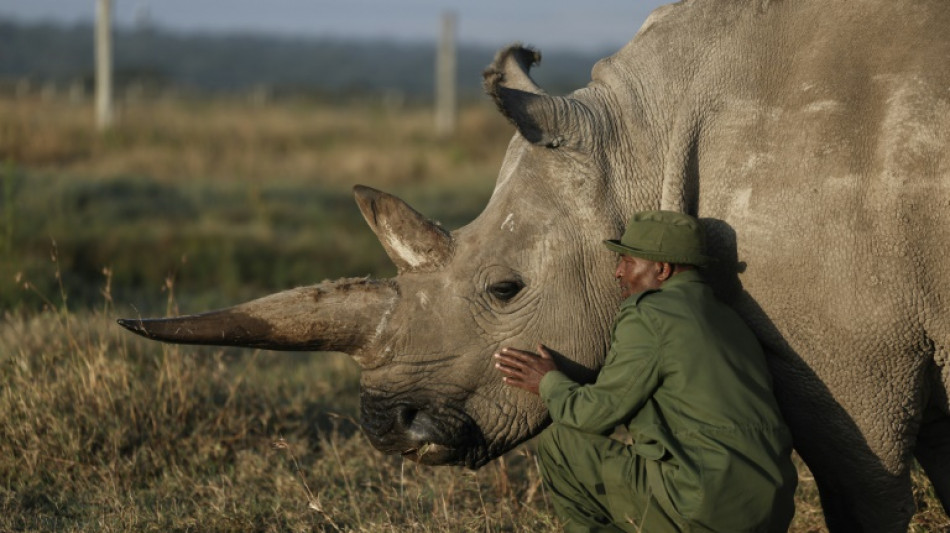
'We will save them': The quest to rescue nearly extinct rhino / Photo: SIMON MAINA - AFP

 NASA scan discovers new, 'once in a century' Moon crater

 Most stocks rise as Fed hikes and indicates drive to curb inflation

 UK-Sudanese author pens book to give children 'African history of Africa'

 US Congress passes sweeping Russia sanctions bill

 US stocks fall, dollar gains after Fed lifts interest rates

 US Fed raises rates to tackle 'too high' inflation in move sure to rile Trump

 US Fed raises rates to battle inflation in move likely to rile Trump

 US House faces test on sweeping Russia sanctions bill

 British PM says to make 'difficult decisions' as inflation rises

 Global fuel price demos: a round-up

 Leverate Launches MCP for Traders to Connect AI Assistants With Trading Platforms

 MEXC Launches $1M "Discover Your Wall Street DNA" Campaign to Help Traders Find Their Market Fit

 Stocks edge higher ahead of US Fed rate call

 BASIS.pro Expands On-Chain Infrastructure with XDC Network Partnership and Zypher DAO as Auto Earn Goes Live

 Pickle-flavoured tart? AI inspires Japan's convenience stores

 EU chief hosts Canada's Carney in push to 'deepen' alliance

 Meta chief pushes back on AI slowdown calls

 US Fed to deliver rate decision with markets betting on hike

 i-payout Expands U.S. Money Transmitter Licensing Footprint and Advances European EMI Strategy

 US Senate crypto bill collapses amid partisan deadlock

 OpenAI, Anthropic and Google are working to create an AI standards body

 Protesting shepherds, farmers clash with Romanian police

 Foundation Lets Ledger Users Switch to Open Source Without Starting Over

 EU to propose curbing social media, online games for under 15s

 FX Junction Reaches 40,600 Members and 26 Million Trades

Two rhinos munch serenely on grass as the sun rises over Mount Kenya, oblivious to the massive global endeavour to prevent them being the last of their kind.
Najin and her daughter Fatu are the only northern white rhinos left on Earth. The clock is ticking before they become the latest in a long line of animals that humans have poached to extinction.
But a recent breakthrough means this could be the year the world celebrates a new northern white rhino foetus.
It would be an unprecedented comeback for the subspecies, declared functionally extinct after the death of the last male, Sudan, in 2018.
Uterus problems mean neither Sudan's daughter Najin nor his granddaughter Fatu can carry a pregnancy to term.
But Fatu still produces viable eggs, making her a candidate for in-vitro fertilisation (IVF).
For years, scientists have been collecting her eggs at the Ol Pejeta Conservancy in Kenya, where the rhinos remain under 24-hour guard. The eggs are sent to Europe where they are fertilised in a lab with sperm from dead male northern whites.
There are now 36 fertilised eggs -- or embryos -- ready to be implanted, said Jan Stejskal, project coordinator for BioRescue, the most prominent of numerous such initiatives worldwide.
It is thought Fatu can produce around 10 more eggs before she is too old.
"We hope to achieve the first successful pregnancy with the northern rhino embryo this year," said Stejskal.
"But I cannot promise it."
- 'Mixed with sadness' -
The plan is to use a female southern white rhino -- a closely related subspecies -- as a surrogate.
A year ago scientists announced a breakthrough: a surrogate was pregnant with a male southern white foetus, the first time IVF had worked for rhinos.
But like so much about this long and difficult process, the joy was "mixed with sadness", Ol Pejeta head of research Samuel Mutisya told AFP.
By the time the 6.4-centimetre, 70-day-old foetus was discovered, the surrogate had already died from an unrelated bacteria infection.
Worse still, a sterilised male who had played the role of "teaser bull" -- to help identify when the female is ready for impregnation -- also died from the infection, and finding a replacement has proved tricky.
The team is determined to try again, this time with a northern white embryo.
- So how many chances? -
There are other avenues, including a Japanese effort using stem cells to create northern white rhino eggs and sperm.
This could dramatically boost the number of embryos, and create a wider gene pool for future inseminations.
The stem cell efforts are roughly halfway there, Stejskal said, estimating they could produce embryos in around four years.
Meanwhile, another initiative at Oxford University is attempting to use ovary tissue from dead rhinos to create eggs.
It could mean that even after Najin, 35, and Fatu, 24, have died, scientists could retrieve immature eggs from their ovaries.
Suzannah Williams, a researcher leading the effort, said her "best guess" was they could retrieve a few hundred eggs, even if not all would be viable.
But scientists hope for a solution while Najin and Fatu are still alive to teach the future baby how to be a northern white rhino.
- 'When not if' -
No one knows how likely it is that an individual IVF attempt will result in pregnancy.
It took three attempts for the southern white surrogate, but that is a tiny sample size.
Plenty else could go wrong during a rhino pregnancy, which lasts up to 18 months.
Stejskal remains optimistic, insisting: "We will save them," while Williams agreed it was a matter of "when, not if".
Others are unconvinced.
Even if babies were born from the embryos, the genetic diversity would still be "too low" to revive the species, Save the Rhino International CEO Jo Shaw told AFP.
It is likely too late for northern rhinos, she said, and the focus should be on the Javan and Sumatran subspecies, which each have fewer than 50 surviving.
The northern white researchers maintain the techniques they are developing will help all rhinos, as well as other species.
BioRescue's work is already contributing to saving the Sumatran rhino, Stejskal said.
Back in the Ol Pejeta enclosure, Najin and Fatu's main handler Zacharia Mutai argued it was humans who poached northern whites to the edge of extinction, so it is our responsibility to bring them back.
Mutai, who was there when Sudan died, said the birth of a new baby would be a cause for "world celebration".
"And I will be looking after the baby," he said with a smile, as Fatu and Najin kept on munching behind him.
St.Ch.Baker--CPN

