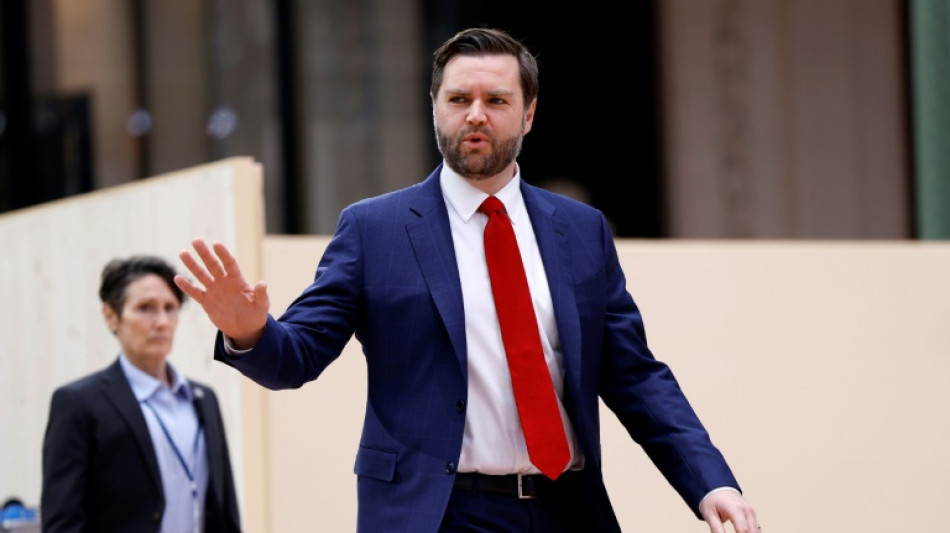
JD Vance puts Europe, China on notice at AI summit / Photo: Ian LANGSDON - AFP

 NASA scan discovers new, 'once in a century' Moon crater

 Most stocks rise as Fed hikes and indicates drive to curb inflation

 UK-Sudanese author pens book to give children 'African history of Africa'

 US Congress passes sweeping Russia sanctions bill

 US stocks fall, dollar gains after Fed lifts interest rates

 US Fed raises rates to tackle 'too high' inflation in move sure to rile Trump

 US Fed raises rates to battle inflation in move likely to rile Trump

 US House faces test on sweeping Russia sanctions bill

 British PM says to make 'difficult decisions' as inflation rises

 Global fuel price demos: a round-up

 Leverate Launches MCP for Traders to Connect AI Assistants With Trading Platforms

 MEXC Launches $1M "Discover Your Wall Street DNA" Campaign to Help Traders Find Their Market Fit

 Stocks edge higher ahead of US Fed rate call

 BASIS.pro Expands On-Chain Infrastructure with XDC Network Partnership and Zypher DAO as Auto Earn Goes Live

 Pickle-flavoured tart? AI inspires Japan's convenience stores

 EU chief hosts Canada's Carney in push to 'deepen' alliance

 Meta chief pushes back on AI slowdown calls

 US Fed to deliver rate decision with markets betting on hike

 i-payout Expands U.S. Money Transmitter Licensing Footprint and Advances European EMI Strategy

 US Senate crypto bill collapses amid partisan deadlock

 OpenAI, Anthropic and Google are working to create an AI standards body

 Protesting shepherds, farmers clash with Romanian police

 Foundation Lets Ledger Users Switch to Open Source Without Starting Over

 EU to propose curbing social media, online games for under 15s

 FX Junction Reaches 40,600 Members and 26 Million Trades

US Vice President JD Vance on Tuesday warned European allies against over-regulating the US-dominated artificial intelligence sector and China against using the technology to tighten its grip on citizens and allies.
Speaking at a global AI summit aimed at finding common ground on the emergence of a technology set to shake up global business and society, Vance struck a more confrontational tone than other leaders in the room.
"Excessive regulation... could kill a transformative sector just as it's taking off," Vance told global leaders and tech industry chiefs in the opulent surroundings of the French capital's Grand Palais.
"We need international regulatory regimes that fosters the creation of AI technology rather than strangles it," he added, calling on Europe to show "optimism rather than trepidation".
India's Prime Minister Narendra Modi, co-hosting with French President Emmanuel Macron, had minutes earlier called for "collective, global efforts to establish governance and standards that uphold our shared values, address risks and build trust".
Future AI would need to be "free from biases" and "address concerns related to cybersecurity, disinformation and deepfakes" to benefit all, he added.
Vance, by contrast, said it was not up to national capitals to "prevent a grown man or woman from accessing an opinion that the government thinks is misinformation".
The US vice president also took a thinly veiled shot at China, saying "authoritarian regimes" were looking to use AI for increased control of citizens at home and abroad.
"Partnering with them means chaining your nation to an authoritarian master that seeks to infiltrate, dig in and seize your information infrastructure," Vance said.
Chinese startup DeepSeek rattled the AI sector last month by unveiling a sophisticated chatbot that it claims was developed on a relatively low budget. A growing number of countries have taken steps to block the app from government devices over security concerns.
Vance also pointed to "cheap tech... heavily subsidised and exported by authoritarian regimes", referring to surveillance cameras and 5G mobile internet equipment widely sold abroad by China.
- Hundreds of billions lined up -
President Donald Trump's deputy left the venue immediately after his speech as other speakers including European Commission chief Ursula von der Leyen and Google boss Sundar Pichai took the stage.
Von der Leyen said Brussels would push to mobilise 200 billion euros ($206 billion) for AI investments in Europe, with 50 billion euros to come from the EU's budget and the rest from "providers, investors and industry".
Following Macron's trumpeting Monday of 109 billion euros of investment into French AI projects and the $500-billion US "Stargate" programme led by developer OpenAI, the vast figure underscored the resources needed to compete on catching the next technological wave.
Overnight, the Wall Street Journal had reported a near-$100 billion bid to buy ChatGPT maker OpenAI from a consortium headed by Elon Musk.
If successful, the deal would compound the tech influence of the world's richest man, already boss of X, Tesla, SpaceX and his own AI developer xAI as well as a Trump confidant.
Sam Altman, the OpenAI chief set to speak in Paris later Tuesday, responded to the reported offer with a dry "no thank you" on X.
Vance did not comment directly on the prospective deal.
But while he said the Trump administration would "ensure that American AI technology continues to be the gold standard worldwide", he also took aim at heavyweight tech "incumbents" who he said pushed for regulation that could strangle emerging challengers.
Rather than only benefiting big players, "we believe, and we will fight for policies that ensure, that AI is going to make our workers more productive", Vance said.
"We expect that they will reap the rewards with higher wages, better benefits, and safer and more prosperous communities," he added.
For now, AI is mostly replacing humans in clerical jobs disproportionately held by women, International Labour Organization head Gilbert Houngbo said on Monday.
That risks widening the gender pay gap even though more jobs are being created than destroyed by AI on current evidence, he added.
- 'Existential risk' -
Suspense remained as the AI summit drew to a close Tuesday on the language and signatories of a final statement.
Media reports suggest that neither Britain nor the United States -- two leading countries for AI development -- will sign a planned joint declaration as it stands.
Outside observers criticised an alleged leaked draft of the joint statement for failing to mention AI's suspected threat to humanity's future as a species.
The supposed draft "fails to even mention these risks" said Max Tegmark, head of the US-based Future of Life Institute, which has warned of AI's "existential risk".
D.Avraham--CPN

