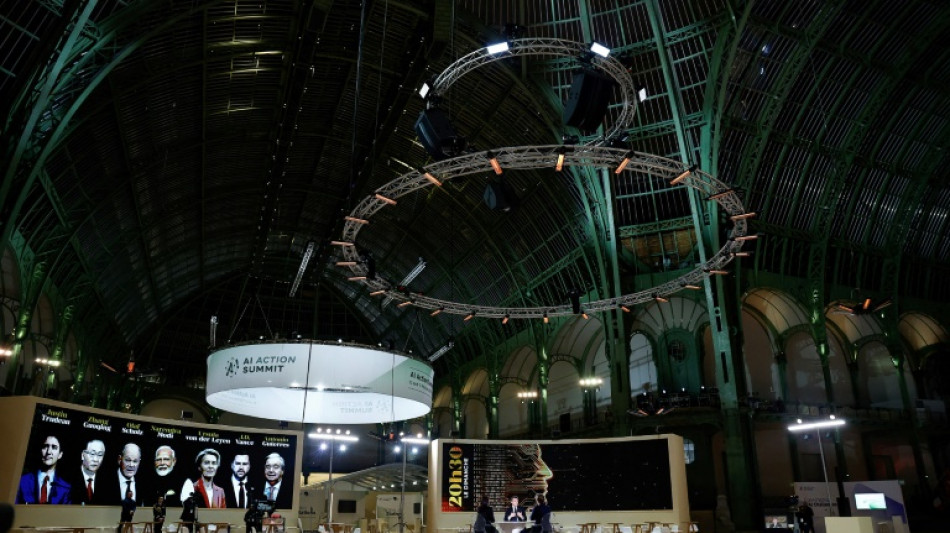
Government chiefs and tech leaders gather in Paris for AI summit / Photo: Gonzalo Fuentes - POOL/AFP

 NASA scan discovers new, 'once in a century' Moon crater

 Most stocks rise as Fed hikes and indicates drive to curb inflation

 UK-Sudanese author pens book to give children 'African history of Africa'

 US Congress passes sweeping Russia sanctions bill

 US stocks fall, dollar gains after Fed lifts interest rates

 US Fed raises rates to tackle 'too high' inflation in move sure to rile Trump

 US Fed raises rates to battle inflation in move likely to rile Trump

 US House faces test on sweeping Russia sanctions bill

 British PM says to make 'difficult decisions' as inflation rises

 Global fuel price demos: a round-up

 Leverate Launches MCP for Traders to Connect AI Assistants With Trading Platforms

 MEXC Launches $1M "Discover Your Wall Street DNA" Campaign to Help Traders Find Their Market Fit

 Stocks edge higher ahead of US Fed rate call

 BASIS.pro Expands On-Chain Infrastructure with XDC Network Partnership and Zypher DAO as Auto Earn Goes Live

 Pickle-flavoured tart? AI inspires Japan's convenience stores

 EU chief hosts Canada's Carney in push to 'deepen' alliance

 Meta chief pushes back on AI slowdown calls

 US Fed to deliver rate decision with markets betting on hike

 i-payout Expands U.S. Money Transmitter Licensing Footprint and Advances European EMI Strategy

 US Senate crypto bill collapses amid partisan deadlock

 OpenAI, Anthropic and Google are working to create an AI standards body

 Protesting shepherds, farmers clash with Romanian police

 Foundation Lets Ledger Users Switch to Open Source Without Starting Over

 EU to propose curbing social media, online games for under 15s

 FX Junction Reaches 40,600 Members and 26 Million Trades

Political and tech industry leaders were set to descend on Paris Monday for a two-day summit on artificial intelligence, hoping to find common ground on a technology with the potential to upset global business and society.
Co-hosted by French President Emmanuel Macron and Indian Prime Minister Narendra Modi, the gathering's stated aims include "mapping" AI governance around the world, promoting the idea of more ethical, accessible and frugal AI and pushing for European sovereignty over the technology.
Monday's meeting of around 1,500 guests in the French capital's opulent Grand Palais will feature lectures and panel discussions outlining the promises of and challenges posed by AI, from around 9:30 am (0830 GMT).
Political leaders, including US Vice President JD Vance and Chinese Vice Premier Zhang Guoqing, are set to rub shoulders with the likes of OpenAI boss Sam Altman and Google chief Sundar Pichai.
Two years on from the emergence of OpenAI's ChatGPT chatbot, able to respond to all kinds of natural-language prompts, Macron on Sunday trumpeted the benefits of artificial intelligence and French efforts in the field.
- 'Stargate' sets the pace -
In a TV interview, he trailed "109 billion euros ($113 billion) of investment in artificial intelligence in the coming years" in France.
The cash would come from the United Arab Emirates, "major American and Canadian investment funds" and French companies, Macron said.
Sunday's 109-billion-euro figure was "the equivalent for France of what the US has announced with 'Stargate'," the $500-billion US programme led by ChatGPT maker OpenAI, he added.
The technical challenges and price of entry for nations hoping to keep abreast in the AI race have become clearer in recent weeks.
Chinese startup DeepSeek stunned Silicon Valley heavyweights with its low-cost, high-performance AI models.
In the United States, President Donald Trump lent the aura of his office to the "Stargate" project to build computing infrastructure such as data centres.
These vast buildings concentrate in one place the data storage and processing power needed to develop and run the most advanced AI models.
"Europe has to find a way to take a position, take some initiative and take back control," said Sylvain Duranton of the Boston Consulting Group.
European Commission chief Ursula von der Leyen is expected to announce around 10 public supercomputers designed for use by researchers and startups while attending the summit.
- Global governance puzzle -
Away from the investment grandstanding, a group of countries, companies and philanthropic organisations said Sunday they would pump $400 million into a partnership called "Current AI" that would foster "public interest" approaches to the technology.
Current AI aims to raise as much as $2.5 billion for its mission to grant AI developers access to more data, offer open-source tools and infrastructure for programmers to build on, and "develop systems to measure AI's social and environmental impact".
"We've seen the harms of unchecked tech development and the transformative potential it holds when aligned with the public interest," Current AI founder Martin Tisne said.
France hopes governments will agree on voluntary commitments to make AI sustainable and environmentally friendly.
But any agreement may prove elusive between blocs as diverse as the European Union, United States, China and India, each with different priorities in tech development and regulation.
A.Leibowitz--CPN

