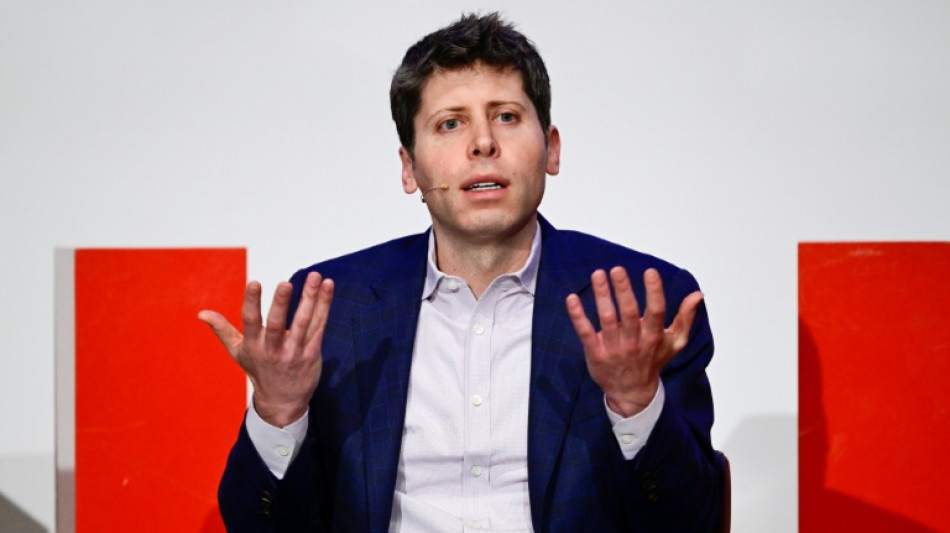
OpenAI's Altman warns EU regulation may hold Europe back / Photo: John MACDOUGALL - AFP

 NASA scan discovers new, 'once in a century' Moon crater

 Most stocks rise as Fed hikes and indicates drive to curb inflation

 UK-Sudanese author pens book to give children 'African history of Africa'

 US Congress passes sweeping Russia sanctions bill

 US stocks fall, dollar gains after Fed lifts interest rates

 US Fed raises rates to tackle 'too high' inflation in move sure to rile Trump

 US Fed raises rates to battle inflation in move likely to rile Trump

 US House faces test on sweeping Russia sanctions bill

 British PM says to make 'difficult decisions' as inflation rises

 Global fuel price demos: a round-up

 Leverate Launches MCP for Traders to Connect AI Assistants With Trading Platforms

 MEXC Launches $1M "Discover Your Wall Street DNA" Campaign to Help Traders Find Their Market Fit

 Stocks edge higher ahead of US Fed rate call

 BASIS.pro Expands On-Chain Infrastructure with XDC Network Partnership and Zypher DAO as Auto Earn Goes Live

 Pickle-flavoured tart? AI inspires Japan's convenience stores

 EU chief hosts Canada's Carney in push to 'deepen' alliance

 Meta chief pushes back on AI slowdown calls

 US Fed to deliver rate decision with markets betting on hike

 i-payout Expands U.S. Money Transmitter Licensing Footprint and Advances European EMI Strategy

 US Senate crypto bill collapses amid partisan deadlock

 OpenAI, Anthropic and Google are working to create an AI standards body

 Protesting shepherds, farmers clash with Romanian police

 Foundation Lets Ledger Users Switch to Open Source Without Starting Over

 EU to propose curbing social media, online games for under 15s

 FX Junction Reaches 40,600 Members and 26 Million Trades

OpenAI chief Sam Altman on Friday suggested European regulation could hold back the development of artificial intelligence (AI), while promising the US company would abide by new EU legislation.
At a panel discussion on AI at Berlin's Technical University, Altman was asked directly about the EU's "AI Act", considered the most comprehensive regulatory framework for the emerging technology in the world.
"We will comply with the law and respect the wishes of the European people", Altman said.
"There are benefits to different regulatory regimes," the Open AI chief said, but added that "there are going to be economic impacts that will become societal impacts".
"We want to be able to deploy our products in Europe as quickly as we do in the rest of the world", Altman said.
It was "in Europe's interest to be able to adopt AI and not be behind the rest of the world".
The EU AI Act was passed in March 2024. This week regulators gave guidance as to what types of AI tools will be outlawed as too dangerous.
They include tools that scrape online images to create facial recognition databases or allow police to evaluate criminal risk based solely on biometric data.
The United States is taking steps to loosen AI regulation. President Donald Trump last month rescinded an order from his predecessor Joe Biden establishing oversight measures for companies developing AI models.
On Thursday, OpenAI announced it would allow some European customers to store and process data from conversations with its chatbots within the European Union in order to help "organisations operating in Europe meet local data sovereignty requirements".
Altman said he was bullish about the pace of development of AI, despite some experts saying the chances of developing artificial general intelligence (AGI) that surpasses all human capabilities are being exaggerated.
"I think you should all be very sceptical when people start saying this is about to run out... or we're going to hit this limit," Altman told the event.
"I think we'll get to something in the next couple of years that many people will look at and say: 'I really didn't think computer was going to do that.'"
Next week, Altman will be one of the high-profile guests at an AI summit in Paris billed by France as a "wake-up call" for Europe.
OpenAI raised public awareness of AI generative models in 2022 with the launch of ChatGPT. It is to open its first office in Germany in Munich later this year.
Ng.A.Adebayo--CPN

