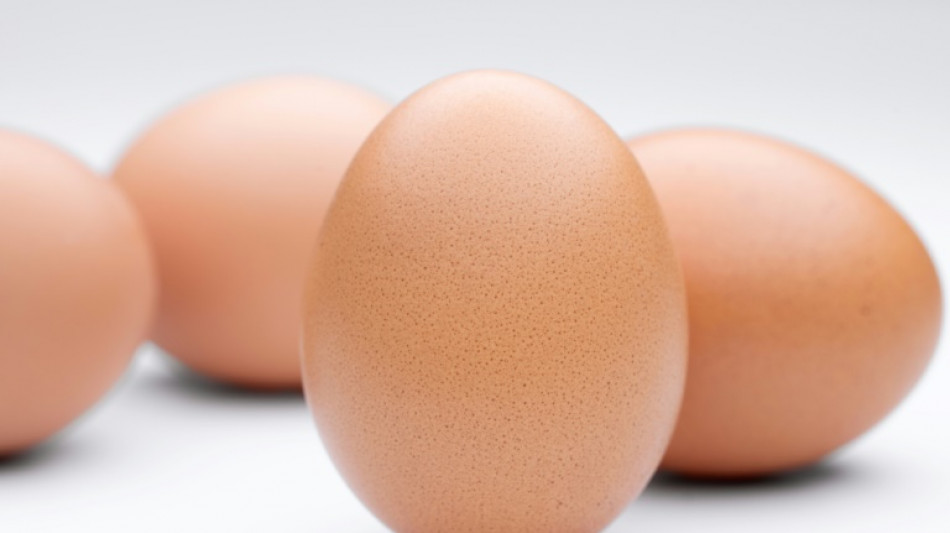
Scientists claim to have cracked how to cook the perfect egg / Photo: JOEL SAGET - AFP/File

 NASA scan discovers new, 'once in a century' Moon crater

 Most stocks rise as Fed hikes and indicates drive to curb inflation

 UK-Sudanese author pens book to give children 'African history of Africa'

 US Congress passes sweeping Russia sanctions bill

 US stocks fall, dollar gains after Fed lifts interest rates

 US Fed raises rates to tackle 'too high' inflation in move sure to rile Trump

 US Fed raises rates to battle inflation in move likely to rile Trump

 US House faces test on sweeping Russia sanctions bill

 British PM says to make 'difficult decisions' as inflation rises

 Global fuel price demos: a round-up

 Leverate Launches MCP for Traders to Connect AI Assistants With Trading Platforms

 MEXC Launches $1M "Discover Your Wall Street DNA" Campaign to Help Traders Find Their Market Fit

 Stocks edge higher ahead of US Fed rate call

 BASIS.pro Expands On-Chain Infrastructure with XDC Network Partnership and Zypher DAO as Auto Earn Goes Live

 Pickle-flavoured tart? AI inspires Japan's convenience stores

 EU chief hosts Canada's Carney in push to 'deepen' alliance

 Meta chief pushes back on AI slowdown calls

 US Fed to deliver rate decision with markets betting on hike

 i-payout Expands U.S. Money Transmitter Licensing Footprint and Advances European EMI Strategy

 US Senate crypto bill collapses amid partisan deadlock

 OpenAI, Anthropic and Google are working to create an AI standards body

 Protesting shepherds, farmers clash with Romanian police

 Foundation Lets Ledger Users Switch to Open Source Without Starting Over

 EU to propose curbing social media, online games for under 15s

 FX Junction Reaches 40,600 Members and 26 Million Trades

Hard-boiled, soft-boiled or poached. Scientists have studied how to cook the perfect egg and have come up with a new recipe that they say optimises its taste and nutritional quality.
Cooking an egg is a delicate art because the yolk and the white do not cook at the same temperature.
The yolk begins to solidify at 65 degrees Celsius (149 degrees Fahrenheit) and the white at 85C.
To avoid ending up with a soft-boiled egg, chefs have to choose a "compromise temperature", said the authors of a study published on Thursday in the journal Communications Engineering.
In the case of a hard-boiled egg -- cooked for 12 minutes at 100C -- all parts of the egg have a final temperature of 100C, well above the ideal cooking temperature, particularly for the yolk.
In the case of egg sous vide, which is cooked between 60 and 70C, the final egg is at a temperature of 65C.
But while this is the ideal temperature for the yolk, it is much too low for the proteins in the egg white to stick together.
As for the soft-boiled egg, cooked for six minutes at 100C, the authors say the egg yolk is undercooked.
The Italian polymer specialists approached the problem by simulating the process with the help of computational fluid dynamics software, which was used to simulate and analyse the flow of fluids and their interactions with solid surfaces.
- Recyclable materials -
The solution, they suggest, is to use a saucepan of boiling water at 100C and a saucepan of water at 30C and to transfer the egg from one to the other every two minutes for exactly 32 minutes in total.
"It is found that a stationary state at the centre of the yolk is reached at a constant temperature of 67C," namely the mean value between the temperatures of the saucepan of boiling water and the saucepan of lukewarm water, Pellegrino Musto, one of the study's authors, told AFP.
"Conversely, the albumen alternatively sees temperatures in the range 100–87C and 30–55C during the hot and cold cycles respectively," which allows all the layers of the egg white to reach cooking temperature, added Musto, research director at the National Research Council of Italy's Institute for Polymers, Composites and Biomaterials.
The authors then tested this method of "cooking in cycles" and found that the result was "more similar to the soft boiled when analysing the texture of its albumen, while it is very similar to the sous videsample when considering its yolk," the study says.
Cooking in cycles also has a "better advantage over conventional cooking methods in terms of nutritional content", the authors said.
The chemical analysis showed that the yolks of eggs cooked in cycles contained more polyphenols -- healthy micronutrients -- than hard-boiled eggs, soft-boiled eggs or sous videeggs.
Musto said in an email that the result was "(partially) unexpected" and proposed that "temperature degradation of bioactive molecules" at higher temperatures could be a possible cause.
The study has also found practical application, with one of the study's authors, Ernesto Di Maio, using the cyclic cooking method "regularly for his family and friends, who appreciate it a lot".
However, Musto pointed out that the study would have applications beyond the kitchen, especially with regard to recyclability, which he said was the main theme of the research group.
"A well designed thermal profile may allow the development of layered structures within an object made from a single material" that is entirely recyclable, Musto said.
"The resulting object will have layered properties as if it were a multi-material object," Musto said, adding that these are "very difficult to recycle" except in rare circumstances.
L.K.Baumgartner--CPN

