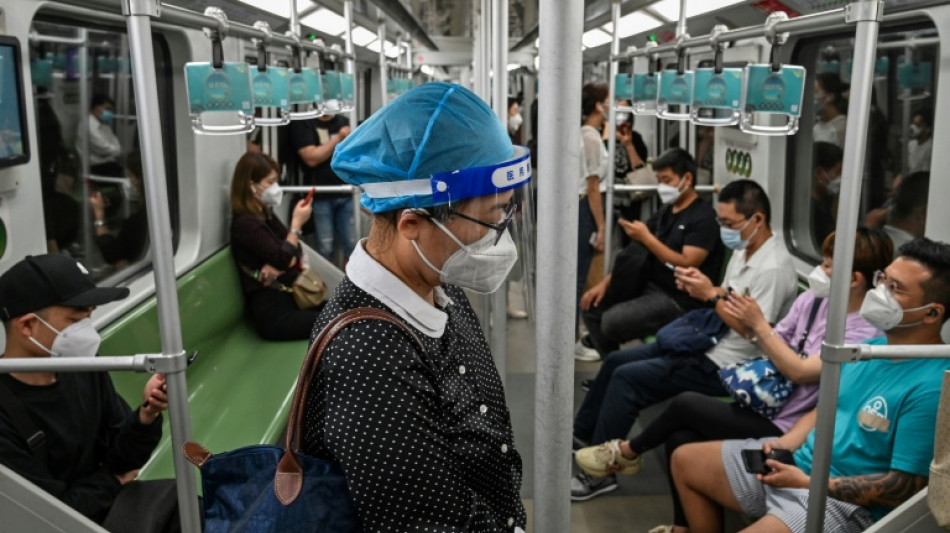
Shanghai euphoria tempered by deep wound to China's economy / Photo: Hector RETAMAL - AFP

 EU to ban social media for under 13s, curb access until 15

 Wildfires push endangered Sumatran elephants to brink: Indonesian NGO

 Bank of Japan set to raise rates under pressure from inflation, US

 EU chief to unveil social media, gaming curbs for under-15s

 'Resident Evil' film brings video game's ethos to the big screen

 i-payout Expands U.S. Money Transmitter Licensing Footprint and Advances European EMI Strategy

 US Senate crypto bill collapses amid partisan deadlock

 OpenAI, Anthropic and Google are working to create an AI standards body

 Protesting shepherds, farmers clash with Romanian police

 Foundation Lets Ledger Users Switch to Open Source Without Starting Over

 EU to propose curbing social media, online games for under 15s

 FX Junction Reaches 40,600 Members and 26 Million Trades

 'We unleashed the beast': the world's fears and hopes about AI

 Hospitality leaders ask Burnham to halve VAT amid rising costs

 Worcestershire invited to nominate groups for 2027 King’s volunteer award

 Berlin's run-down public spaces at heart of election campaign
 'Widow's Bay' and 'The Pitt' win big at Emmy Awards
 Most markets drop as oil extends gains ahead of expected US rate hike

 Sri Lanka's famed beach shack battles demolition

 Vserv targets ₹1,000 crore revenue by 2030 through AI expansion

 India prohibits bank fees on UPI payments up to ₹2,000

 Brazil's Amazon defender Raoni has cancer

 Trump rejects AI slowdown concerns as UN urges coordinated controls

 Higher wages draw migrant workers to Kashmir despite attacks

 Oil supply concerns and AI warnings weigh on global markets

Orders have evaporated at Zhou's textile company based just outside Shanghai, a city now stumbling free from a two-month lockdown that has left small businesses on life support.
Sales are on "a very serious downward slope" and layoffs are imminent at his factory, owner Zhou told AFP, asking for his company to remain unidentified.
The firm is based in Zhejiang province, the anteroom to Shanghai's cavernous consumer and manufacturing market.
His is one of tens of thousands of small enterprises clinging to life as China's strict zero-Covid policies drive a crippling economic slowdown.
Shanghai, a city of 25 million, is the centre for innumerable supply lines that radiate across the country's eastern seaboard, including Tesla cars and iPhones.
For Zhou, survival will be his only thought over the next two months in an economy whose growth forecast has been clipped by rating agencies.
"I will have to fire people," Zhou said, as he scours for customers to fill his order book.
- Supply chains chained -
Beijing is tied to a strategy of eliminating Covid outbreaks through harsh lockdowns and mass testing, even as most of the rest of the world has chosen to live with the virus.
That has meant closing factories, disrupting logistics, and squeezing travel to almost zero for weeks on end in major manufacturing hubs including Shenzhen and Shanghai, home to the world's busiest container port.
Factory activity nationwide plummeted to a two-year low in April after Shanghai shut its 25 million residents at home while multiple Omicron-driven outbreaks bubbled up elsewhere, with activity continuing to shrink -- albeit at a slower pace -- into May.
The slowdown has choked entire supply lines.
"Downstream factories, stores and businesses are all affected," Xu Xuebing, owner of Shanghai-based wood supplier Sam Wood told AFP.
"The impact is big... I didn't even (try to) evaluate how much I have lost during the lockdown," Xu said, adding he hopes the next two to three months could see a bounce-back.
Shanghai's lockdown has calcified businesses across China, analysts say, with fears any new virus clusters could see swathes of the country once more plunged into lockdown.
"Lingering uncertainties" are bad for business confidence, Peiqian Liu, China Economist at NatWest Markets, told AFP.
- Constant uncertainty -
Reopening also does not guarantee total recovery, Zhaopeng Xing, senior China strategist at ANZ Research, warned.
"Mobility inside Shanghai is lifted," Xing said.
"But the restrictions when you go outside of Shanghai are still there."
"A lot of logistics issues haven't been restored 100 percent to previous levels," Xing said, adding "the losses of the past two months" would not be easy to recover from.
Spooked by the unpredictability and harshness of the Shanghai lockdown, foreign businesses have also raised fears over their futures in China.
Meanwhile, experts say smaller enterprises will shy away from hiring "due to the uncertainty of business environment from future lockdowns," Iris Pang, chief economist for Greater China at ING, told AFP.
China's urban youth unemployment rate hit 18.2 percent in April, according to the National Bureau of Statistics.
- Staying alive -
Sagging economic indicators have alarmed Chinese authorities, who are now rushing to inflate confidence and prop up ailing sectors.
The central government has said it will offer tax relief and a bond drive to help industries while increasing government procurement from smaller businesses.
But analysts are cautious about China's growth in the coming months, with Moody's on Monday lowering its annual growth forecast to 4.5 percent.
Beijing is likely to "hand out its stimulus as fast as possible", Natixis economist Gary Ng said.
"But the rebound may not arrive in Q3 2022 and it is unlikely to see a big change in the Covid-19 policy until the year-end," he added.
For Zhou the textile maker, survival trumps profit in zero-Covid China.
"I don't need to make more money than my competitors, but I need to be able to hold on for longer than them over this difficult period," he said. "This is my short-term plan."
T.Morelli--CPN