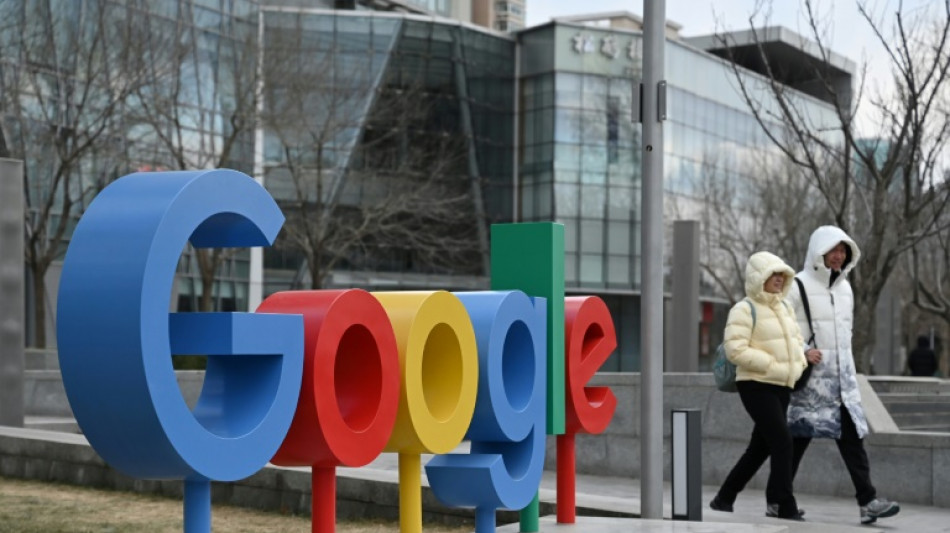
Google pledge against using AI for weapons vanishes / Photo: GREG BAKER - AFP

 Modi pitches India as global chipmaking hub

 Ukraine plans record defence spending in 2027

 NASA scan discovers new, 'once in a century' Moon crater

 Most stocks rise as Fed hikes and indicates drive to curb inflation

 UK-Sudanese author pens book to give children 'African history of Africa'

 US Congress passes sweeping Russia sanctions bill

 US stocks fall, dollar gains after Fed lifts interest rates

 US Fed raises rates to tackle 'too high' inflation in move sure to rile Trump

 US Fed raises rates to battle inflation in move likely to rile Trump

 US House faces test on sweeping Russia sanctions bill

 British PM says to make 'difficult decisions' as inflation rises

 Global fuel price demos: a round-up

 Leverate Launches MCP for Traders to Connect AI Assistants With Trading Platforms

 MEXC Launches $1M "Discover Your Wall Street DNA" Campaign to Help Traders Find Their Market Fit

 Stocks edge higher ahead of US Fed rate call

 BASIS.pro Expands On-Chain Infrastructure with XDC Network Partnership and Zypher DAO as Auto Earn Goes Live

 Pickle-flavoured tart? AI inspires Japan's convenience stores

 EU chief hosts Canada's Carney in push to 'deepen' alliance

 Meta chief pushes back on AI slowdown calls

 US Fed to deliver rate decision with markets betting on hike

 i-payout Expands U.S. Money Transmitter Licensing Footprint and Advances European EMI Strategy

 US Senate crypto bill collapses amid partisan deadlock

 OpenAI, Anthropic and Google are working to create an AI standards body

 Protesting shepherds, farmers clash with Romanian police

 Foundation Lets Ledger Users Switch to Open Source Without Starting Over

Google on Tuesday updated its principles when it comes to artificial intelligence, removing vows not to use the technology for weapons or surveillance.
Revised AI principles were posted just weeks after Google chief executive Sundar Pichai and other tech titans attended the inauguration of US President Donald Trump.
When asked by AFP about the change, a Google spokesperson referred to a blog post outlining the company's AI principles that made no mention of the promises, which Pichai first outlined in 2018.
"We believe democracies should lead in AI development, guided by core values like freedom, equality, and respect for human rights," read an updated AI principles blog post by Google DeepMind chief Demis Hassabis and research labs senior vice president James Manyika.
"And we believe that companies, governments, and organizations sharing these values should work together to create AI that protects people, promotes global growth, and supports national security," it continued.
Pichai had previously stated that the company would not design or deploy the technology for weapons designed to hurt people or "that gather or use information for surveillance violating internationally accepted norms."
That wording was gone from the updated AI principles shared by Google on Tuesday.
Upon taking office, Trump quickly rescinded an executive order by his predecessor, former president Joe Biden, mandating safety practices for AI.
Companies in the race to lead the burgeoning AI field in the United States now have fewer obligations to adhere to, such as being required to share test results signalling the technology has serious risks to the nation, its economy or its citizens.
Google noted in its blog post that it publishes an annual report about its AI work and progress.
"There's a global competition taking place for AI leadership within an increasingly complex geopolitical landscape," Hassabis and Manyika said in their post.
"Billions of people are using AI in their everyday lives."
Google's original AI principles were published after employee backlash to its involvement in a Pentagon research project looking into using AI to improve the ability of weapons systems to identify targets.
Google ended its involvement in the project.
Y.Jeong--CPN