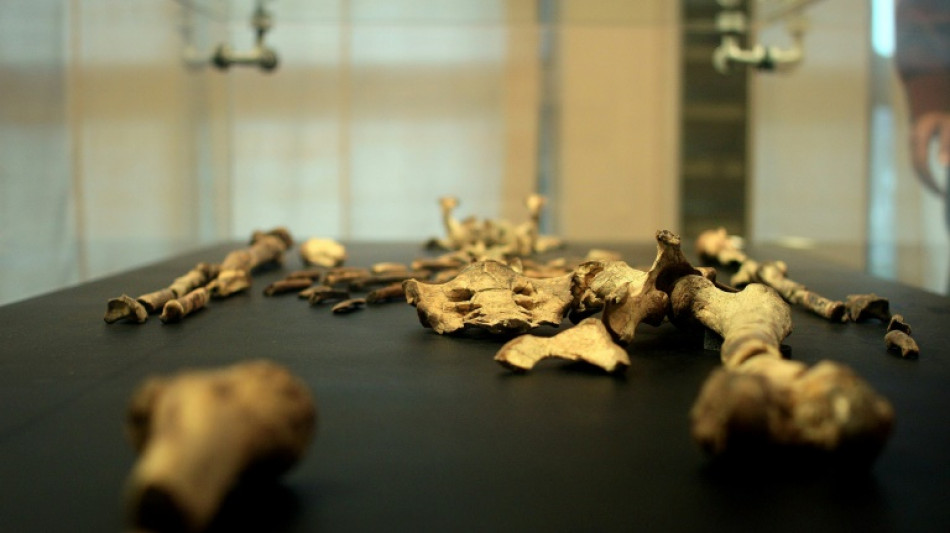
Prague museum to host first European display of 3.18 million year old Lucy / Photo: JENNY VAUGHAN - AFP

 Modi pitches India as global chipmaking hub

 Ukraine plans record defence spending in 2027

 NASA scan discovers new, 'once in a century' Moon crater

 Most stocks rise as Fed hikes and indicates drive to curb inflation

 UK-Sudanese author pens book to give children 'African history of Africa'

 US Congress passes sweeping Russia sanctions bill

 US stocks fall, dollar gains after Fed lifts interest rates

 US Fed raises rates to tackle 'too high' inflation in move sure to rile Trump

 US Fed raises rates to battle inflation in move likely to rile Trump

 US House faces test on sweeping Russia sanctions bill

 British PM says to make 'difficult decisions' as inflation rises

 Global fuel price demos: a round-up

 Leverate Launches MCP for Traders to Connect AI Assistants With Trading Platforms

 MEXC Launches $1M "Discover Your Wall Street DNA" Campaign to Help Traders Find Their Market Fit

 Stocks edge higher ahead of US Fed rate call

 BASIS.pro Expands On-Chain Infrastructure with XDC Network Partnership and Zypher DAO as Auto Earn Goes Live

 Pickle-flavoured tart? AI inspires Japan's convenience stores

 EU chief hosts Canada's Carney in push to 'deepen' alliance

 Meta chief pushes back on AI slowdown calls

 US Fed to deliver rate decision with markets betting on hike

 i-payout Expands U.S. Money Transmitter Licensing Footprint and Advances European EMI Strategy

 US Senate crypto bill collapses amid partisan deadlock

 OpenAI, Anthropic and Google are working to create an AI standards body

 Protesting shepherds, farmers clash with Romanian police

 Foundation Lets Ledger Users Switch to Open Source Without Starting Over

The bone fragments of Lucy, a 3.18 million year-old human ancester which rarely leave Ethiopia, will go on display in Europe for the first time in Prague this year, the Czech premier said Tuesday.
The ancient remains of the Australopithecus afarensis were discovered in Ethiopia in 1974. The find was, at the time, the most complete ever found, and revolutionised the understanding of humanity's ancestors.
"Lucy's skeletal remains will be displayed in Europe for the first time ever," Prime Minister Petr Fiala told reporters as he announced the rare loan by Ethiopia's National Museum. The fragments will be shown at Prague's National Museum as part of a "Human Origins and Fossils" exhibition for two months from August 25.
The remains will be presented alongside Selam, the fossil of a baby Australopithecus who was about 100,000 years older than Lucy and found in the same place 25 years later.
"This historic exhibition... will offer tourists and researchers a once-in-a-lifetime opportunity to see these priceless fossils first-hand," said Ethiopian Tourism Minister Selamawit Kassa.
In her current shape, Lucy consists of fossilised dental remains, skull fragments, parts of the pelvis and femur.
The fossilised skeleton of the 1.1-metre-tall (3.6 feet), 29-kilogramme (64-pound) Lucy last left Ethiopia between 2007 and 2013 when it toured US museums.
The hominid was named after the Beatles' song "Lucy in the Sky with Diamonds" which the team that had found her listened to after the discovery.
Lucy walked on two legs and is thought to have died aged between 11 and 13 -- considered an adult for this species.
She was believed to be the oldest human ancestor found until the discovery of "Toumai" in Chad in 2001 -- a skull dated to six or seven million years old.
In a 2016 study, researchers said Lucy had strong upper arms, suggesting she regularly climbed trees and nested in branches at night.
She also had relatively weak legs that were not used for climbing and were inefficient for walking, the study concluded.
An analysis of a fracture on one of Lucy's bones in the same year suggested that she probably died from a fall from a tall tree.
Long considered the longest living human relative, Lucy was dethroned of her status in 1994 following the discovery -— also in Ethiopia -— of Ardi, a female Ardipithecus ramidus who lived 4.5 million years ago.
A.Zimmermann--CPN