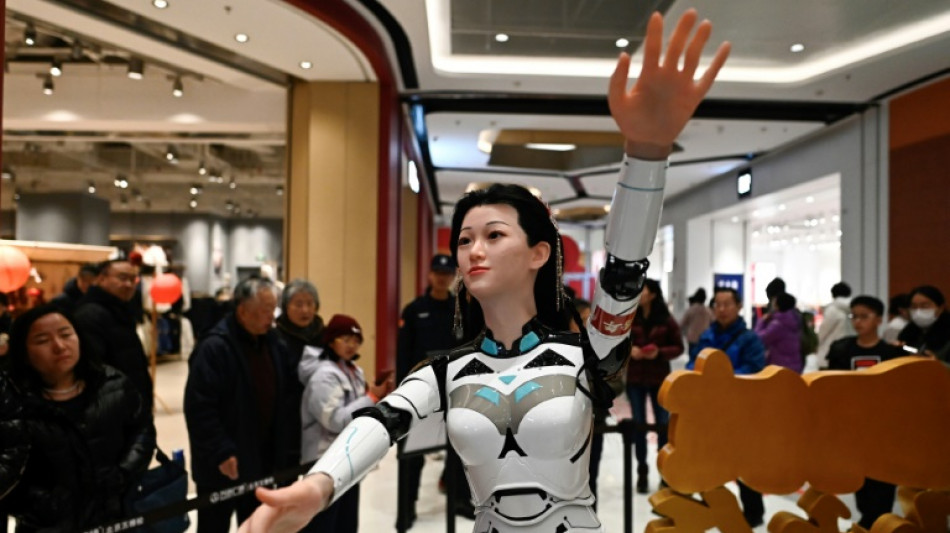
Tradition and technology sync at China 'AI temple fair' / Photo: Pedro PARDO - AFP

 Modi pitches India as global chipmaking hub

 Ukraine plans record defence spending in 2027

 NASA scan discovers new, 'once in a century' Moon crater

 Most stocks rise as Fed hikes and indicates drive to curb inflation

 UK-Sudanese author pens book to give children 'African history of Africa'

 US Congress passes sweeping Russia sanctions bill

 US stocks fall, dollar gains after Fed lifts interest rates

 US Fed raises rates to tackle 'too high' inflation in move sure to rile Trump

 US Fed raises rates to battle inflation in move likely to rile Trump

 US House faces test on sweeping Russia sanctions bill

 British PM says to make 'difficult decisions' as inflation rises

 Global fuel price demos: a round-up

 Leverate Launches MCP for Traders to Connect AI Assistants With Trading Platforms

 MEXC Launches $1M "Discover Your Wall Street DNA" Campaign to Help Traders Find Their Market Fit

 Stocks edge higher ahead of US Fed rate call

 BASIS.pro Expands On-Chain Infrastructure with XDC Network Partnership and Zypher DAO as Auto Earn Goes Live

 Pickle-flavoured tart? AI inspires Japan's convenience stores

 EU chief hosts Canada's Carney in push to 'deepen' alliance

 Meta chief pushes back on AI slowdown calls

 US Fed to deliver rate decision with markets betting on hike

 i-payout Expands U.S. Money Transmitter Licensing Footprint and Advances European EMI Strategy

 US Senate crypto bill collapses amid partisan deadlock

 OpenAI, Anthropic and Google are working to create an AI standards body

 Protesting shepherds, farmers clash with Romanian police

 Foundation Lets Ledger Users Switch to Open Source Without Starting Over

A humanoid robot gyrates to pulsing music at a shopping mall in Beijing, part of an exhibition harnessing artificial intelligence to enhance the flavour of China's biggest annual festival.
The country is celebrating the eight-day Lunar New Year holiday that typically sees people return home to eat, drink and make merry with family and friends.
From dragon dances to incense offerings, the festival is also a time to nurture centuries-old traditions -- though in this corner of the capital, they come with a high-tech twist.
Billed as an "AI temple fair", the event in Beijing's well-heeled Haidian district is a chance for local technology firms to display their products to the public.
"(Robots) can already do a lot of things, like take things off the shelves and make coffee," said Sophia Wu as she strolled among silicon shop assistants and binary baristas.
"I'd love to have a robot, and then it could do all my chores for me, and that would free up a lot of my time," the 48-year-old housewife and retired engineer told AFP.
A troupe of robots manufactured by Hangzhou-based tech firm Unitree made global headlines this week after they performed a synchronised dance on China's Spring Festival TV gala.
The singular dancer in the mall, however, put on a more modest show, staying rooted on the ground while jerkily swaying its hips and arms.
Described as a "high-quality human imitation robot" called Xiao Xin, it was capable of communicating with people and making tiny adjustments to the expressions on its lifelike prosthetic face, a display placard said.
Nearby, a visitor tentatively asked a life-size humanoid dressed as China's traditional wealth god what it had eaten for breakfast.
"This morning, I enjoyed a hearty breakfast that included fresh fruit, delicious fried eggs, and sweet bread," the robot replied in a resounding baritone, shaking its wispy beard and glittering crimson robe.
"I hope that in the new year, you can also eat healthily and deliciously, and be happy every day."
- 'Charm of robots' -
Elsewhere, a motley band of automated musicians cranked out holiday songs on analogue instruments, and finely tuned robotic arms wielded ink brushes to write calligraphy on thick red paper.
Waiting for his scroll to dry, Bai Song, 34, said the exhibition had left him with a "deep impression of the charm of robots".
"Every era inevitably produces different things. It's possible that AI will replace some of us, but there will also be new jobs, or new types of work," the IT professional told AFP.
"Also, we're a socialist country, so there's no way that people's lives are suddenly going to get worse, because the state will provide our safety net."
China leads the world in some advanced technologies and aims to achieve global supremacy in AI by the end of the decade.
An AI chatbot developed by Chinese start-up DeepSeek sent shockwaves through the industry this week with its R1 programme that can match American competitors seemingly at a fraction of the cost.
Still, not everything at the AI temple fair seemed quite so disruptive just yet.
A robotic koi carp repeatedly swam into the wall of its water-filled enclosure, and two semi-automated football teams plodded around an indoor pitch, colliding with each other and scuffing their kicks.
On the touchline, Cheng Cheng, a software development engineer at manufacturer Booster Robotics, said the company was working on "research-oriented applications" like refining foot and hand movements and interactions with AI.
Despite the scrappy game -- won 5-2 by a pair of robots in pink jerseys -- the 36-year-old was upbeat about the firm's future prospects.
"This is a starting point for us to make our robots more robust and fall-resistant... (and to) enhance their strength," he told AFP.
M.P.Jacobs--CPN