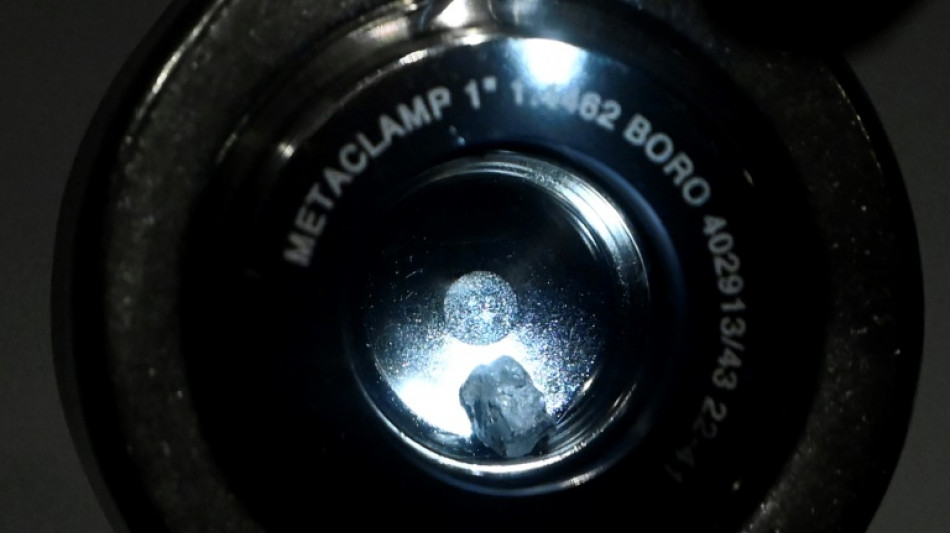
Life's 'basic building blocks' found in asteroid samples / Photo: OLIVIER DOULIERY - AFP

 Modi pitches India as global chipmaking hub

 Ukraine plans record defence spending in 2027

 NASA scan discovers new, 'once in a century' Moon crater

 Most stocks rise as Fed hikes and indicates drive to curb inflation

 UK-Sudanese author pens book to give children 'African history of Africa'

 US Congress passes sweeping Russia sanctions bill

 US stocks fall, dollar gains after Fed lifts interest rates

 US Fed raises rates to tackle 'too high' inflation in move sure to rile Trump

 US Fed raises rates to battle inflation in move likely to rile Trump

 US House faces test on sweeping Russia sanctions bill

 British PM says to make 'difficult decisions' as inflation rises

 Global fuel price demos: a round-up

 Leverate Launches MCP for Traders to Connect AI Assistants With Trading Platforms

 MEXC Launches $1M "Discover Your Wall Street DNA" Campaign to Help Traders Find Their Market Fit

 Stocks edge higher ahead of US Fed rate call

 BASIS.pro Expands On-Chain Infrastructure with XDC Network Partnership and Zypher DAO as Auto Earn Goes Live

 Pickle-flavoured tart? AI inspires Japan's convenience stores

 EU chief hosts Canada's Carney in push to 'deepen' alliance

 Meta chief pushes back on AI slowdown calls

 US Fed to deliver rate decision with markets betting on hike

 i-payout Expands U.S. Money Transmitter Licensing Footprint and Advances European EMI Strategy

 US Senate crypto bill collapses amid partisan deadlock

 OpenAI, Anthropic and Google are working to create an AI standards body

 Protesting shepherds, farmers clash with Romanian police

 Foundation Lets Ledger Users Switch to Open Source Without Starting Over

Pristine samples of the asteroid Bennu transported to Earth contain the "basic building blocks" for life, shedding new light on the perennial question of how life began on our planet.
The revelation, in two studies published Wednesday, is the result of work on just 120 grams of material -- about the weight of a banana -- collected from Bennu by NASA's OSIRIS-REx spacecraft in 2020.
The samples from Bennu, then around 300 million kilometres (186 million miles) from Earth, were returned in a capsule that OSIRIS-REx dropped off during a pass-by in 2023.
Initial analysis had already revealed evidence of high-carbon content and water.
But the new research found that evaporated water on Bennu's parent asteroid left behind "the raw ingredients of life", said Tim McCoy, curator of meteorites at the Smithsonian's National Museum of Natural History and co-lead author of one of the studies.
"We have discovered that next step on a pathway to life," he said in a press release issued by the museum.
Bennu appears to have formed around 65 million years ago from the debris of a parent asteroid dating back some 4.5 billion years.
The findings suggest Bennu's parent was once home to pockets of liquid water. When these evaporated, they left behind a "briny broth" of salts and minerals.
Some of the minerals include compounds that have never been seen in samples from outer space, the museum said.
And analysis of the samples strongly suggests a "non-terrestrial origin", adds one of the studies.
That could lend support to the theory that life on Earth was seeded from outer space.
- 'Unprecedented insight' -
The samples "give unprecedented insight into the processes that drove the formation of the Solar System," according to Yasuhito Sekine, a professor at the Institute of Science Tokyo.
"This discovery was only possible by analysing samples that were collected directly from the asteroid then carefully preserved back on Earth," he added.
"The salts would otherwise have rapidly absorbed moisture in the Earth's humid atmosphere."
The researchers believe similar salty brines may exist on other extraterrestrial bodies, including the dwarf planet Ceres and Saturn's moon Enceladus, as well as other asteroids.
They plan to reexamine specimens already on Earth for traces of compounds that previous research might have missed.
"Even though asteroid Bennu has no life, the question is could other icy bodies harbour life?" said Nick Timms, an associate professor at Curtin University's School of Earth and Planetary Sciences also involved in the research.
Much about life's origin remains unclear despite the secrets revealed from Bennu, McCoy cautioned.
"We now know we have the basic building blocks to move along this pathway towards life, but we don't know how far along that pathway this environment could allow things to progress," he said.
Still, Sara Russell, co-lead author with McCoy and a cosmic mineralogist at the museum, said the research had made "huge progress in understanding how asteroids like Bennu evolved, and how they may have helped make the Earth habitable".
P.Gonzales--CPN