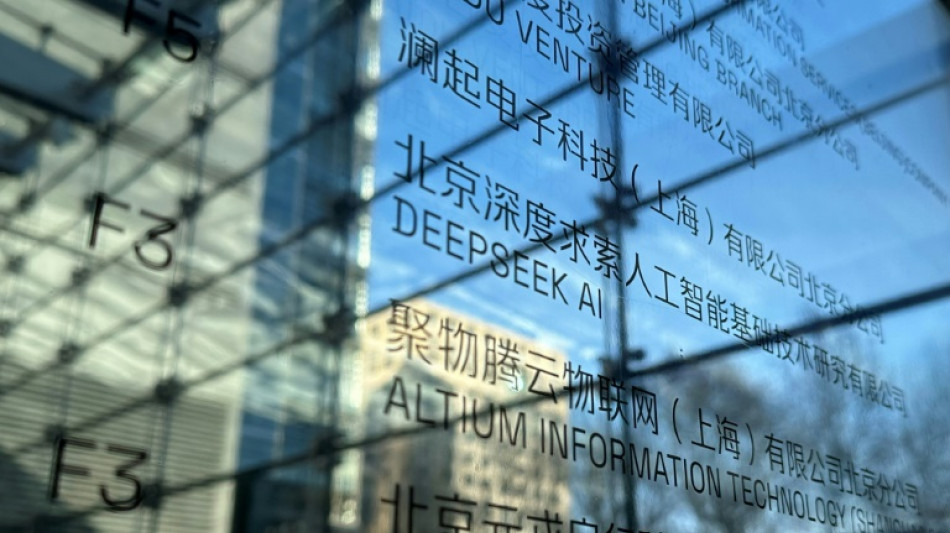
DeepSeek's 'Sputnik moment' exposes holes in US chip curbs / Photo: PETER CATTERALL - AFP

 Modi pitches India as global chipmaking hub

 Ukraine plans record defence spending in 2027

 NASA scan discovers new, 'once in a century' Moon crater

 Most stocks rise as Fed hikes and indicates drive to curb inflation

 UK-Sudanese author pens book to give children 'African history of Africa'

 US Congress passes sweeping Russia sanctions bill

 US stocks fall, dollar gains after Fed lifts interest rates

 US Fed raises rates to tackle 'too high' inflation in move sure to rile Trump

 US Fed raises rates to battle inflation in move likely to rile Trump

 US House faces test on sweeping Russia sanctions bill

 British PM says to make 'difficult decisions' as inflation rises

 Global fuel price demos: a round-up

 Leverate Launches MCP for Traders to Connect AI Assistants With Trading Platforms

 MEXC Launches $1M "Discover Your Wall Street DNA" Campaign to Help Traders Find Their Market Fit

 Stocks edge higher ahead of US Fed rate call

 BASIS.pro Expands On-Chain Infrastructure with XDC Network Partnership and Zypher DAO as Auto Earn Goes Live

 Pickle-flavoured tart? AI inspires Japan's convenience stores

 EU chief hosts Canada's Carney in push to 'deepen' alliance

 Meta chief pushes back on AI slowdown calls

 US Fed to deliver rate decision with markets betting on hike

 i-payout Expands U.S. Money Transmitter Licensing Footprint and Advances European EMI Strategy

 US Senate crypto bill collapses amid partisan deadlock

 OpenAI, Anthropic and Google are working to create an AI standards body

 Protesting shepherds, farmers clash with Romanian police

 Foundation Lets Ledger Users Switch to Open Source Without Starting Over

US export controls on high-tech chips may have inadvertently fuelled the success of start-up DeepSeek's AI chatbot, sparking fears in Washington there could be little it can do to stop China in the push for global dominance in AI.
The firm, based in the eastern Chinese city of Hangzhou, has stunned investors and industry insiders with its R1 programme, which can match its American competitors seemingly at a fraction of the cost.
That's despite a strict US regime prohibiting Chinese firms from accessing the kinds of advanced chips needed to power the massive learning models used to develop AI.
DeepSeek founder Liang Wenfeng has admitted the "embargo on high-end chips" has proved a major hurdle in its work.
But while the curbs have long aimed to ensure US tech dominance, analysts suggest they may have spurred the firm to develop clever ways to overcome them.
The company has said it used the less-advanced H800 chips -- permitted for export to China until late 2023 -- to power its large learning model.
"The constraints on China's access to chips forced the DeepSeek team to train more efficient models that could still be competitive without huge compute training costs," George Washington University's Jeffrey Ding told AFP.
The success of DeepSeek, he said, showed "US export controls are ineffective at preventing other countries from developing frontier models".
"History tells us it is impossible to bottle up a general-purpose technology like artificial intelligence."
DeepSeek is far from the first Chinese firm forced to innovate in this way: tech giant Huawei has roared back into profit in recent years after reorienting its business to address US sanctions.
But it is the first to spark such panic in Silicon Valley and Washington.
Venture capitalist Marc Andreessen described it as a "Sputnik moment" -- a reference to the Soviet satellite launch that exposed the yawning technology gap between the United States and its primary geopolitical adversary.
- Fraction of the cost -
For years many had assumed US supremacy in AI was a given, with the field dominated by big Silicon Valley names like OpenAI and Facebook-parent Meta.
While China has invested millions and vowed to be the world leader in AI technology by 2030, its offerings were hardly enough to raise hackles across the Pacific.
Tech giant Baidu's attempt at matching ChatGPT, Ernie Bot, failed to impress on release -- seemingly confirming views among many that Beijing's stifling regulatory environment for big tech would prevent any real innovation.
That was combined with a tough regime, spearheaded by the administration of Joe Biden, aimed at limiting Chinese purchases of the high-tech chips needed to power AI large language models.
But DeepSeek has blown many of those ideas out of the water.
"It's overturned the long-held assumptions that many had about the computation power, the data processing that's required to innovate," Samm Sacks, a Research Scholar in Law and Senior Fellow at Yale Law School's Paul Tsai China Center, told AFP.
"And so the question is can we get cutting-edge AI at a fraction of the cost and a fraction of the computation?"
While DeepSeek's model emphasised cost-cutting and efficiency, American policy towards AI has long been based on assumptions about scale.
"Throw more and more computing power and performance at the problem to achieve better and better performance," according to George Washington University's Ding.
That's the central idea behind President Donald Trump's Stargate venture, a $500 billion initiative to build infrastructure for artificial intelligence led by Japanese giant SoftBank and ChatGPT-maker OpenAI.
But the success of DeepSeek's R1 chatbot -- which its developers claim was built for just $5.6 million -- suggest innovation can come much cheaper.
Some urge caution, stressing the firm's cost-saving measures might not be quite so innovative.
"DeepSeek V3's training costs, while competitive, fall within historical efficiency trends," Lennart Heim, an associate information scientist at the RAND Corporation, told AFP, referring to R1's previous iteration.
"AI models have consistently become cheaper to train over time -- this isn't new," he explained.
"We also don't see the full cost picture of infrastructure, research, and development."
- 'Wake-up call' -
Nevertheless, Trump has described DeepSeek as a "wake-up call" for Silicon Valley that they needed to be "laser-focused on competing to win".
Former US Representative Mark Kennedy told AFP that DeepSeek's success "does not undermine the effectiveness of export controls moving forward".
Washington could choose to fire the next salvo by "expanding restrictions on AI chips" and increased oversight of precisely what technology Chinese firms can access, he added.
But it could also look to bolster its own industry, said Kennedy, who is now Director of the Wilson Center's Wahba Institute for Strategic Competition.
"Given the limitations of purely defensive measures, it may also ramp up domestic AI investment, strengthen alliances, and refine policies to ensure it maintains leadership without unintentionally driving more nations toward China's AI ecosystem," he said.
Rebecca Arcesati, an analyst at Mercator Institute for China Studies (MERICS), told AFP "the very real fear of falling behind China could now catalyse that push".
U.Ndiaye--CPN