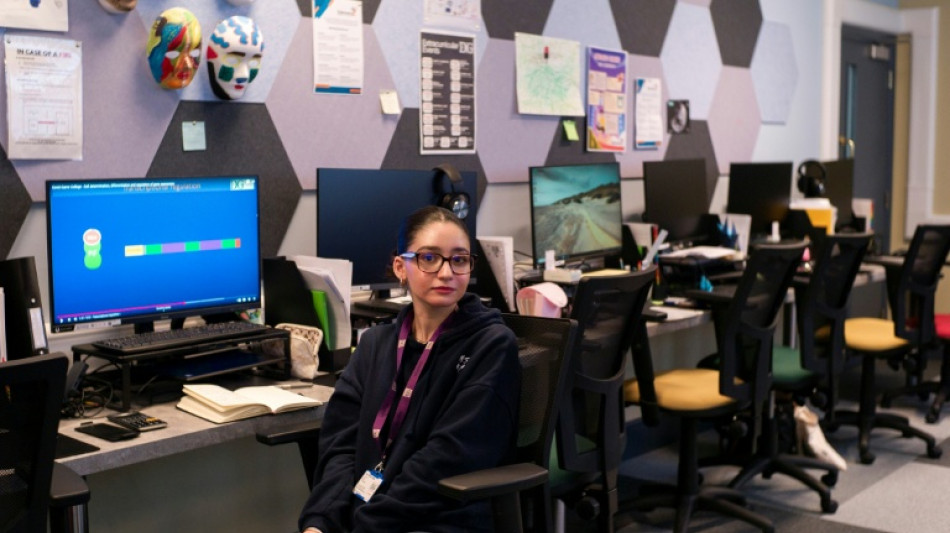
UK's first AI classroom without teachers sparks debate / Photo: Lena VOELK - AFP

 Modi pitches India as global chipmaking hub

 Ukraine plans record defence spending in 2027

 NASA scan discovers new, 'once in a century' Moon crater

 Most stocks rise as Fed hikes and indicates drive to curb inflation

 UK-Sudanese author pens book to give children 'African history of Africa'

 US Congress passes sweeping Russia sanctions bill

 US stocks fall, dollar gains after Fed lifts interest rates

 US Fed raises rates to tackle 'too high' inflation in move sure to rile Trump

 US Fed raises rates to battle inflation in move likely to rile Trump

 US House faces test on sweeping Russia sanctions bill

 British PM says to make 'difficult decisions' as inflation rises

 Global fuel price demos: a round-up

 Leverate Launches MCP for Traders to Connect AI Assistants With Trading Platforms

 MEXC Launches $1M "Discover Your Wall Street DNA" Campaign to Help Traders Find Their Market Fit

 Stocks edge higher ahead of US Fed rate call

 BASIS.pro Expands On-Chain Infrastructure with XDC Network Partnership and Zypher DAO as Auto Earn Goes Live

 Pickle-flavoured tart? AI inspires Japan's convenience stores

 EU chief hosts Canada's Carney in push to 'deepen' alliance

 Meta chief pushes back on AI slowdown calls

 US Fed to deliver rate decision with markets betting on hike

 i-payout Expands U.S. Money Transmitter Licensing Footprint and Advances European EMI Strategy

 US Senate crypto bill collapses amid partisan deadlock

 OpenAI, Anthropic and Google are working to create an AI standards body

 Protesting shepherds, farmers clash with Romanian police

 Foundation Lets Ledger Users Switch to Open Source Without Starting Over

Britain's first teacherless AI classroom may be an "outlier", but it underlines the potential benefits and risks of a UK government drive to rollout artificial intelligence in education, experts say.
David Game College, a private school in central London, is nearly six months into a trial in which students are taught core curriculum subjects for the GCSE state exams sat by 16-year-olds by AI platforms.
"Teaching and education will be transformed by AI. There is no doubt about that, and AI is not going to go away," said co-principal John Dalton, urging people to become "agile and adopt it".
The AI systems "monitor" how the students respond to course material and provide the school with "feedback information about their learning habits", he explained.
Prime Minister Keir Starmer this month laid out a vision to harness the power of artificial intelligence and pledged to make Britain an "AI superpower".
The government says the technology could help educators with lesson planning and correction, and has developed its own AI lesson assistant called "Aila" aligned with the UK's national curriculum.
Instead of teachers, the class at David Game College has real life "learning coaches", who are qualified as teachers but do not necessarily know the content of subjects and instead guide students through using the AI systems. They also mentor them in soft skills like debating and financial literacy.
The pilot, which currently has seven students and plans to have one coach for them, is a "leap of faith", Dalton admitted.
Dalton, a biology teacher, told AFP the AI platforms can assess a student's knowledge "with a greater degree of accuracy than your average teacher" to enable more personalised teaching.
"I believe that AI will augment and it will change the role of teachers," he said.
- 'Efficient' -
However, Rose Luckin, a professor at University College London (UCL) who researches AI in education, said AI was an "outlier" with an uncertain future in British classrooms.
While she agreed the technology would transform the role of teachers, Luckin told AFP it was "impossible" to say what that role might become.
"I don't want to be overly negative about it, because unless we try these things, we won't see how they work," Luckin said.
Student Massa Aldalate, 15, has been won over to AI learning.
"I was unsure at the beginning ... And then after actually being with it for a long time now, you can see the evidence right in front of you," she said, sitting on a swivelling chair surrounded by computers.
Does she miss a traditional classroom? "Not really," she replied, adding people attach "sentimental value" to the idea of a classroom.
"But this is just much more efficient if you actually want your studies to be done."
One of her favourite subjects is English, although she had been concerned how an AI platform would tackle the creative discipline.
"(For) English, I thought you just have to have a teacher with you. Apparently not, because it worked," she explained.
"You just have the work in front of you. You answer the questions, and it makes sense."
- 'Unequal access' -
National Education Union — one of the two main UK teacher unions — last week said it was "pleased to see the focus on training for teachers in the use of digital tools" by the government.
But Daniel Kebede, general secretary of the NEU, warned the government's ambitions must be "matched by significant investment in technology and IT infrastructure for schools".
And Luckin questioned "exactly how effective is this AI tutor", adding she hoped the pilot would provide "solid evidence" on whether AI is having a positive or negative impact.
She also voiced concerns about whether there is "sufficient social learning" for students, although the college says pupils have plenty of time with classmates.
Dalton said the programme is good at pinpointing gaps in a pupil's knowledge.
But with an eye-watering annual cost of £27,000 ($32,900) -- over £10,000 higher than average UK private school fees -- the model is an "elite" one, said Luckin.
She also highlighted concerns about unequal access to technology and data infrastructure.
The college's "high ratio of coach support to individual" is also "not something that can be replicated very much", said Luckin.
"So we need to learn from these examples, but I don't see it as being representative of the future for everyone."
U.Ndiaye--CPN