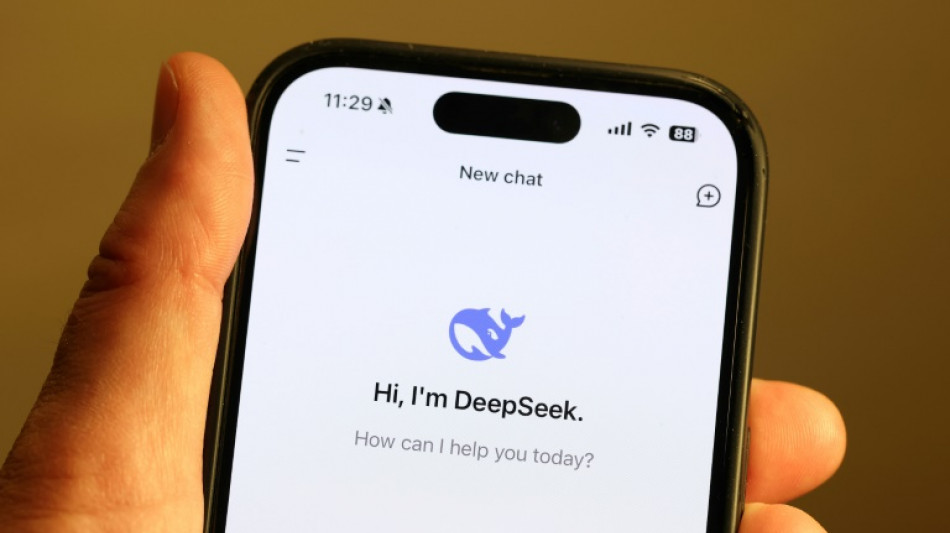
DeepSeek, Chinese AI startup roiling US tech giants / Photo: JUSTIN SULLIVAN - GETTY IMAGES NORTH AMERICA/AFP

 Modi pitches India as global chipmaking hub

 Ukraine plans record defence spending in 2027

 NASA scan discovers new, 'once in a century' Moon crater

 Most stocks rise as Fed hikes and indicates drive to curb inflation

 UK-Sudanese author pens book to give children 'African history of Africa'

 US Congress passes sweeping Russia sanctions bill

 US stocks fall, dollar gains after Fed lifts interest rates

 US Fed raises rates to tackle 'too high' inflation in move sure to rile Trump

 US Fed raises rates to battle inflation in move likely to rile Trump

 US House faces test on sweeping Russia sanctions bill

 British PM says to make 'difficult decisions' as inflation rises

 Global fuel price demos: a round-up

 Leverate Launches MCP for Traders to Connect AI Assistants With Trading Platforms

 MEXC Launches $1M "Discover Your Wall Street DNA" Campaign to Help Traders Find Their Market Fit

 Stocks edge higher ahead of US Fed rate call

 BASIS.pro Expands On-Chain Infrastructure with XDC Network Partnership and Zypher DAO as Auto Earn Goes Live

 Pickle-flavoured tart? AI inspires Japan's convenience stores

 EU chief hosts Canada's Carney in push to 'deepen' alliance

 Meta chief pushes back on AI slowdown calls

 US Fed to deliver rate decision with markets betting on hike

 i-payout Expands U.S. Money Transmitter Licensing Footprint and Advances European EMI Strategy

 US Senate crypto bill collapses amid partisan deadlock

 OpenAI, Anthropic and Google are working to create an AI standards body

 Protesting shepherds, farmers clash with Romanian police

 Foundation Lets Ledger Users Switch to Open Source Without Starting Over

Chinese startup DeepSeek, which has sparked panic on Wall Street with its powerful new chatbot developed at a fraction of the cost of its competitors, was founded by a hedgefund whizz-kid who believes AI can change the world.
Based out of the eastern Chinese city of Hangzhou -- sometimes known as "China's Silicon Valley" -- DeepSeek has come seemingly out of nowhere to release a cutting-edge product.
But in China it was already making waves, last year dubbed the "Pinduoduo of AI" -- a reference to a popular online shopping app that steamrolled big players like Alibaba with its low prices.
DeepSeek has won plaudits for its cost-effectiveness and praise in China for its seeming ability to navigate US sanctions that have aimed to prevent access to the high-tech chips needed to power the AI revolution.
AFP paid visits to the firm's offices in both Hangzhou and the capital Beijing on Tuesday, but offices appeared closed for the Lunar New Year holidays.
The firm is the child of tech and business prodigy Liang Wenfeng, born in 1985 and an engineering graduate of Hangzhou's prestigious Zhejiang University, where he has said he became convinced "artificial intelligence would change the world".
He spent years trying to work out how to apply AI to a number of different fields, according to an interview with Chinese investment news outlet Waves last year.
But he eventually struck gold with High-Flyer, a quantitative investing firm specialising in using AI to analyse stock market patterns.
That technique brought in tens of billions of yuan in assets managed, and made it one of China's top quantitative hedge funds.
"We just do things according to our own pace, then calculate costs and prices," Liang told Waves.
"Our principle is to not subsidise or make a huge profit."
- 'More a geek than a boss' -
For Liang, DeepSeek was always a passion project.
In 2021, the Financial Times reported, he began purchasing Nvidia graphic processing units for a side project -- an account also featured in a local media report on the firm.
Associates told Waves he is "not at all like a boss and much more like a geek", with a "terrifying ability to learn".
And his passion project has now shocked industry experts and triggered a plummet in the shares of US chip-making giant Nvidia.
It also brought Liang right into the corridors of power.
Last week, he appeared in a lineup of other key business representatives meeting with China's second-ranking leader, Premier Li Qiang, at a seminar to solicit opinions on the government's economic work for the year ahead.
Footage of the meeting from Chinese state broadcaster CCTV showed a moppy-haired Liang wearing thick-rimmed glasses addressing Li, who sat listening intently from his chair opposite.
- 'Wake-up call' -
Beijing has good reason to be pleased: DeepSeek's success called into question the vast sums of money funnelled by tech giants into developing advanced generative AI, as well as the ability of Western sanctions to prevent Chinese competitors from keeping up -- or even winning.
US President Donald Trump said it was a "wake-up call" for Silicon Valley, and tech investor and ally Marc Andreessen declared it was "AI's Sputnik moment".
It also amplified calls for Washington to get even tougher on restricting Chinese firms from getting hold of high-tech chips.
In his interview with Waves, Liang acknowledged that the toughest obstacle has been those US curbs.
"Money has never been the problem we face; it's the embargo on high-end chips," he said.
But beyond the geopolitics, the "geeky" AI guru said he hoped the technology could help us understand deeper things about the human mind.
"We hypothesize that the essence of human intelligence might be language, and human thought could essentially be a linguistic process," he said.
"What you think of as 'thinking' might actually be your brain weaving language."
M.Anderson--CPN