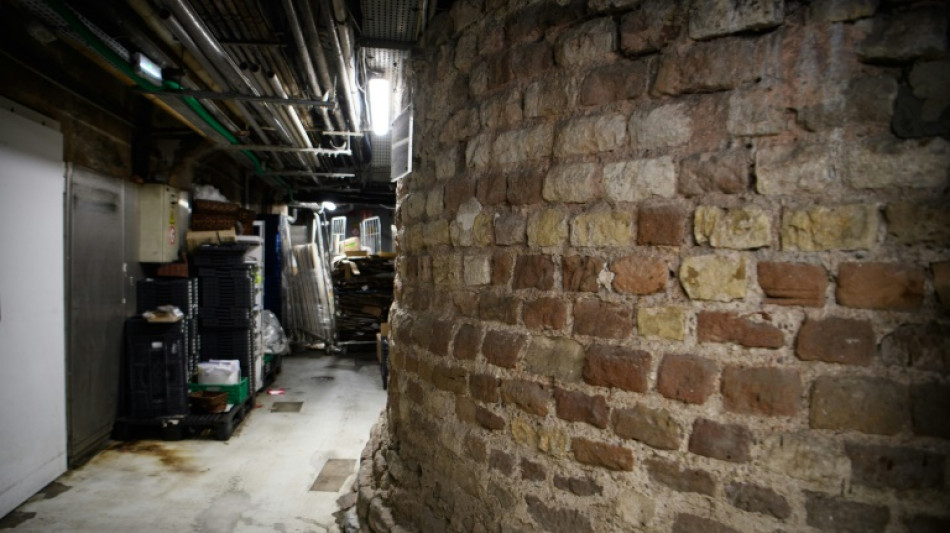
Shoppers unaware as Roman tower lurks under French supermarket / Photo: ELSA RANCEL - AFP

 Modi pitches India as global chipmaking hub

 Ukraine plans record defence spending in 2027

 NASA scan discovers new, 'once in a century' Moon crater

 Most stocks rise as Fed hikes and indicates drive to curb inflation

 UK-Sudanese author pens book to give children 'African history of Africa'

 US Congress passes sweeping Russia sanctions bill

 US stocks fall, dollar gains after Fed lifts interest rates

 US Fed raises rates to tackle 'too high' inflation in move sure to rile Trump

 US Fed raises rates to battle inflation in move likely to rile Trump

 US House faces test on sweeping Russia sanctions bill

 British PM says to make 'difficult decisions' as inflation rises

 Global fuel price demos: a round-up

 Leverate Launches MCP for Traders to Connect AI Assistants With Trading Platforms

 MEXC Launches $1M "Discover Your Wall Street DNA" Campaign to Help Traders Find Their Market Fit

 Stocks edge higher ahead of US Fed rate call

 BASIS.pro Expands On-Chain Infrastructure with XDC Network Partnership and Zypher DAO as Auto Earn Goes Live

 Pickle-flavoured tart? AI inspires Japan's convenience stores

 EU chief hosts Canada's Carney in push to 'deepen' alliance

 Meta chief pushes back on AI slowdown calls

 US Fed to deliver rate decision with markets betting on hike

 i-payout Expands U.S. Money Transmitter Licensing Footprint and Advances European EMI Strategy

 US Senate crypto bill collapses amid partisan deadlock

 OpenAI, Anthropic and Google are working to create an AI standards body

 Protesting shepherds, farmers clash with Romanian police

 Foundation Lets Ledger Users Switch to Open Source Without Starting Over

Few grocery shoppers in a regular central Strasbourg supermarket have any idea that below their feet is a third-century tower that once helped defend the Roman empire.
The ancient semi-circular structure -- part of fortifications against attack by Germanic tribes then known as "barbarians" from the east -- now shares space with pallets, boxes and stepladders in the basement of the supermarket in the eastern French city's main tourist area.
Nothing above ground hints at the presence of the Roman structure, with the shop fearing being overrun by curious crowds if it became too well-known.
"It would be difficult to organise visits to the tower because of safety considerations," said store manager Gwendal Le Gourrierec.
"But I've never turned anybody down who wanted to see it."
There is, meanwhile, no legal obligation to do so, noted Quentin Richard, curator at Strasbourg's archaeological museum.
A door at the far end of the store, marked "staff only", leads to a stone staircase which brings a visitor face to face with the 1,700-year-old monument.
"We walk past it every day," said Le Gourrierec. "It's an unusual experience."
The tower, which now stands just under 3.5 metres (11.5 feet) tall, was originally nearly three times that height, said Maxime Werle, at the regional archaeological service.
It belonged to a Roman military camp of around 20 hectares (50 acres), he said, which covered much of today's downtown Strasbourg and housed some 6,000 legionaries.
Its geographical location placed Strasbourg on the Roman Empire's frontier, known by its Latin name "Limes", with the nearby Rhine serving as a natural defence against "barbarian" assaults.
At the time the Empire was under intense pressure from foreign invasions, civil wars and economic troubles.
The tower was discovered in 1906 during the construction of a brewery and was listed as a historical monument in the 1920s.
Although its location is owned by a private company, "it is prohibited to destroy or damage it", said Werle. "They can't just do what they want with it."
Strasbourg boasts other vestiges of the Roman camp which are off limits to the public and also "much less impressive than the tower in the supermarket", he said.
X.Cheung--CPN