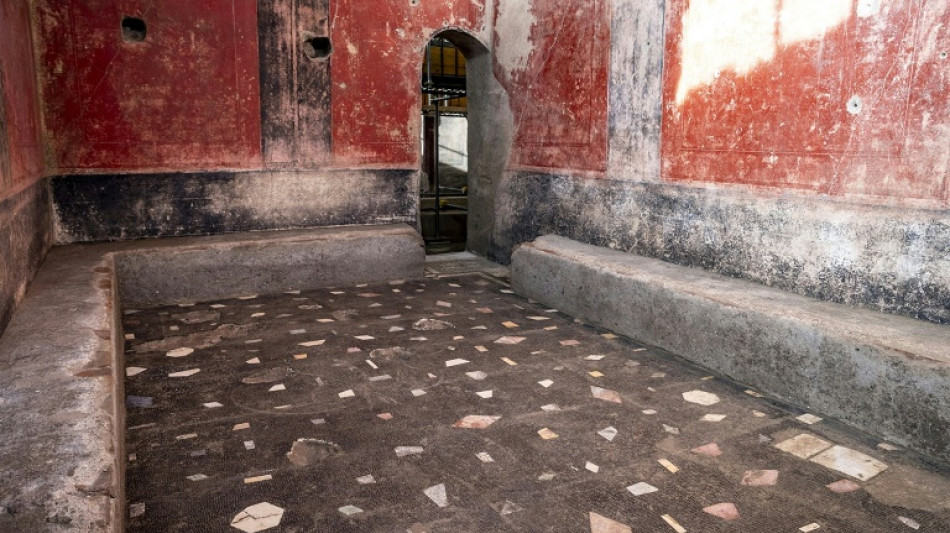
Pompeii reveals 'impressive' bath complex / Photo: Handout - Parco Archeologico di Pompei press office/AFP

 Modi pitches India as global chipmaking hub

 Ukraine plans record defence spending in 2027

 NASA scan discovers new, 'once in a century' Moon crater

 Most stocks rise as Fed hikes and indicates drive to curb inflation

 UK-Sudanese author pens book to give children 'African history of Africa'

 US Congress passes sweeping Russia sanctions bill

 US stocks fall, dollar gains after Fed lifts interest rates

 US Fed raises rates to tackle 'too high' inflation in move sure to rile Trump

 US Fed raises rates to battle inflation in move likely to rile Trump

 US House faces test on sweeping Russia sanctions bill

 British PM says to make 'difficult decisions' as inflation rises

 Global fuel price demos: a round-up

 Leverate Launches MCP for Traders to Connect AI Assistants With Trading Platforms

 MEXC Launches $1M "Discover Your Wall Street DNA" Campaign to Help Traders Find Their Market Fit

 Stocks edge higher ahead of US Fed rate call

 BASIS.pro Expands On-Chain Infrastructure with XDC Network Partnership and Zypher DAO as Auto Earn Goes Live

 Pickle-flavoured tart? AI inspires Japan's convenience stores

 EU chief hosts Canada's Carney in push to 'deepen' alliance

 Meta chief pushes back on AI slowdown calls

 US Fed to deliver rate decision with markets betting on hike

 i-payout Expands U.S. Money Transmitter Licensing Footprint and Advances European EMI Strategy

 US Senate crypto bill collapses amid partisan deadlock

 OpenAI, Anthropic and Google are working to create an AI standards body

 Protesting shepherds, farmers clash with Romanian police

 Foundation Lets Ledger Users Switch to Open Source Without Starting Over

Archaeologists at Pompeii have uncovered a private thermal baths complex where guests would take the plunge before sitting down to sumptuous feasts, the Italian site said Friday.
The baths excavated at the Roman villa make up "one of the largest private thermal complexes" found so far in the ancient city, near Naples, which was devastated when nearby Mount Vesuvius erupted almost 2,000 years ago.
Guests would shed their robes in a changing room that could accommodate up to 30 people, judging by the benches present, according to the Pompeii statement.
They would then relax in the "calidarium" -- a room with a hot bath -- followed by the "tepidarium" or warm room, and finally take a plunge in a pool of cold water in the "frigidarium".
The cold room in particular is "very impressive", with "a porticoed courtyard measuring 10 metres squared, at the centre of which is a large pool", Pompeii said.
Afterwards, guests would dine by candlelight in a black-walled banqueting hall decorated with scenes from Greek mythology.
The hall and spa are part of a grand villa which archaeologists have spent the past two years uncovering.
"The direct connection of the thermal spaces to the large convivial hall suggests the Roman house lent itself to staging sumptuous banquets," the Pompeii statement said.
These were "precious opportunities for the owner to ensure the electoral consensus of his guests, to promote the candidacy of friends or relatives, or simply to affirm his social status", it said.
When Vesuvius erupted in 79 AD, the ash and rock that fell helped preserve many of Pompeii's buildings almost in their original state, as well as forming eerie shapes around the curled-up corpses of victims of the disaster.
The remains of more than 1,000 victims have been found during excavations in Pompeii, but many more are thought to have died.
Pompeii is now a UNESCO World Heritage Site and the second most visited tourist site in Italy, after the Colosseum in Rome.
X.Cheung--CPN