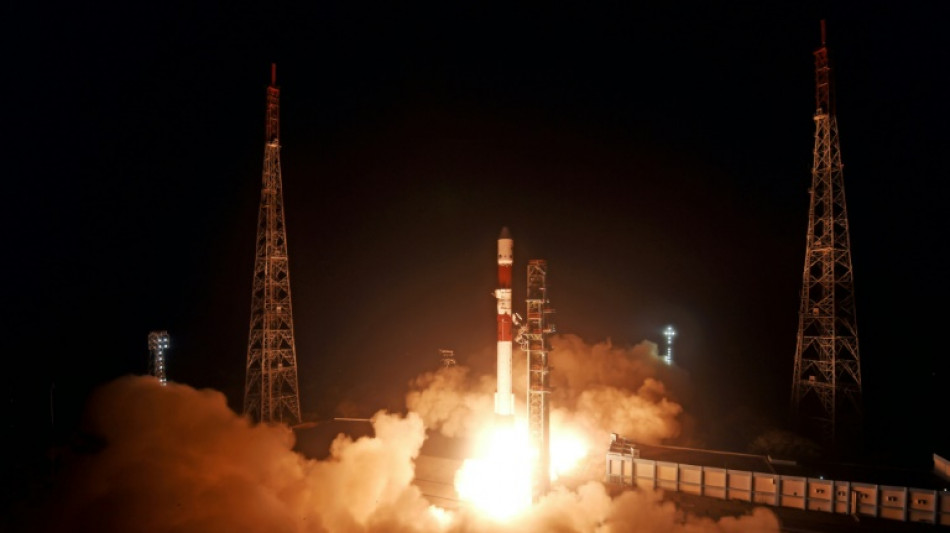
India achieves 'historic' space docking mission / Photo: Handout - Indian Space Research Organisation (ISRO)/AFP

 Modi pitches India as global chipmaking hub

 Ukraine plans record defence spending in 2027

 NASA scan discovers new, 'once in a century' Moon crater

 Most stocks rise as Fed hikes and indicates drive to curb inflation

 UK-Sudanese author pens book to give children 'African history of Africa'

 US Congress passes sweeping Russia sanctions bill

 US stocks fall, dollar gains after Fed lifts interest rates

 US Fed raises rates to tackle 'too high' inflation in move sure to rile Trump

 US Fed raises rates to battle inflation in move likely to rile Trump

 US House faces test on sweeping Russia sanctions bill

 British PM says to make 'difficult decisions' as inflation rises

 Global fuel price demos: a round-up

 Leverate Launches MCP for Traders to Connect AI Assistants With Trading Platforms

 MEXC Launches $1M "Discover Your Wall Street DNA" Campaign to Help Traders Find Their Market Fit

 Stocks edge higher ahead of US Fed rate call

 BASIS.pro Expands On-Chain Infrastructure with XDC Network Partnership and Zypher DAO as Auto Earn Goes Live

 Pickle-flavoured tart? AI inspires Japan's convenience stores

 EU chief hosts Canada's Carney in push to 'deepen' alliance

 Meta chief pushes back on AI slowdown calls

 US Fed to deliver rate decision with markets betting on hike

 i-payout Expands U.S. Money Transmitter Licensing Footprint and Advances European EMI Strategy

 US Senate crypto bill collapses amid partisan deadlock

 OpenAI, Anthropic and Google are working to create an AI standards body

 Protesting shepherds, farmers clash with Romanian police

 Foundation Lets Ledger Users Switch to Open Source Without Starting Over

India docked two satellites in space Thursday, a key milestone for the country's dreams of a space station and manned Moon mission, the space agency said.
The satellites, weighing 220-kilogrammes (485 pounds) each, blasted off in December on a single rocket from India's Sriharikota launch site. Later they separated.
On Thursday, the two satellites were manoeuvered back together in a "precision" process resulting in a "successful spacecraft capture", the Indian Space Research Organisation (ISRO) said, calling it a "historic moment".
India became the fourth country to achieve the feat -- dubbed as SpaDeX, or Space Docking Experiment -- after Russia, the United States and China.
The aim of the mission is to "develop and demonstrate the technology needed for rendezvous, docking, and undocking of two small spacecraft", ISRO said.
Two earlier docking attempts were postponed due to technical issues.
ISRO said the technology is "essential" for India's Moon mission, and comes after Prime Minister Narendra Modi announced plans last year to send a manned mission to the Moon by 2040.
The world's most populous nation has flexed its spacefaring ambitions in the last decade with its space programme growing considerably, matching the achievements of established powers at a much cheaper price tag.
In August 2023, it became just the fourth nation to land an unmanned craft on the Moon.
O.Ignatyev--CPN