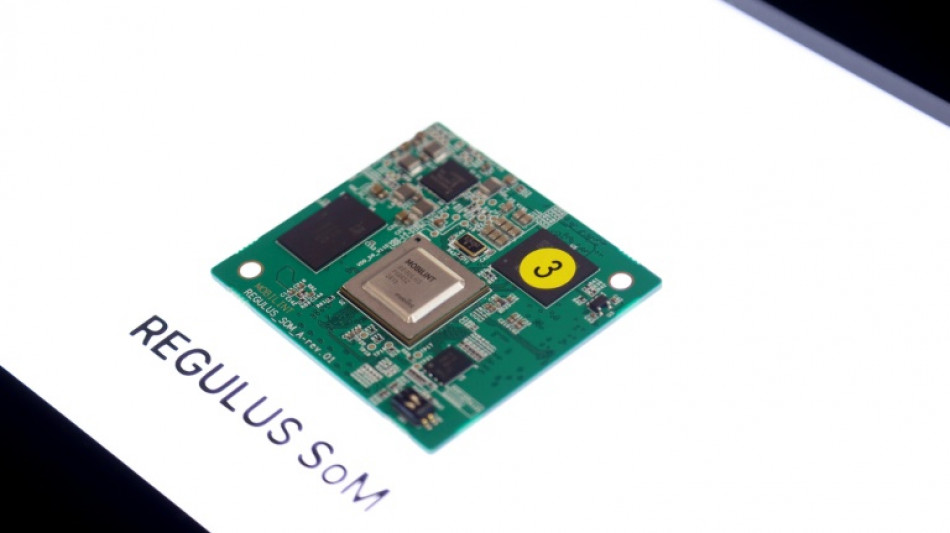
US announces new restrictions on AI chip exports / Photo: Ian Maule - AFP

 Modi pitches India as global chipmaking hub

 Ukraine plans record defence spending in 2027

 NASA scan discovers new, 'once in a century' Moon crater

 Most stocks rise as Fed hikes and indicates drive to curb inflation

 UK-Sudanese author pens book to give children 'African history of Africa'

 US Congress passes sweeping Russia sanctions bill

 US stocks fall, dollar gains after Fed lifts interest rates

 US Fed raises rates to tackle 'too high' inflation in move sure to rile Trump

 US Fed raises rates to battle inflation in move likely to rile Trump

 US House faces test on sweeping Russia sanctions bill

 British PM says to make 'difficult decisions' as inflation rises

 Global fuel price demos: a round-up

 Leverate Launches MCP for Traders to Connect AI Assistants With Trading Platforms

 MEXC Launches $1M "Discover Your Wall Street DNA" Campaign to Help Traders Find Their Market Fit

 Stocks edge higher ahead of US Fed rate call

 BASIS.pro Expands On-Chain Infrastructure with XDC Network Partnership and Zypher DAO as Auto Earn Goes Live

 Pickle-flavoured tart? AI inspires Japan's convenience stores

 EU chief hosts Canada's Carney in push to 'deepen' alliance

 Meta chief pushes back on AI slowdown calls

 US Fed to deliver rate decision with markets betting on hike

 i-payout Expands U.S. Money Transmitter Licensing Footprint and Advances European EMI Strategy

 US Senate crypto bill collapses amid partisan deadlock

 OpenAI, Anthropic and Google are working to create an AI standards body

 Protesting shepherds, farmers clash with Romanian police

 Foundation Lets Ledger Users Switch to Open Source Without Starting Over

The United States unveiled new export rules Monday on chips used for artificial intelligence, furthering efforts to make it tough for China and other rivals to access advanced technology in Joe Biden's final days as president.
The restrictions build on curbs announced in 2023 on exporting certain AI chips to China, which the United States sees as a strategic competitor in the field of advanced semiconductors.
"The US leads the world in AI now -- both AI development and AI chip design -- and it's critical that we keep it that way," Commerce Secretary Gina Raimondo told reporters.
But the effort drew industry criticism and sharp warnings that it would hurt US competitiveness.
Semiconductor Industry Association chief executive John Neuffer said: "We're deeply disappointed that a policy shift of this magnitude and impact is being rushed out the door days before a presidential transition and without any meaningful input from industry."
He added in a statement on Monday that the rule could cause "lasting damage to America's economy and global competitiveness" by ceding key markets to rivals.
Chip titan Nvidia said in a blog post that "while cloaked in the guise of an 'anti-China' measure, these rules would do nothing to enhance US security."
The new rules update controls on chips, requiring authorizations for exports, re-exports and in-country transfers -- while also including a series of exceptions for countries considered friendly to the United States.
AI data centers meanwhile will need to comply with enhanced security parameters in order to be able to import chips.
The rules make it "hard for our strategic competitors to use smuggling and remote access to evade our export control," White House National Security Advisor Jake Sullivan said.
They also create "incentives for our friends and partners around the world to use trusted vendors for advanced AI," he added.
The new rules will take effect in 120 days, Raimondo said, giving the incoming administration of President-elect Donald Trump time to potentially make changes.
In its blog post, Nvidia stressed that the first Trump administration showed how the United States "wins through innovation, competition and by sharing our technologies with the world -- not by retreating behind a wall of government overreach."
Trump put heavy tariffs on China during his first presidential term.
However, his backers in Silicon Valley could also see the rules as an undue burden on their ability to export products.
T.Morelli--CPN