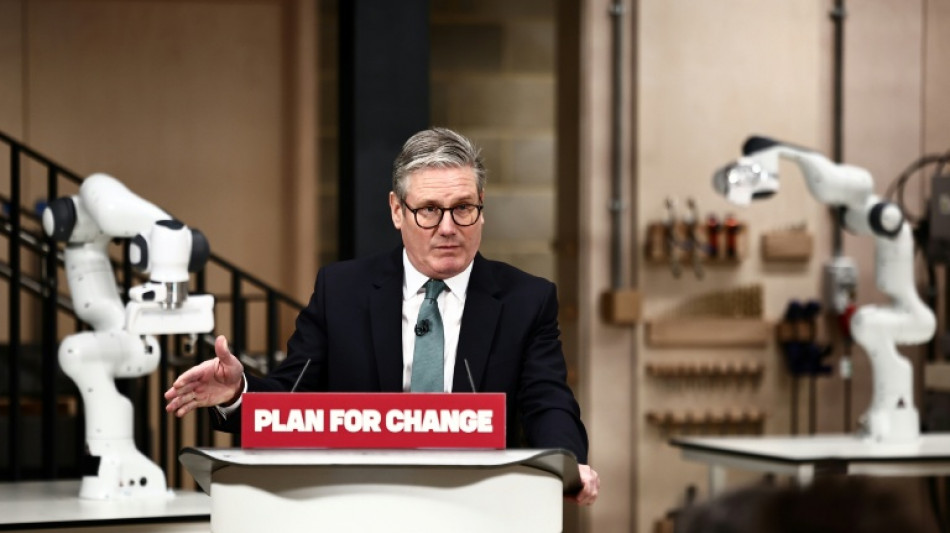
PM vows 'pro-growth' rules to make Britain an 'AI superpower' / Photo: HENRY NICHOLLS - POOL/AFP

 Modi pitches India as global chipmaking hub

 Ukraine plans record defence spending in 2027

 NASA scan discovers new, 'once in a century' Moon crater

 Most stocks rise as Fed hikes and indicates drive to curb inflation

 UK-Sudanese author pens book to give children 'African history of Africa'

 US Congress passes sweeping Russia sanctions bill

 US stocks fall, dollar gains after Fed lifts interest rates

 US Fed raises rates to tackle 'too high' inflation in move sure to rile Trump

 US Fed raises rates to battle inflation in move likely to rile Trump

 US House faces test on sweeping Russia sanctions bill

 British PM says to make 'difficult decisions' as inflation rises

 Global fuel price demos: a round-up

 Leverate Launches MCP for Traders to Connect AI Assistants With Trading Platforms

 MEXC Launches $1M "Discover Your Wall Street DNA" Campaign to Help Traders Find Their Market Fit

 Stocks edge higher ahead of US Fed rate call

 BASIS.pro Expands On-Chain Infrastructure with XDC Network Partnership and Zypher DAO as Auto Earn Goes Live

 Pickle-flavoured tart? AI inspires Japan's convenience stores

 EU chief hosts Canada's Carney in push to 'deepen' alliance

 Meta chief pushes back on AI slowdown calls

 US Fed to deliver rate decision with markets betting on hike

 i-payout Expands U.S. Money Transmitter Licensing Footprint and Advances European EMI Strategy

 US Senate crypto bill collapses amid partisan deadlock

 OpenAI, Anthropic and Google are working to create an AI standards body

 Protesting shepherds, farmers clash with Romanian police

 Foundation Lets Ledger Users Switch to Open Source Without Starting Over

Prime Minister Keir Starmer on Monday laid out his vision to harness the power of artificial intelligence to boost Britain's flagging economy, promising "pro-growth" regulations amid concerns about the technology's unchecked use.
Speaking following the launch of a government "action plan", Starmer pledged to ease red tape to attract billions of pounds of AI investment to Britain.
The "AI Opportunities Action Plan" includes 50 recommendations that the government will implement to boost AI-driven efficiency in the public sector, from education and healthcare to detecting potholes.
"Mark my words, Britain will be one of the great AI superpowers," Starmer said at an event at the UCL campus in east London, hailing the technology which is raising complex questions for governments around the world.
The UK -- which has the third-largest AI industry after the United States and China -- will be "pro-growth and pro-innovation on regulation", Starmer said.
"I think it is important to recognise that we've got freedom now in relation to regulation, to do it in the way that we think is best for the UK," said Starmer, calling for AI to be "tested" before it is "regulated".
"We don't need to walk down a US or an EU path on AI regulation", the prime minister wrote in the Financial Times ahead of the speech, calling for a "distinctively British approach".
Starmer's position marks a shift from the EU's heavy-handed regulation of the sector, especially regarding data protection laws, which has faced criticism from tech giants.
In the US, incoming President Donald Trump's desire to deregulate the economy and his team of Silicon Valley-linked advisors could influence policies on AI regulation.
- Data library -
The UK's latest plans include the creation of a national data library which would make public data sets, including anonymised National Health Service records, "available to AI researchers and innovators".
The data library would be bolstered by a "clear and trusted copyright regime", Starmer added. "It is important that we keep control of that data."
"But I don't think that we should have a defensive stance here that will inhibit the sort of breakthroughs that we need."
The latest plans come amid concerns surrounding AI's role in spreading online misinformation and deepfake pornography, as well as fears robots could one day outsmart humans if left unchecked.
The government outlined plans for the creation of "dedicated AI growth zones" designed to speed up planning proposals for data centres and other AI infrastructure.
It also hopes to increase server capacity twentyfold by 2030, including by building "a brand new supercomputer with enough AI power to play itself at chess half a million times a second".
The new supercomputer pledge comes months after Starmer axed a previous supercomputer project in Edinburgh planned by the previous government, citing a lack of funds.
- 'Economic mismanagement' -
Starmer's administration estimated that AI could be worth £47 billion ($57 billion) to the UK each year over a decade.
It announced that three tech companies -- Vantage Data Centres, Nscale and Kyndryl -- had committed to spending £14 billion on AI in the UK, leading to the creation of more than 13,000 jobs.
Starmer has put firing up Britain's economy at the heart of his agenda since taking office last July. In his speech, Starmer staked economic growth on advancements in AI, saying the technology "would turbocharge every single element of our plan for change".
But weaker-than-expected growth, rising borrowing costs and a falling pound is complicating his task, meaning he could be forced to make spending cuts or hike taxes this year.
Shadow Science Secretary Alan Mak accused Labour of insufficiently funding its AI ambitions.
"AI does have the potential to transform public services, but Labour's economic mismanagement and uninspiring plan will mean Britain is left behind," Mak said.
There are also concerns that the sector-wide implementation of AI could result in job losses.
"It's a disruptive technology, like many other previous technological waves," senior cabinet minister Pat McFadden told Times Radio.
"But I think it's too pessimistic to simply talk about job losses," he added.
The government is expected to wrap up next month a consultation to clarify the application of copyright law to AI, which it says aims to protect the creative industry.
S.F.Lacroix--CPN