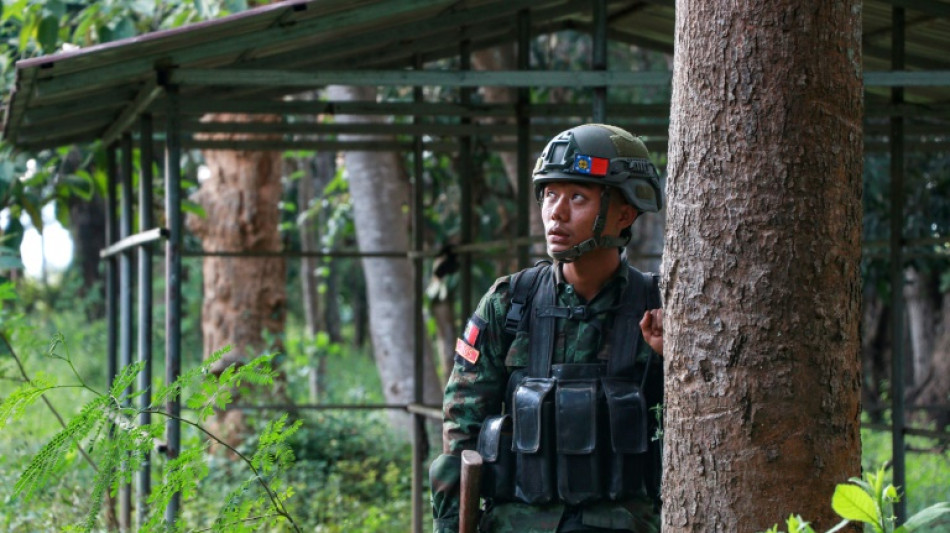
Myanmar military adopts anti-junta fighters' drone tactics / Photo: STR - AFP

 Modi pitches India as global chipmaking hub

 Ukraine plans record defence spending in 2027

 NASA scan discovers new, 'once in a century' Moon crater

 Most stocks rise as Fed hikes and indicates drive to curb inflation

 UK-Sudanese author pens book to give children 'African history of Africa'

 US Congress passes sweeping Russia sanctions bill

 US stocks fall, dollar gains after Fed lifts interest rates

 US Fed raises rates to tackle 'too high' inflation in move sure to rile Trump

 US Fed raises rates to battle inflation in move likely to rile Trump

 US House faces test on sweeping Russia sanctions bill

 British PM says to make 'difficult decisions' as inflation rises

 Global fuel price demos: a round-up

 Leverate Launches MCP for Traders to Connect AI Assistants With Trading Platforms

 MEXC Launches $1M "Discover Your Wall Street DNA" Campaign to Help Traders Find Their Market Fit

 Stocks edge higher ahead of US Fed rate call

 BASIS.pro Expands On-Chain Infrastructure with XDC Network Partnership and Zypher DAO as Auto Earn Goes Live

 Pickle-flavoured tart? AI inspires Japan's convenience stores

 EU chief hosts Canada's Carney in push to 'deepen' alliance

 Meta chief pushes back on AI slowdown calls

 US Fed to deliver rate decision with markets betting on hike

 i-payout Expands U.S. Money Transmitter Licensing Footprint and Advances European EMI Strategy

 US Senate crypto bill collapses amid partisan deadlock

 OpenAI, Anthropic and Google are working to create an AI standards body

 Protesting shepherds, farmers clash with Romanian police

 Foundation Lets Ledger Users Switch to Open Source Without Starting Over

A Myanmar military drone tracked a car carrying anti-junta forces as it drove through the contested village of Moe Bye. Moments after it parked near a house, the operator dropped an explosive.
Myanmar has been mired in bloody conflict since the military seized power in a 2021 coup, sparking a widespread armed uprising that has seen their pro-democracy opponents take swathes of territory, while millions of civilians have been displaced.
Drone strikes have been crucial to the insurgents' successes, including pushing junta troops out of large areas in Myanmar's north, many of them near the border with China.
Now the military is adopting the equipment of the anti-coup fighters, using drones to drop mortars or guide artillery strikes and bombing runs by its Chinese and Russian-built air force.
"We were very weak in technology and suffered much," one frontline Myanmar military officer told AFP.
"We lost some military posts in the regions because of bombing by drones," he said, declining to be named for security reasons.
"Now we are also using drones for counter-attack. They used big jammers to block the signal. We also use jammers."
Early morning mist gives cover to Kayan National Army (KNA) personnel as they patrol Moe Bye, in the rugged jungle-covered hills that run along the border of Shan and Kayah states.
But when the weather clears, the skies open to the Myanmar military's new weapons.
As the KNA troops sheltered in a wooded area, their faces etched with tension, the sound of the bomb explosion rang out. Two anti-junta fighters were injured in the blast.
"In the past, their strategy was to send soldiers first when they attacked," said Ba Kone, a battalion commander in the KNA, one of the myriad groups battling the military.
"Now they send drones first and then soldiers follow."
Flying at 1500 metres or higher -- altitudes far beyond the range of civilian drones -- the junta's devices are out of reach of the KNA's jammers.
"We can't do anything except hide in a safe place," said Ba Kone.
- China visit –
Facing one of the region's biggest and most battle-hardened militaries, the youth-led "People's Defence Forces" quickly turned to drones after the coup in their battle to topple the junta.
Fighters smuggled drones built for filming or agricultural purposes -- many of them made in China, which dominates the global drone industry -- into anti-junta camps where teams repurposed them to carry crude but effective "drop bombs".
Top military officials have acknowledged that drone strikes were key in a huge rebel offensive in 2023 that pushed junta troops out of thousands of square kilometres of northern Shan state.
At the time, junta chief Min Aung Hlaing accused unnamed "foreign drone experts" of helping their opponents as they dealt the military its most significant setback since it seized power.
Beijing has long been the junta's key ally and Jason Tower of the United States Institute of Peace said there was now "growing evidence that would suggest that the junta is obtaining drones from China".
In November, during his first known trip to China, Min Aung Hlaing visited Zhongyue Aviation UAV Firefighting-Drone in Chongqing and "observed the advanced drones created by the company", according to Myanmar state media.
The firm did not respond to a request for comment from AFP.
Myanmar military sources told AFP their supplies of drones had increased after Min Aung Hlaing's journey.
The military has become "much more accurate" in its use of offensive drones, said Dave Eubank of the Free Burma Rangers, a Christian aid group that has long worked in conflict areas in Myanmar, adding they were helping it exploit its huge advantage in firepower.
In 2021, air strikes were 500 to 1,000 metres off target, he told AFP. "By 2022, they were within 500 metres. By 2023, they were within 10-20 metres."
- 'Like dogs' –
The clashes in Moe Bye are an overspill from fighting in Kayah state, a hotbed of resistance where the United Nations says more than 130,000 people have been forced from their homes by conflict -- over a third of the population.
In December, Lway Zar arrived with her family at a makeshift encampment for the displaced in Pekon township, just a few minutes drive from Moe Bye.
It was the fifth time she had been forced to move since the coup, by fighting, floods -- and now military shelling.
"I don't know how long we can stay here," she said. "Even if we don't hear heavy gunfire, we still think that drones and air strikes are always following us.
"Before the coup, our family was poor but we had good living conditions in our own house and we could store rice from our fields," she told AFP.
"After that, we lost everything in the war. My husband said we used to be human but now we are like dogs."
A.Agostinelli--CPN