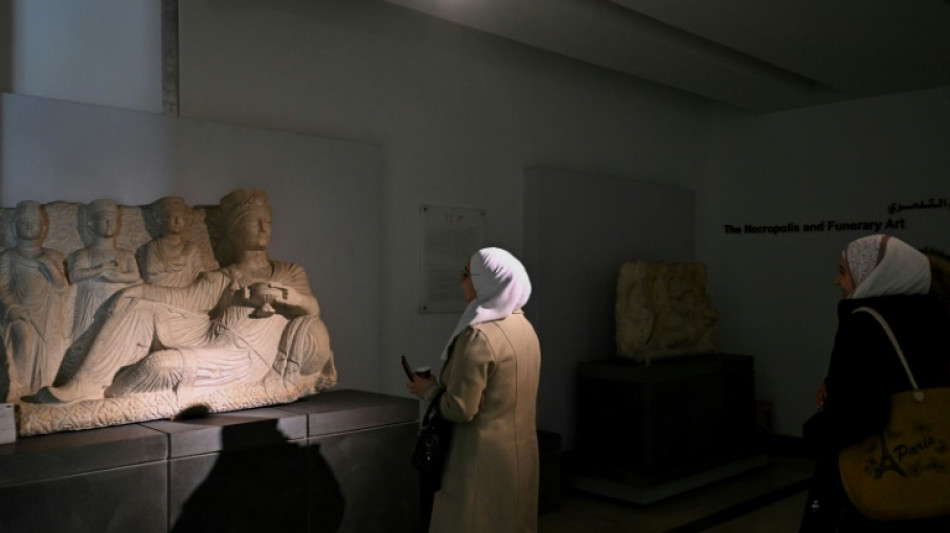
Safe from looting, Damascus museum reopens a month after Assad's fall / Photo: LOUAI BESHARA - AFP

 Modi pitches India as global chipmaking hub

 Ukraine plans record defence spending in 2027

 NASA scan discovers new, 'once in a century' Moon crater

 Most stocks rise as Fed hikes and indicates drive to curb inflation

 UK-Sudanese author pens book to give children 'African history of Africa'

 US Congress passes sweeping Russia sanctions bill

 US stocks fall, dollar gains after Fed lifts interest rates

 US Fed raises rates to tackle 'too high' inflation in move sure to rile Trump

 US Fed raises rates to battle inflation in move likely to rile Trump

 US House faces test on sweeping Russia sanctions bill

 British PM says to make 'difficult decisions' as inflation rises

 Global fuel price demos: a round-up

 Leverate Launches MCP for Traders to Connect AI Assistants With Trading Platforms

 MEXC Launches $1M "Discover Your Wall Street DNA" Campaign to Help Traders Find Their Market Fit

 Stocks edge higher ahead of US Fed rate call

 BASIS.pro Expands On-Chain Infrastructure with XDC Network Partnership and Zypher DAO as Auto Earn Goes Live

 Pickle-flavoured tart? AI inspires Japan's convenience stores

 EU chief hosts Canada's Carney in push to 'deepen' alliance

 Meta chief pushes back on AI slowdown calls

 US Fed to deliver rate decision with markets betting on hike

 i-payout Expands U.S. Money Transmitter Licensing Footprint and Advances European EMI Strategy

 US Senate crypto bill collapses amid partisan deadlock

 OpenAI, Anthropic and Google are working to create an AI standards body

 Protesting shepherds, farmers clash with Romanian police

 Foundation Lets Ledger Users Switch to Open Source Without Starting Over

Syrians returned on Wednesday to the national museum in Damascus, reopened for the first time since Islamist-led forces seized the capital and ousted president Bashar al-Assad.
The antiquities museum closed its doors on December 7, a day before Damascus was taken by rebel forces, over fears of looting.
"We firmly shut the museum's iron doors after we saw the situation was unstable," said Mohamed Nair Awad, head of the national antiquities authority.
In the early hours of December 8, after Assad had fled and as rebels approached the capital, many soldiers and police officers from the forces of the deposed president's government quit their posts.
With checkpoints unmanned and no security personnel outside public institutions, looters were able to enter the central bank, several government ministries and other buildings.
Awad said his team immediately reached out to the new authorities, led by Islamist group Hayat Tahrir al-Sham.
"They sent us a group of fighters to protect the museum," and it survived unscathed, he said.
On Wednesday, members of the public walked around the building and admired its collection.
Archeology student Shahanda al-Baroudi, 29, was giving a friend abroad a tour of the museum via video call.
"When the regime fell, I remembered scenes from the Baghdad museum after the fall of Saddam Hussein and feared I wouldn't see the artefacts again," she said.
"I cried when I came back and discovered it had not been damaged."
The Baghdad museum's collection was decimated by looters in the chaos that followed the 2003 US-led invasion of Iraq.
Outside the Damascus museum, Iyad Ghanem was among a group holding up signs demanding the new rulers help preserve the country's cultural heritage.
Some artefacts at the museum date back more than 10,000 years, he said.
The museum's vast collection includes tens of thousands of pieces, ranging from prehistoric blades and Greco-Roman sculptures to Islamic art.
The museum was closed for six years during Syria's civil war, which broke out in 2011 with the brutal repression of anti-Assad protests, to protect its precious artefacts from violence or looting.
It reopened in 2018, after Assad clawed back control of large swathes of the country.
H.Cho--CPN