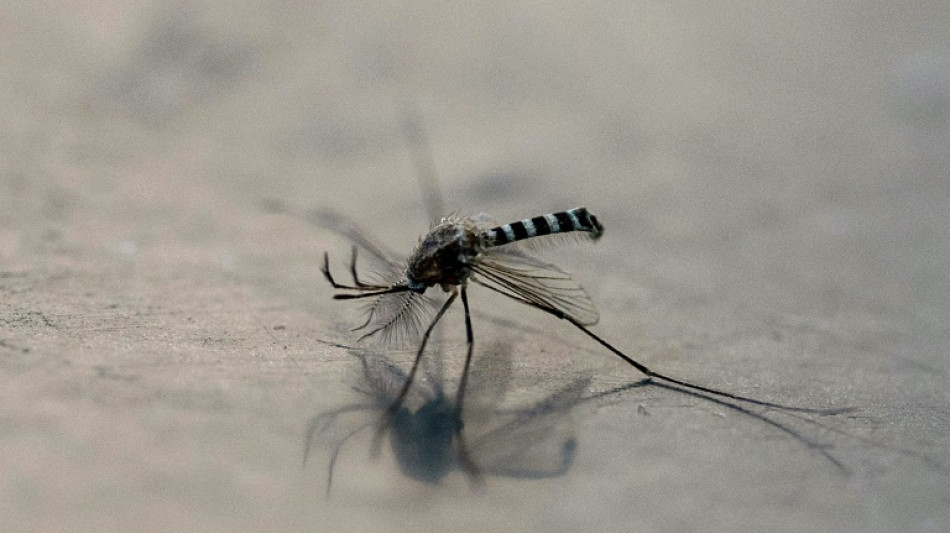
Mosquitoes with 'toxic' semen could stem disease spread: research / Photo: Yuri CORTEZ - AFP

 Modi pitches India as global chipmaking hub

 Ukraine plans record defence spending in 2027

 NASA scan discovers new, 'once in a century' Moon crater

 Most stocks rise as Fed hikes and indicates drive to curb inflation

 UK-Sudanese author pens book to give children 'African history of Africa'

 US Congress passes sweeping Russia sanctions bill

 US stocks fall, dollar gains after Fed lifts interest rates

 US Fed raises rates to tackle 'too high' inflation in move sure to rile Trump

 US Fed raises rates to battle inflation in move likely to rile Trump

 US House faces test on sweeping Russia sanctions bill

 British PM says to make 'difficult decisions' as inflation rises

 Global fuel price demos: a round-up

 Leverate Launches MCP for Traders to Connect AI Assistants With Trading Platforms

 MEXC Launches $1M "Discover Your Wall Street DNA" Campaign to Help Traders Find Their Market Fit

 Stocks edge higher ahead of US Fed rate call

 BASIS.pro Expands On-Chain Infrastructure with XDC Network Partnership and Zypher DAO as Auto Earn Goes Live

 Pickle-flavoured tart? AI inspires Japan's convenience stores

 EU chief hosts Canada's Carney in push to 'deepen' alliance

 Meta chief pushes back on AI slowdown calls

 US Fed to deliver rate decision with markets betting on hike

 i-payout Expands U.S. Money Transmitter Licensing Footprint and Advances European EMI Strategy

 US Senate crypto bill collapses amid partisan deadlock

 OpenAI, Anthropic and Google are working to create an AI standards body

 Protesting shepherds, farmers clash with Romanian police

 Foundation Lets Ledger Users Switch to Open Source Without Starting Over

Genetically engineered mosquitoes with toxic semen could be a new weapon against tropical disease, Australian scientists said after trialling the novel pest control method.
The "toxic male technique" aims to breed mosquitoes that express venomous proteins in their semen, killing off females after mating.
Female mosquitoes are targeted because only they bite and drink blood, thereby spreading diseases such as malaria and dengue fever.
Scientist Sam Beach from Australia's Macquarie University said the method "could work as quickly as pesticides without also harming beneficial species".
"This innovative solution could transform how we manage pests, offering hope for healthier communities and a more sustainable future."
The first proof-of-concept trials used fruit flies, a common laboratory species favoured for its short two-week life cycle.
Female flies that bred with "toxic" males had a significantly reduced lifespan, the scientists found.
Researcher Maciej Maselko said the team would now trial the method in mosquitoes.
"We still need to implement it in mosquitoes and conduct rigorous safety testing to ensure there are no risks to humans or other non-target species," he said.
Genetic engineering has been used for years to control populations of disease-spreading mosquitoes.
Typically, these approaches slow reproduction by releasing hordes of male insects that are genetically modified to be sterile.
Computer models showed techniques actively killing biting females could be far more effective, the research team said.
The research was described in a paper published by peer-reviewed journal Nature Communications on Tuesday evening.
S.F.Lacroix--CPN