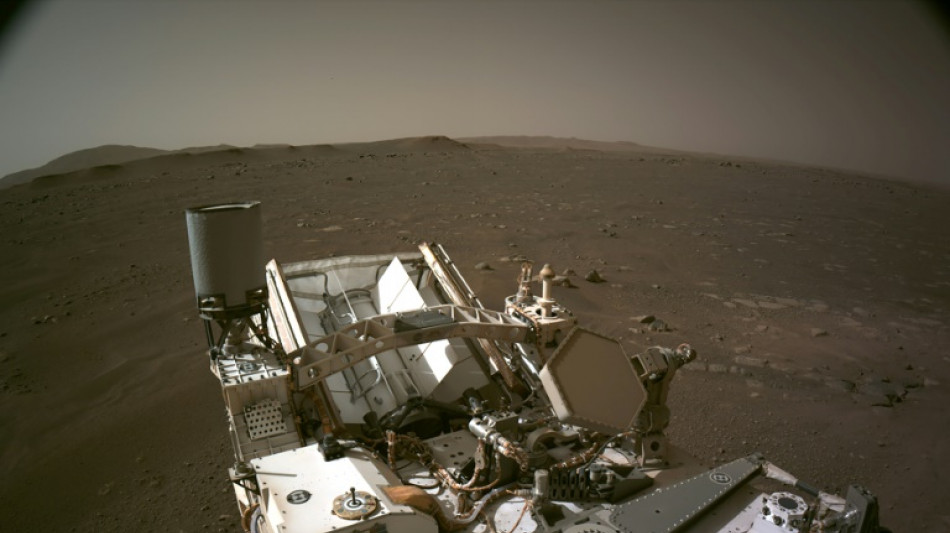
NASA eyes SpaceX, Blue Origin to cut Mars rock retrieval costs / Photo: Handout - NASA/JPL-CALTECH/AFP/File

 Modi pitches India as global chipmaking hub

 Ukraine plans record defence spending in 2027

 NASA scan discovers new, 'once in a century' Moon crater

 Most stocks rise as Fed hikes and indicates drive to curb inflation

 UK-Sudanese author pens book to give children 'African history of Africa'

 US Congress passes sweeping Russia sanctions bill

 US stocks fall, dollar gains after Fed lifts interest rates

 US Fed raises rates to tackle 'too high' inflation in move sure to rile Trump

 US Fed raises rates to battle inflation in move likely to rile Trump

 US House faces test on sweeping Russia sanctions bill

 British PM says to make 'difficult decisions' as inflation rises

 Global fuel price demos: a round-up

 Leverate Launches MCP for Traders to Connect AI Assistants With Trading Platforms

 MEXC Launches $1M "Discover Your Wall Street DNA" Campaign to Help Traders Find Their Market Fit

 Stocks edge higher ahead of US Fed rate call

 BASIS.pro Expands On-Chain Infrastructure with XDC Network Partnership and Zypher DAO as Auto Earn Goes Live

 Pickle-flavoured tart? AI inspires Japan's convenience stores

 EU chief hosts Canada's Carney in push to 'deepen' alliance

 Meta chief pushes back on AI slowdown calls

 US Fed to deliver rate decision with markets betting on hike

 i-payout Expands U.S. Money Transmitter Licensing Footprint and Advances European EMI Strategy

 US Senate crypto bill collapses amid partisan deadlock

 OpenAI, Anthropic and Google are working to create an AI standards body

 Protesting shepherds, farmers clash with Romanian police

 Foundation Lets Ledger Users Switch to Open Source Without Starting Over

NASA announced Tuesday it may turn to Elon Musk's SpaceX or Jeff Bezos's Blue Origin to help reduce the soaring costs of returning Martian rocks collected by the Perseverance rover to Earth.
Originally planned to deliver 30 sample tubes to Earth by the 2030s, the Mars Sample Return mission has faced rising expenses and delays, prompting the US space agency to explore more streamlined solutions.
The pivot comes as China progresses towards a simpler "grab-and-go" sample return mission to the Red Planet "around 2028," according to state media, potentially making it the first nation to achieve the feat.
Outgoing NASA Administrator Bill Nelson revealed Tuesday that the agency is evaluating two potential architectures for landing a robotic platform on Mars, with a final decision expected in mid-2026.
The first option uses NASA's tried-and-true Sky Crane system, a robotic jetpack that famously lowered the Curiosity and Perseverance rovers onto the Martian surface in 2012 and 2021, respectively.
The second involves a "heavy lift lander" developed by a commercial partner to place the necessary hardware on the surface.
"You all know that SpaceX and Blue Origin have already been ones that have expressed an interest, but it could be others as well," said Nelson.
Under both scenarios, the lander would carry a scaled-down Mars Ascent Vehicle -- a lightweight rocket designed to launch samples into Mars orbit.
There, the Earth Return Orbiter, being developed by the European Space Agency (ESA), would intercept the payload for the journey back to Earth.
NASA is also revising its power strategy for the lander. Instead of solar panels, which are vulnerable to Mars's dust storms, the agency plans to use a nuclear battery for heat and energy.
With the Sky Crane option, NASA estimates expenses could range from $6.6 billion to $7.7 billion -- far less than the $11 billion projected under the original plan, as reported in an independent audit.
Partnering with commercial providers could reduce costs further, to between $5.8 billion and $7.1 billion, with the return expected between 2035-2039, compared to 2040 under the original plan.
The mission's timeline depends on variables like annual congressional funding and whether NASA and ESA opt for a direct Mars-to-Earth flight or a detour to a "cislunar orbit" around the Moon, where samples would need retrieval.
Meanwhile, China's simpler mission could deliver samples years ahead of NASA, marking a significant symbolic victory.
Nelson downplayed comparisons between the programs, emphasizing the complexity and scope of NASA's effort. "You cannot compare the two -- ours... is an extremely well thought-out mission created by the scientific community of the world," he said.
Perseverance landed on Mars in 2021 to search for evidence of ancient microbial life from billions of years ago, when the planet was warmer and wetter.
A.Samuel--CPN