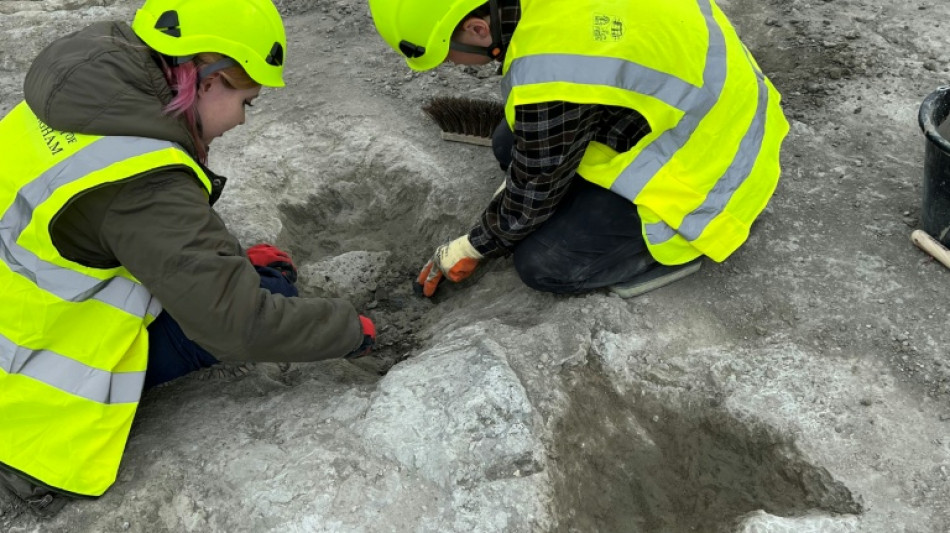
UK's biggest dinosaur footprint site uncovered / Photo: Emma NICHOLLS - Oxford University Museum of Natural History/AFP

 Modi pitches India as global chipmaking hub

 Ukraine plans record defence spending in 2027

 NASA scan discovers new, 'once in a century' Moon crater

 Most stocks rise as Fed hikes and indicates drive to curb inflation

 UK-Sudanese author pens book to give children 'African history of Africa'

 US Congress passes sweeping Russia sanctions bill

 US stocks fall, dollar gains after Fed lifts interest rates

 US Fed raises rates to tackle 'too high' inflation in move sure to rile Trump

 US Fed raises rates to battle inflation in move likely to rile Trump

 US House faces test on sweeping Russia sanctions bill

 British PM says to make 'difficult decisions' as inflation rises

 Global fuel price demos: a round-up

 Leverate Launches MCP for Traders to Connect AI Assistants With Trading Platforms

 MEXC Launches $1M "Discover Your Wall Street DNA" Campaign to Help Traders Find Their Market Fit

 Stocks edge higher ahead of US Fed rate call

 BASIS.pro Expands On-Chain Infrastructure with XDC Network Partnership and Zypher DAO as Auto Earn Goes Live

 Pickle-flavoured tart? AI inspires Japan's convenience stores

 EU chief hosts Canada's Carney in push to 'deepen' alliance

 Meta chief pushes back on AI slowdown calls

 US Fed to deliver rate decision with markets betting on hike

 i-payout Expands U.S. Money Transmitter Licensing Footprint and Advances European EMI Strategy

 US Senate crypto bill collapses amid partisan deadlock

 OpenAI, Anthropic and Google are working to create an AI standards body

 Protesting shepherds, farmers clash with Romanian police

 Foundation Lets Ledger Users Switch to Open Source Without Starting Over

British researchers have unearthed some 200 dinosaur footprints dating back 166 million years in a find believed to be biggest in the UK.
Teams from Oxford and Birmingham Universities made the "exhilarating" discovery at a quarry in Oxfordshire in central England after a worker came across "unusual bumps" as he was stripping clay back with a mechanical digger, according to a new BBC documentary.
The site features five extensive trackways, with the longest continuous track stretching more than 150 metres (490 feet) in length.
Four of the five trackways uncovered are believed to have been made by a long-necked herbivorous dinosaur, most likely a cetiosaurus.
The fifth set of tracks likely belongs to a nine-metre long carnivorous megalosaurus known for its distinctive three-toed feet with claws, according to the University of Birmingham.
"It's rare to find them so numerous in one place and it's rare to find such extensive trackways as well," Emma Nicholls of Oxford University's Museum of Natural History told AFP.
The area could turn out to be one of the world's biggest dinosaur track sites, she added.
The discovery will feature in the BBC television documentary "Digging for Britain", due to be broadcast on January 8.
- 'So surreal' -
A 100-strong team led by academics from Oxford and Birmingham excavated the tracks during a week-long dig in June.
The new footprints follow a smaller discovery in the area in 1997, when 40 sets were uncovered during limestone quarrying, with some trackways reaching up to 180 metres in length.
The researchers took 20,000 photographs of the latest footprints and created detailed 3D models of the site using aerial drone photography.
It is hoped the discovery will provide clues about how dinosaurs interacted, as well as their size and the speeds at which they moved.
"Knowing that this one individual dinosaur walked across this surface and left exactly that print is so exhilarating," the Oxford museum's Duncan Murdock told the BBC.
"You can sort of imagine it making its way through, pulling its legs out of the mud as it was going," he added.
Richard Butler, a palaeobiologist from the University of Birmingham, said some chance weather may be the reason the tracks had been so well preserved.
"We don't know exactly... but it might be that there was a storm event that came in, deposited a load of sediments on top of the footprints, and meant that they were preserved rather than just being washed away," he said.
Quarry worker Gary Johnson, whose watchfulness triggered the excavation, said the experience had been spellbinding.
"I thought I'm the first person to see them. And it was so surreal -- a bit of a tingling moment, really," he said.
H.Meyer--CPN