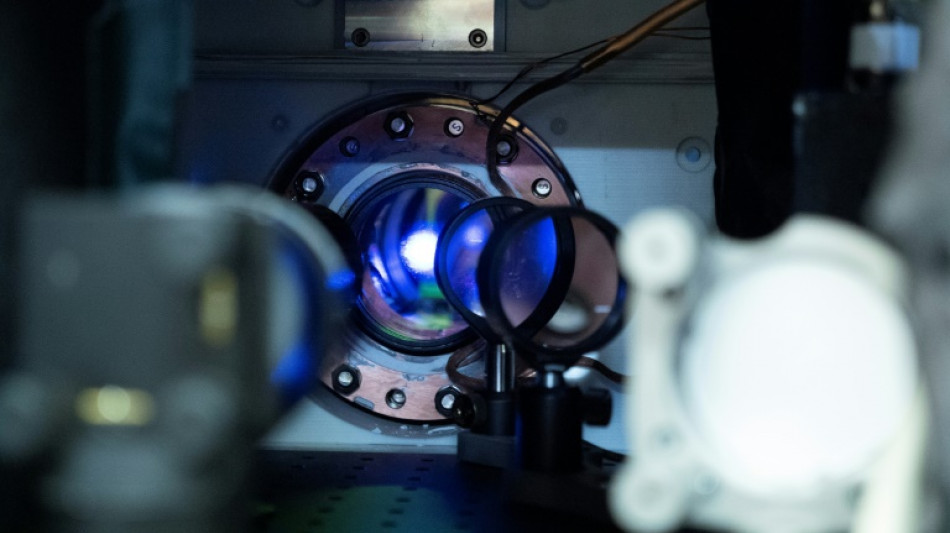
Secret lab developing UK's first quantum clock: defence ministry / Photo: Handout - NIST/AFP

 Modi pitches India as global chipmaking hub

 Ukraine plans record defence spending in 2027

 NASA scan discovers new, 'once in a century' Moon crater

 Most stocks rise as Fed hikes and indicates drive to curb inflation

 UK-Sudanese author pens book to give children 'African history of Africa'

 US Congress passes sweeping Russia sanctions bill

 US stocks fall, dollar gains after Fed lifts interest rates

 US Fed raises rates to tackle 'too high' inflation in move sure to rile Trump

 US Fed raises rates to battle inflation in move likely to rile Trump

 US House faces test on sweeping Russia sanctions bill

 British PM says to make 'difficult decisions' as inflation rises

 Global fuel price demos: a round-up

 Leverate Launches MCP for Traders to Connect AI Assistants With Trading Platforms

 MEXC Launches $1M "Discover Your Wall Street DNA" Campaign to Help Traders Find Their Market Fit

 Stocks edge higher ahead of US Fed rate call

 BASIS.pro Expands On-Chain Infrastructure with XDC Network Partnership and Zypher DAO as Auto Earn Goes Live

 Pickle-flavoured tart? AI inspires Japan's convenience stores

 EU chief hosts Canada's Carney in push to 'deepen' alliance

 Meta chief pushes back on AI slowdown calls

 US Fed to deliver rate decision with markets betting on hike

 i-payout Expands U.S. Money Transmitter Licensing Footprint and Advances European EMI Strategy

 US Senate crypto bill collapses amid partisan deadlock

 OpenAI, Anthropic and Google are working to create an AI standards body

 Protesting shepherds, farmers clash with Romanian police

 Foundation Lets Ledger Users Switch to Open Source Without Starting Over

A top-secret lab in the UK is developing the country's first quantum clock to help the British military boost intelligence and reconnaissance operations, the defence ministry said Thursday.
The clock is so precise that it will lose less than one second over billions of years, "allowing scientists to measure time at an unprecedented scale," the ministry said in a statement.
"The trialling of this emerging, groundbreaking technology could not only strengthen our operational capability, but also drive progress in industry, bolster our science sector and support high-skilled jobs," Minister for Defence Procurement Maria Eagle said.
The groundbreaking technology by the Defence Science and Technology Laboratory will reduce reliance on GPS technology, which "can be disrupted and blocked by adversaries," the ministry added.
It is not a world first, as the University of Colorado at Boulder developed a quantum clock 15 years ago with the US National Institute of Standards and Technology.
But it is "the first device of its kind to be built in the UK," the statement said, adding it could be deployed by the military "in the next five years".
A quantum clock uses quantum mechanics -- the physics of matter and energy at the atomic and subatomic scale -- to keep time with unprecedented accuracy by measuring energy fluctuations within atoms.
Accurate timekeeping is crucial for satellite navigation systems, mobile telephones and digital TV, among other applications, and may open new frontiers in research fields such as quantum science.
Companies and governments around the world are keen to cash in on the huge potential benefits quantum technology could bring.
Google last month unveiled a new quantum computing chip it said could do in minutes what it would take leading supercomputers 10 septillion years to complete.
The United States and China are investing heavily in quantum research, and the US administration has imposed tight restrictions on exporting such sensitive technology.
One expert, Olivier Ezratty, told AFP in October that private and public investment in such technology had reached $20 billion during the past five years.
The defence ministry said future research would "see the technology decrease in size to allow mass manufacturing and miniaturisation, unlocking a wide range of applications, such as use by military vehicles and aircraft".
H.Cho--CPN