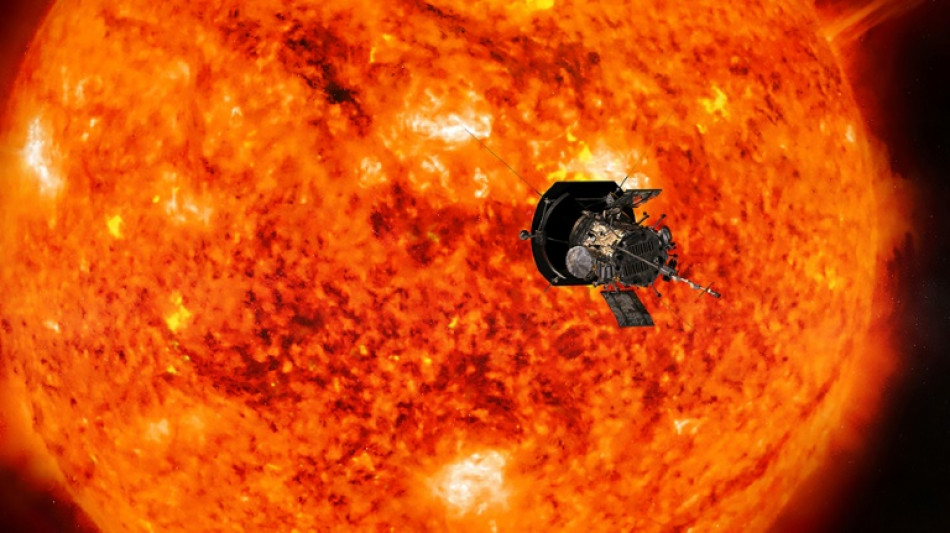
NASA probe makes closest ever pass by the Sun / Photo: HO - NASA/Johns Hopkins APL/AFP/File

 Isolated Syrian-Druze city blames Damascus for shortages

 Kerry James Marshall: American 'blackness' painter celebrated in Europe

 Infantino 'must go', says German FA vice-president

 Japan's busiest rail station tests robot bins

 Backpackers fret over Australian visa crackdown

 Bank of Japan hikes rates to 31-year high to battle inflation

 AI doomsday warnings unlikely to slow IPOs but questions linger

 In Brazil's Amazon, the hunt for oil fuels hopes and fears

 Baby orangutans in India expose 'frightening' scale of trafficking

 Oversight Board blasts 'inadequate' Meta safeguards for AI deepfakes

 Harry makes first public appearance since return to UK

 Princess Diana's brother makes new explosive claims against Charles

 Trump admin overhauls key protection for endangered species

 Mbappe draws political fire over Ceuta t-shirt controversy

 Third malaria death in Germany from outbreak tied to Frankfurt airport

 AtlasClear Holdings Reports Preliminary Fiscal 2026 Revenue of Approximately $20.1 Million, Up 85%; Revenue Plus Interest Income of Approximately $21.9 Million

 'Another arrow to the quiver': World Bank posts record private capital mobilization

 Ireland to boycott Eurovision 2027 over Gaza

 India's Tata Sons reappoints N. Chandrasekaran as chairman

 Germany urges EU action against China to defend carmakers

 Japan eyes changing prostitution law to punish sex buyers

 Modi pitches India as global chipmaking hub

 Ukraine plans record defence spending in 2027

 NASA scan discovers new, 'once in a century' Moon crater

 Most stocks rise as Fed hikes and indicates drive to curb inflation

NASA's pioneering Parker Solar Probe made history Tuesday, flying closer to the Sun than any other spacecraft with its heat shield exposed to scorching temperatures of more than 1,700 degrees Fahrenheit (930 degrees Celsius).
Launched in August 2018, the spaceship is on a seven-year mission to deepen scientific understanding of our star and help forecast space-weather events that can affect life on Earth.
Tuesday’s historic fly-by should have occurred at precisely 6:53am (1153 GMT), although mission scientists will have to wait until Friday for confirmation as they lose contact with the craft for several days due to its proximity to the Sun.
If the distance between Earth and the Sun is the equivalent to the length of an American football field, the spacecraft should have been about four yards (meters) from the end zone at the moment of closest approach – known as perihelion.
"This is one example of NASA's bold missions, doing something that no one else has ever done before to answer longstanding questions about our universe," Arik Posner, Parker Solar Probe program scientist said in a statement on Monday.
"We can't wait to receive that first status update from the spacecraft and start receiving the science data in the coming weeks."
So effective is the heat shield, that the probe’s internal instruments remain near room temperature -- around 85F (29C) -- as it explores the Sun's outer atmosphere, called the corona.
Parker will also be moving at a blistering pace of around 430,000 mph (690,000 kph), fast enough to fly from the US capital Washington to Tokyo in under a minute.
"No human-made object has ever passed this close to a star, so Parker will truly be returning data from uncharted territory," said Nick Pinkine, mission operations manager at the Johns Hopkins Applied Physics Laboratory (APL) in Laurel, Maryland.
"We're excited to hear back from the spacecraft when it swings back around the Sun."
By venturing into these extreme conditions, Parker has been helping scientists tackle some of the Sun's biggest mysteries: how the solar wind originates, why the corona is hotter than the surface below, and how coronal mass ejections -- massive clouds of plasma that hurl through space -- are formed.
The Christmas Eve flyby is the first of three record-setting close passes, with the next two -- on March 22, 2025, and June 19, 2025 -- both expected to bring the probe back to a similarly close distance from the Sun.
H.Cho--CPN