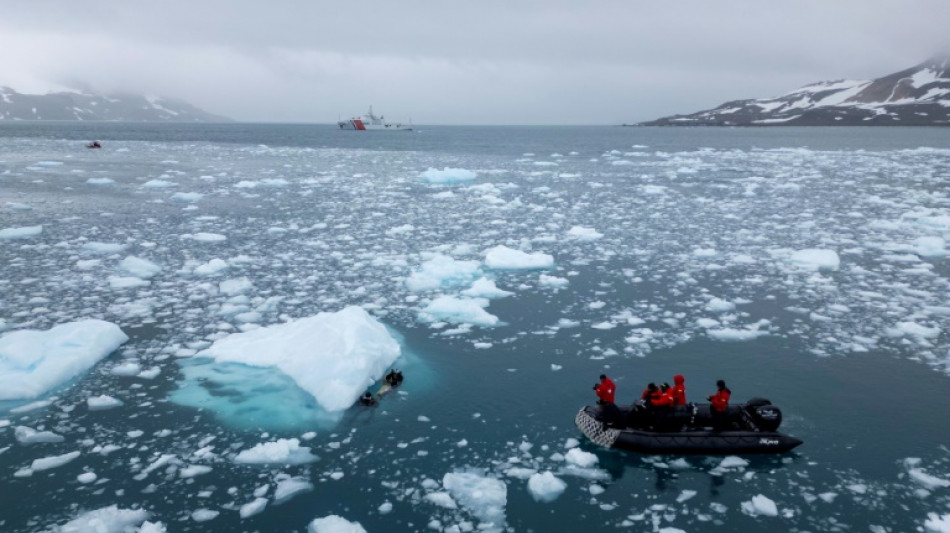
Melting sea ice in Antarctica causes ocean storms, scientists say / Photo: Juan BARRETO - AFP

 Germany urges EU action against China to defend carmakers

 Japan eyes changing prostitution law to punish sex buyers

 Modi pitches India as global chipmaking hub

 Ukraine plans record defence spending in 2027

 NASA scan discovers new, 'once in a century' Moon crater

 Most stocks rise as Fed hikes and indicates drive to curb inflation

 UK-Sudanese author pens book to give children 'African history of Africa'

 US Congress passes sweeping Russia sanctions bill

 US stocks fall, dollar gains after Fed lifts interest rates

 US Fed raises rates to tackle 'too high' inflation in move sure to rile Trump

 US Fed raises rates to battle inflation in move likely to rile Trump

 US House faces test on sweeping Russia sanctions bill

 British PM says to make 'difficult decisions' as inflation rises

 Global fuel price demos: a round-up

 Leverate Launches MCP for Traders to Connect AI Assistants With Trading Platforms

 MEXC Launches $1M "Discover Your Wall Street DNA" Campaign to Help Traders Find Their Market Fit

 Stocks edge higher ahead of US Fed rate call

 BASIS.pro Expands On-Chain Infrastructure with XDC Network Partnership and Zypher DAO as Auto Earn Goes Live

 Pickle-flavoured tart? AI inspires Japan's convenience stores

 EU chief hosts Canada's Carney in push to 'deepen' alliance

 Meta chief pushes back on AI slowdown calls

 US Fed to deliver rate decision with markets betting on hike

 i-payout Expands U.S. Money Transmitter Licensing Footprint and Advances European EMI Strategy

 US Senate crypto bill collapses amid partisan deadlock

 OpenAI, Anthropic and Google are working to create an AI standards body

The record-breaking retreat of Antarctic sea ice in 2023 has led to more frequent storms over newly exposed parts of the Southern Ocean, according to a study published Wednesday.
Scientists know that the loss of Antarctic sea ice can diminish penguin numbers, cause ice shelves to melt in warmer waters, and impede the Southern Ocean from absorbing carbon dioxide.
But this new research, published in the peer-reviewed journal Nature, explores another consequence: increased heat loss from the ocean to the atmosphere, and an associated rise in storms.
Since 2016 there has been a large-scale reduction in Antarctic sea ice, but nothing like 2023 when a record amount failed to reform over the winter.
For this study, Simon Josey of the UK's National Oceanography Centre and colleagues focussed on three regions that experienced unusually high levels of sea-ice retreat that year.
Using satellite imagery, ocean and atmospheric data, and wind and temperature measurements, they found some newly ice-free areas experienced double the heat loss compared to a stabler period before 2015.
This was accompanied by "increases in atmospheric-storm frequency" over previously ice-covered regions, the authors found.
"In the sea-ice-decline regions, the June–July storm frequency has increased by up to 7 days per month in 2023 relative to 1990–2015."
The loss of heat caused by reduced sea ice could have implications for how the ocean circulates and the wider climate system, the study added.
Oceans are a crucial climate regulator and carbon sink, storing more than 90 percent of the excess heat trapped near Earth's surface by greenhouse gas emissions.
In particular, sea-ice retreat could mean changes in how a deeper layer of cold, dense Antarctic bottom water absorbs and stores heat.
The authors said further in-depth analysis of possible climate impacts were needed, including if sea-ice retreat could have even further-reaching consequences.
"Repeated low ice-cover conditions in subsequent winters will strengthen these impacts and are also likely to lead to profound changes further afield, including the tropics and the Northern Hemisphere," it said.
Y.Tengku--CPN