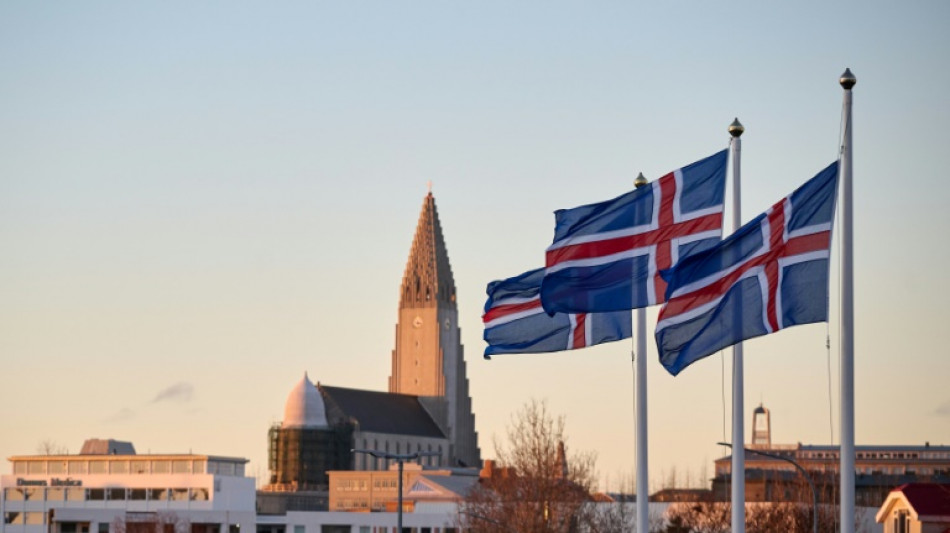
Iceland wants immigrants to learn the language / Photo: Halldor KOLBEINS - AFP

 Isolated Syrian-Druze city blames Damascus for shortages

 Kerry James Marshall: American 'blackness' painter celebrated in Europe

 Infantino 'must go', says German FA vice-president

 Japan's busiest rail station tests robot bins

 Backpackers fret over Australian visa crackdown

 Bank of Japan hikes rates to 31-year high to battle inflation

 AI doomsday warnings unlikely to slow IPOs but questions linger

 In Brazil's Amazon, the hunt for oil fuels hopes and fears

 Baby orangutans in India expose 'frightening' scale of trafficking

 Oversight Board blasts 'inadequate' Meta safeguards for AI deepfakes

 Harry makes first public appearance since return to UK

 Princess Diana's brother makes new explosive claims against Charles

 Trump admin overhauls key protection for endangered species

 Mbappe draws political fire over Ceuta t-shirt controversy

 Third malaria death in Germany from outbreak tied to Frankfurt airport

 AtlasClear Holdings Reports Preliminary Fiscal 2026 Revenue of Approximately $20.1 Million, Up 85%; Revenue Plus Interest Income of Approximately $21.9 Million

 'Another arrow to the quiver': World Bank posts record private capital mobilization

 Ireland to boycott Eurovision 2027 over Gaza

 India's Tata Sons reappoints N. Chandrasekaran as chairman

 Germany urges EU action against China to defend carmakers

 Japan eyes changing prostitution law to punish sex buyers

 Modi pitches India as global chipmaking hub

 Ukraine plans record defence spending in 2027

 NASA scan discovers new, 'once in a century' Moon crater

 Most stocks rise as Fed hikes and indicates drive to curb inflation

In Iceland's parliament, six cleaners take a break from their duties to spend time learning Icelandic, seen as one of the principal barriers to integration in the country.
Of the roughly 400,000 residents of Iceland, about one in five have an immigrant background and few of them speak Icelandic, which experts say could affect social cohesion.
Six years ago, Kanyamon Juisikaew, 46, moved to Reykjavik from Thailand and married an Icelander, and now works as a cleaner in parliament.
"I would like to communicate with Icelandic people when they speak, and in my family because we are an Icelandic family," Juisikaew told AFP in English.
She also said she was disappointed not to be able to follow along during meetings at work.
She has just started taking classes during her regular working hours -- an opportunity provided by a handful of companies and institutions in the Subarctic nation.
Alongside her, colleague Carolina Rivas hopes the classes will help her develop her career.
"It's really good to get to use working time to learn because this language really require a lot of time to learn," Rivas said, adding that it was difficult to find the time to learn when off the clock.
- Overqualified -
Among OECD countries, Iceland has seen the sharpest rise in the share of immigrants in its population, going from three percent in the early 2000s to 20 percent last year.
The Nordic country opened up for migrants in the 2000s to cope with a boom in tourism and a labour shortage for low-paid service jobs.
But a recent report from the OECD, which advises industrialised nations on policy matters, said immigration increases have not been accompanied by sufficiently inclusive public policies.
"Where does Iceland want to be in the future? One cannot afford having 20 percent of the population not speaking the language. So this is really becoming an issue of social cohesion for Iceland," Thomas Liebig, a senior administrator at the OECD's International Migration Division, told AFP.
Coming mainly from the European Economic Area (EEA), immigrants to Iceland do relatively well and enjoy the highest employment rate in the OECD.
But the labour market suffers from over-qualification as language presents a hurdle to job opportunities matching their skills.
At the Mimir training institute in Reykjavik, students flock to take the Icelandic language exam in order to obtain Icelandic citizenship, and language classes are overflowing.
"We see an annual increase every year around 20 percent," Joanna Dominiczak, director of the Icelandic language programmes at Mimir, told AFP.
Dominiczak added that they also had to stop offering classes in September as their funding for the year had run out.
The OECD has also criticised Iceland for providing minimal public funding for language training, and reserving fully subsidised courses for refugees and the unemployed.
- 'Inferiority complex' -
Kronan, one of Iceland's largest supermarket chains, has a workforce where 25 percent are immigrants.
This presents a challenge for HR director Asta Baerings, who recognises that it is difficult to teach Icelandic to new arrivals who are not sure of staying in the country.
Baerings says the core issue is "communication."
"We are trying to make more languages available for employees," Baerings told AFP.
The company has set up a communication portal for employees in Icelandic, English and Polish -- which make up 10 percent of staff.
"But next year we are going to be offering over 30 languages," Baerings said, explaining this is meant to help the 47 nationalities working in their shops.
Anthony John Saunders started working for Kronan when he moved to Iceland from England after Brexit and has become an assistant manager of one of the stores.
"I think being a fluent English speaker, Iceland was quite easy to integrate in because everybody speaks very good English," Saunders said.
He speaks very little Icelandic but hopes to make progress with a customisable app offered by Kronan, which he has just installed.
But Icelanders' grasp of English can be a double-edged sword as immigrants have fewer opportunities to practise what they have learned.
"It also relates to the way we Icelanders perceive our own language," Yrsa Tholl Gylfadottir, a writer and Icelandic teacher, told AFP.
"Some of us have like an inferiority complex, and a disbelief that anyone would want to learn our language or would be able to," she said.
"So Icelanders often resort to English when they speak to people with an accent."
A.Zimmermann--CPN