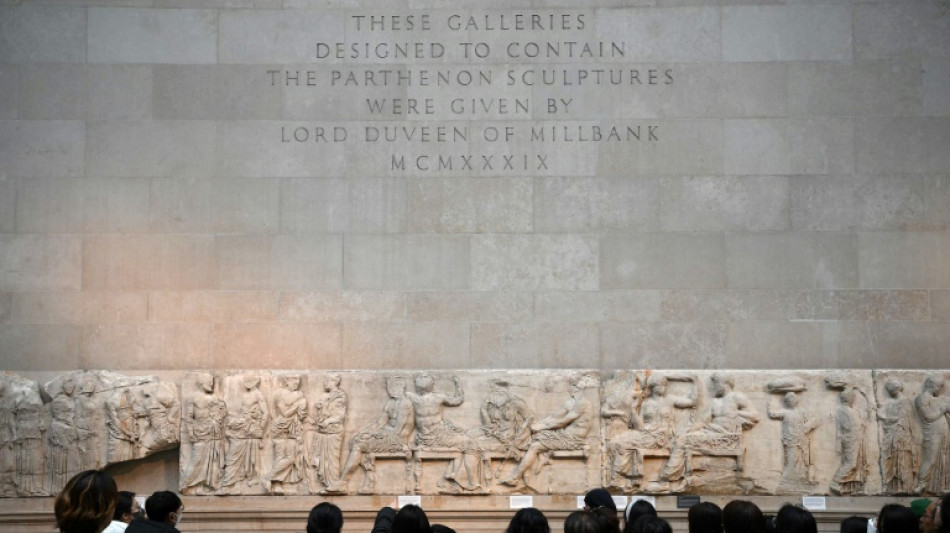
Greeks still sceptical Britain will return Parthenon Marbles / Photo: Daniel LEAL - AFP/File

 Isolated Syrian-Druze city blames Damascus for shortages

 Kerry James Marshall: American 'blackness' painter celebrated in Europe

 Infantino 'must go', says German FA vice-president

 Japan's busiest rail station tests robot bins

 Backpackers fret over Australian visa crackdown

 Bank of Japan hikes rates to 31-year high to battle inflation

 AI doomsday warnings unlikely to slow IPOs but questions linger

 In Brazil's Amazon, the hunt for oil fuels hopes and fears

 Baby orangutans in India expose 'frightening' scale of trafficking

 Oversight Board blasts 'inadequate' Meta safeguards for AI deepfakes

 Harry makes first public appearance since return to UK

 Princess Diana's brother makes new explosive claims against Charles

 Trump admin overhauls key protection for endangered species

 Mbappe draws political fire over Ceuta t-shirt controversy

 Third malaria death in Germany from outbreak tied to Frankfurt airport

 AtlasClear Holdings Reports Preliminary Fiscal 2026 Revenue of Approximately $20.1 Million, Up 85%; Revenue Plus Interest Income of Approximately $21.9 Million

 'Another arrow to the quiver': World Bank posts record private capital mobilization

 Ireland to boycott Eurovision 2027 over Gaza

 India's Tata Sons reappoints N. Chandrasekaran as chairman

 Germany urges EU action against China to defend carmakers

 Japan eyes changing prostitution law to punish sex buyers

 Modi pitches India as global chipmaking hub

 Ukraine plans record defence spending in 2027

 NASA scan discovers new, 'once in a century' Moon crater

 Most stocks rise as Fed hikes and indicates drive to curb inflation

"Positive" talks between Greece and the British Museum over the Parthenon Marbles have rekindled hope that the ancient friezes could be on their way back to Athens after more than two centuries.
UK Prime Minister Keir Starmer hosted his Greek counterpart Kyriakos Mitsotakis in Downing Street on Tuesday just as the British Museum confirmed it had been holding "constructive" negotiations with Athens.
The next day museum chairman George Osborne said the London institution was exploring an "arrangement where at some point some of the sculptures" could be sent to Athens in return for Greece lending the museum "some of its treasures".
But Greek Culture Minister Lina Mendoni cautioned Thursday that an agreement still "requires time and work".
She told Skai radio that the two sides had "broken the ice" and that negotiations were going on in a "positive climate".
"It is positive that the (Labour) government does not have the negativity of prior governments," Mendoni said.
She insisted that the "natural place" to display the marbles was the Acropolis Museum, built for the purpose below the ancient temple in 2009.
- 'They are Greek property' -
Outside the Acropolis Museum, 15-year-old high school pupil Thodoris said he was sceptical that an agreement will be reached.
"I'm not sure it will happen for real." And he was absolutely against having to offer Britain something in return. "We shouldn't have to give anything back -- they are Greek property," he said.
"(Mitsotakis) is not going to manage, I believe they will not return," said a man running a kiosk nearby, who declined to give his name.
"With the bunch we have (running Greece), let's just hope we don't lose the marbles we already have," he jibed.
Known in Britain as the Elgin Marbles, the 2,500-year-old sculptures adorned the Parthenon temple built at the pinnacle of ancient Athens's power in honour of the city's patron goddess, Athena.
It was partially destroyed during a Venetian bombardment in 1687, and in the early 1800s workmen took friezes from the monument on the orders of the British ambassador to the Ottoman Empire, Scottish nobleman Thomas Bruce, known as Lord Elgin.
Elgin sold the marbles to the British government, which in 1817 passed them on to the British Museum where they remain one of its most prized treasures.
But support in Britain for a return of the marbles has been growing.
A YouGov poll on Monday found that 53 percent of respondents said the British Museum should return the sculptures, with 24 percent opposed.
- 'They stole them' -
"They should (give them back) but I don't think they will... they will fight to keep them," said Sandra Hernandez, who was visiting the Acropolis Museum from Spain.
The marbles "belong to Greece... they stole them, they have the responsibility to give them back," said 24-year-old Korean visitor Yungu Lee, who is studying in Britain.
Nearly two million people visited the Acropolis Museum last year, up a third on 2022.
Fragments of the Parthenon are also in the Louvre in Paris and in museums in Copenhagen, Munich, Vienna and Wurzburg.
But with moral pressure building, private citizens and institutions have in recent years been giving fragments back.
In March 2023, the Vatican Museums returned three pieces of the Parthenon's frieze, metopes decorative band and pediments.
The heads of a youth, a bearded man and a horse were reunited with the sculptures on display at the Acropolis Museum.
A year earlier, the Antonino Salinas Museum in Palermo sent Greece another Parthenon marble fragment.
Athens subsequently reached a legal agreement with the Sicilian regional government to make the return permanent.
A.Leibowitz--CPN