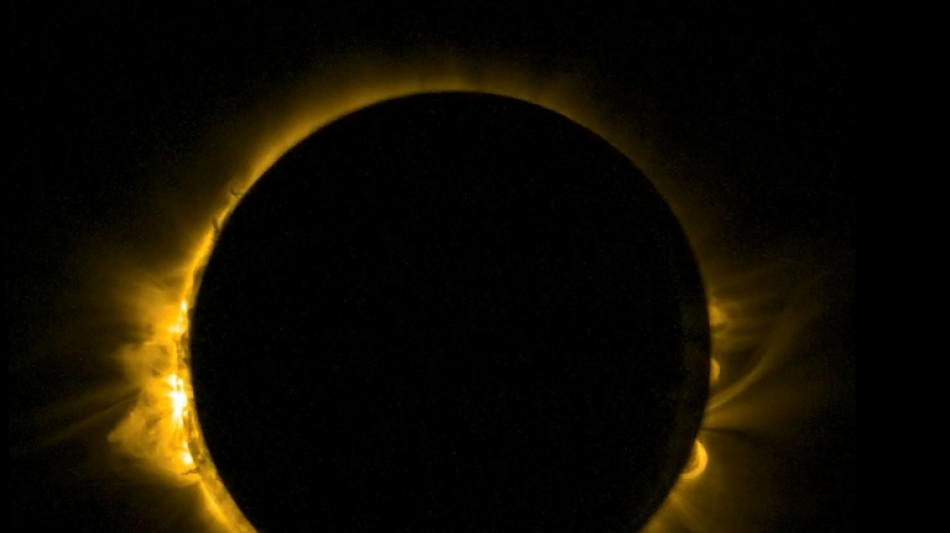
India launches European 'artifical eclipse' satellites / Photo: Proba-2 minisatellite - ESA/AFP/File

 Isolated Syrian-Druze city blames Damascus for shortages

 Kerry James Marshall: American 'blackness' painter celebrated in Europe

 Infantino 'must go', says German FA vice-president

 Japan's busiest rail station tests robot bins

 Backpackers fret over Australian visa crackdown

 Bank of Japan hikes rates to 31-year high to battle inflation

 AI doomsday warnings unlikely to slow IPOs but questions linger

 In Brazil's Amazon, the hunt for oil fuels hopes and fears

 Baby orangutans in India expose 'frightening' scale of trafficking

 Oversight Board blasts 'inadequate' Meta safeguards for AI deepfakes

 Harry makes first public appearance since return to UK

 Princess Diana's brother makes new explosive claims against Charles

 Trump admin overhauls key protection for endangered species

 Mbappe draws political fire over Ceuta t-shirt controversy

 Third malaria death in Germany from outbreak tied to Frankfurt airport

 AtlasClear Holdings Reports Preliminary Fiscal 2026 Revenue of Approximately $20.1 Million, Up 85%; Revenue Plus Interest Income of Approximately $21.9 Million

 'Another arrow to the quiver': World Bank posts record private capital mobilization

 Ireland to boycott Eurovision 2027 over Gaza

 India's Tata Sons reappoints N. Chandrasekaran as chairman

 Germany urges EU action against China to defend carmakers

 Japan eyes changing prostitution law to punish sex buyers

 Modi pitches India as global chipmaking hub

 Ukraine plans record defence spending in 2027

 NASA scan discovers new, 'once in a century' Moon crater

 Most stocks rise as Fed hikes and indicates drive to curb inflation

India on Thursday successfully launched into space a pair of European satellites that will create artificial solar eclipses to help scientists catch a rare glimpse of the Sun's mysterious atmosphere.
Scientists broke into rapturous applause at the Sriharikota launch site as the Indian Space Research Organisation (ISRO) chief announced the spacecraft had been ejected as planned.
"The spacecraft has been placed in the right orbit," ISRO chief S. Somanath said.
The launch, originally scheduled for Wednesday but delayed by a technical fault, was for the European Space Agency's "Project for On-Board Autonomy 3" (Proba-3) mission, part of a series of "in-orbit missions to test out new technologies".
The mission, at a cost of 200 million euros ($211 million), creates artificial total solar eclipses by positioning two satellites 150 metres (500 feet) apart from each other.
The shadow cast by one satellite allows the other to observe solar phenomena while blocking out the light from the Sun itself.
"For six hours at a time, it will be able to see the Sun's faint atmosphere, the corona, in the hard-to-observe region between the Sun's edge and 1.4 million kilometres from its surface," the European Space Agency said in a pre-launch analysis.
The project will help scientists answer key questions, including why the corona is so much hotter than the Sun itself, and how the Sun's energy output changes over time.
India has emerged as a reliable and low-cost option for putting commercial spacecraft and the satellites of other countries into space.
Experts say New Delhi can keep costs low by copying and adapting existing technology, and thanks to an abundance of highly skilled engineers who earn a fraction of their foreign counterparts' wages.
The world's most populous country has flexed its spacefaring ambitions in the last decade with its space programme growing considerably in size and momentum, matching the achievements of established powers at a much cheaper price tag.
In August 2023, it became just the fourth nation to land an unmanned craft on the Moon after Russia, the United States and China.
Prime Minister Narendra Modi also announced plans last year to send a man to the Moon by 2040.
A.Zimmermann--CPN