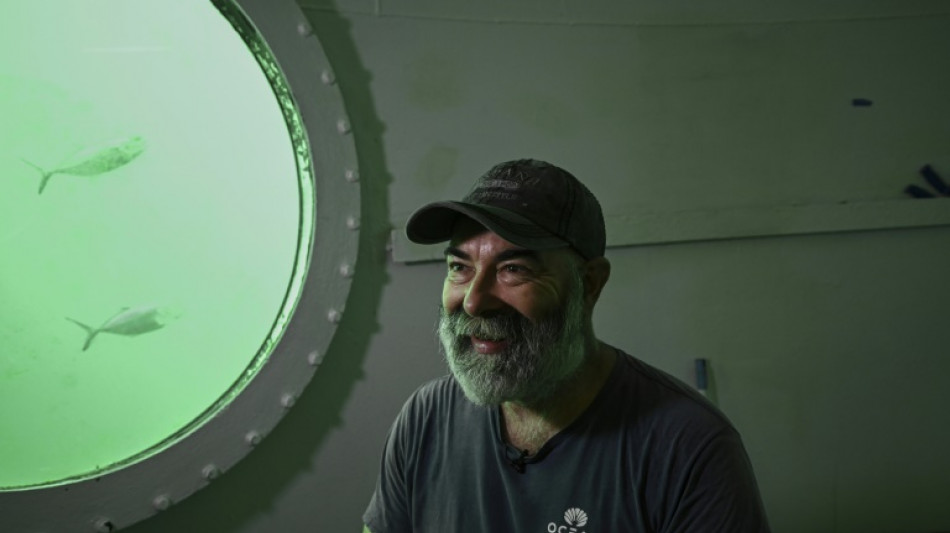
Seeking a new way of life under the sea - and a world record / Photo: MARTIN BERNETTI - AFP

 Isolated Syrian-Druze city blames Damascus for shortages

 Kerry James Marshall: American 'blackness' painter celebrated in Europe

 Infantino 'must go', says German FA vice-president

 Japan's busiest rail station tests robot bins

 Backpackers fret over Australian visa crackdown

 Bank of Japan hikes rates to 31-year high to battle inflation

 AI doomsday warnings unlikely to slow IPOs but questions linger

 In Brazil's Amazon, the hunt for oil fuels hopes and fears

 Baby orangutans in India expose 'frightening' scale of trafficking

 Oversight Board blasts 'inadequate' Meta safeguards for AI deepfakes

 Harry makes first public appearance since return to UK

 Princess Diana's brother makes new explosive claims against Charles

 Trump admin overhauls key protection for endangered species

 Mbappe draws political fire over Ceuta t-shirt controversy

 Third malaria death in Germany from outbreak tied to Frankfurt airport

 AtlasClear Holdings Reports Preliminary Fiscal 2026 Revenue of Approximately $20.1 Million, Up 85%; Revenue Plus Interest Income of Approximately $21.9 Million

 'Another arrow to the quiver': World Bank posts record private capital mobilization

 Ireland to boycott Eurovision 2027 over Gaza

 India's Tata Sons reappoints N. Chandrasekaran as chairman

 Germany urges EU action against China to defend carmakers

 Japan eyes changing prostitution law to punish sex buyers

 Modi pitches India as global chipmaking hub

 Ukraine plans record defence spending in 2027

 NASA scan discovers new, 'once in a century' Moon crater

 Most stocks rise as Fed hikes and indicates drive to curb inflation

There are probably easier ways to set a world record, but Rudiger Koch has found his method 11 meters (36 feet) under the sea.
He's been living in a submerged capsule off the coast of Panama for two months -- which means, he told a visiting AFP journalist, he has about two more to go.
"The last time I checked, I was still married," he joked, as fish swim through bright blue Caribbean waters outside the portholes.
But Koch, a 59-year-old aerospace engineer from Germany, has grander plans than simply notching a record. His stunt, he says, could change the way we think about human life -- and where we can settle, even permanently.
"Moving out to the ocean is something we should do as a species," he told AFP.
"What we are trying to do here is prove that the seas are actually a viable environment for human expansion."
Koch's 30-square-meter (320-square-foot) capsule has most of the trappings of modern life: a bed, toilet, TV, computer and internet -- even an exercise bike.
The only thing missing? A shower.
His home under the sea is attached through a vertical tube to another chamber perched above the waves, housing other members of his team -- and providing a way for food and curious journalists to be sent down.
The underwater chamber, meanwhile, provides a shelter for fish and acts as an artificial reef -- providing an environmental benefit.
"In the night, you can hear all the crustaceans," he said. "There's the fish out there, and there's all that stuff, and that wasn't here before we came."
- A window into the sea -
On a small bedside table lies Jules Verne's "Twenty Thousand Leagues Under the Sea," a 19th century sci-fi classic.
An admirer of the novel's Captain Nemo, Koch, who went down on September 26, is hoping to come up for air on January 24, surpassing by 20 days the record held by American Joseph Dituri, who spent 100 days submerged in a Florida lake.
Two clocks show how much time has passed -- and how much remains.
A narrow spiral staircase leads to the chamber above, the entire contraption located some 15 minutes by boat from the Puerto Lindo coast, off northern Panama.
Four cameras film his moves in the capsule -- capturing his daily life, monitoring his mental health and to provide proof that he's never come up to the surface.
Eial Berja, an Israeli, operates them from the section above, while minding the electricity and back-up generator.
It's not all easy going, he told AFP, noting that a heavy storm almost put an end to the project.
Outside of the media, Koch's only visitors have been his doctor, his children and his wife.
Supporting the project is Grant Romundt, from Canada. Both he and Koch have grander visions linked to the libertarian -- and at-times controversial -- "seasteading" movement that envisions ocean-based communities outside government control.
Though he still has a long way to go to resurface, Koch knows exactly what he'll do first once he's back on land: "a shower, a real shower."
Ch.Lefebvre--CPN