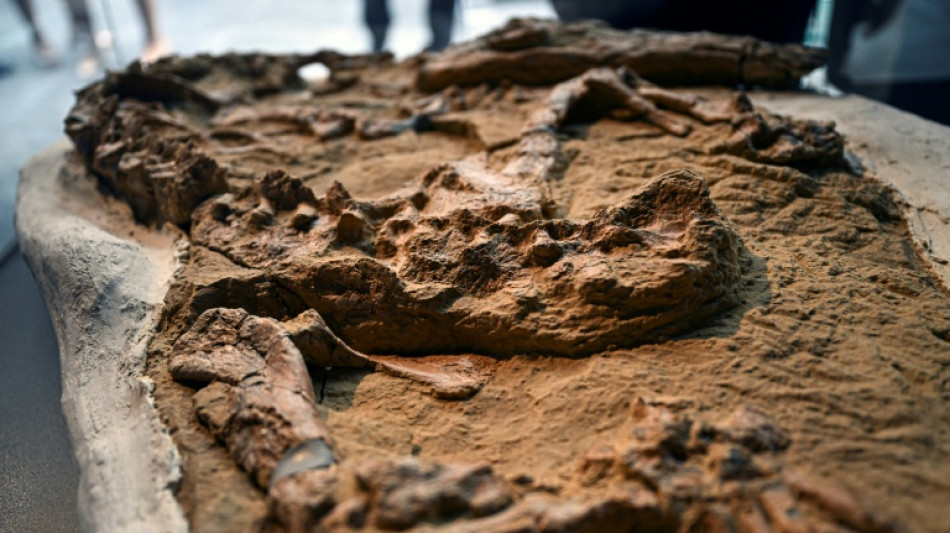
Peru scientists unveil crocodile fossil up to 12 million years old / Photo: Ernesto BENAVIDES - AFP

 Isolated Syrian-Druze city blames Damascus for shortages

 Kerry James Marshall: American 'blackness' painter celebrated in Europe

 Infantino 'must go', says German FA vice-president

 Japan's busiest rail station tests robot bins

 Backpackers fret over Australian visa crackdown

 Bank of Japan hikes rates to 31-year high to battle inflation

 AI doomsday warnings unlikely to slow IPOs but questions linger

 In Brazil's Amazon, the hunt for oil fuels hopes and fears

 Baby orangutans in India expose 'frightening' scale of trafficking

 Oversight Board blasts 'inadequate' Meta safeguards for AI deepfakes

 Harry makes first public appearance since return to UK

 Princess Diana's brother makes new explosive claims against Charles

 Trump admin overhauls key protection for endangered species

 Mbappe draws political fire over Ceuta t-shirt controversy

 Third malaria death in Germany from outbreak tied to Frankfurt airport

 AtlasClear Holdings Reports Preliminary Fiscal 2026 Revenue of Approximately $20.1 Million, Up 85%; Revenue Plus Interest Income of Approximately $21.9 Million

 'Another arrow to the quiver': World Bank posts record private capital mobilization

 Ireland to boycott Eurovision 2027 over Gaza

 India's Tata Sons reappoints N. Chandrasekaran as chairman

 Germany urges EU action against China to defend carmakers

 Japan eyes changing prostitution law to punish sex buyers

 Modi pitches India as global chipmaking hub

 Ukraine plans record defence spending in 2027

 NASA scan discovers new, 'once in a century' Moon crater

 Most stocks rise as Fed hikes and indicates drive to curb inflation

Paleontologists unveiled on Wednesday the fossil of a young marine crocodile dating back 10 to 12 million years that was discovered in a Peruvian desert.
The fossil of the gharial -- or fish-eating -- crocodile, around three meters long (nearly 10 feet), was discovered late 2023 in perfect condition in Peru's Ocucaje desert, around 350 kilometers (190 miles) south of the capital Lima.
"This is the first time we found a juvenile of this species, that is to say, it had not reached its maximum size yet. It died before that," vertebrate paleontologist Mario Gamarra told a news conference.
The skull and jaws of these specimens differed from that of today's crocodiles and alligators, according to Gamarra, who headed the reconstruction of the fossil.
"They had an elongated snout and their diet was entirely piscivorous, feeding on fish," said Gamarra.
"The closest current relative to this crocodile would be the Indian gharial," he added.
The discovery was made jointly by Peru's Geological, Mining and Metallurgical Institute and the La Union school.
Peru's Ocucaje desert is rich in fossils, such as four-legged dwarf whales, dolphins, sharks and other species from the Miocene period -- between 5 and 23 million years ago -- that were previously discovered there.
X.Cheung--CPN