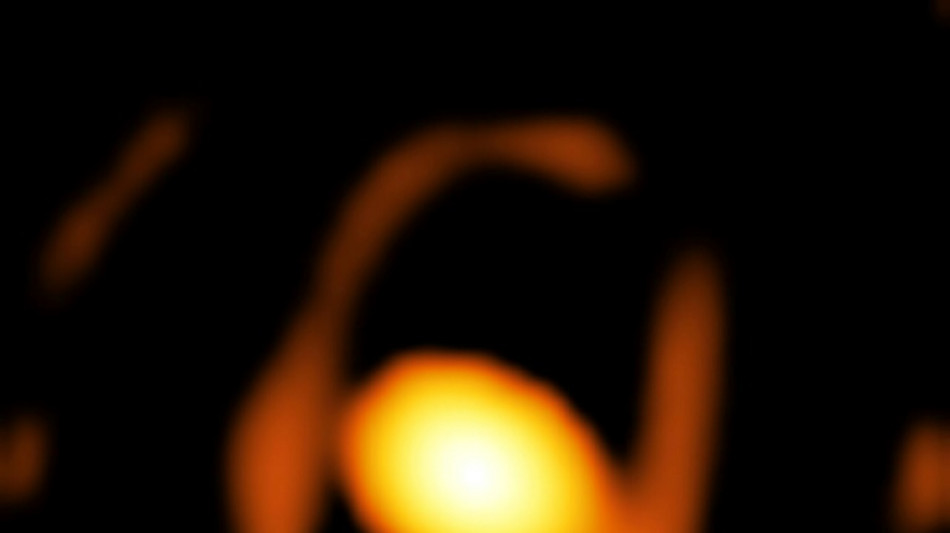
The first 'zoomed-in' image of a star outside our galaxy / Photo: - - European Southern Observatory/AFP

 Isolated Syrian-Druze city blames Damascus for shortages

 Kerry James Marshall: American 'blackness' painter celebrated in Europe

 Infantino 'must go', says German FA vice-president

 Japan's busiest rail station tests robot bins

 Backpackers fret over Australian visa crackdown

 Bank of Japan hikes rates to 31-year high to battle inflation

 AI doomsday warnings unlikely to slow IPOs but questions linger

 In Brazil's Amazon, the hunt for oil fuels hopes and fears

 Baby orangutans in India expose 'frightening' scale of trafficking

 Oversight Board blasts 'inadequate' Meta safeguards for AI deepfakes

 Harry makes first public appearance since return to UK

 Princess Diana's brother makes new explosive claims against Charles

 Trump admin overhauls key protection for endangered species

 Mbappe draws political fire over Ceuta t-shirt controversy

 Third malaria death in Germany from outbreak tied to Frankfurt airport

 AtlasClear Holdings Reports Preliminary Fiscal 2026 Revenue of Approximately $20.1 Million, Up 85%; Revenue Plus Interest Income of Approximately $21.9 Million

 'Another arrow to the quiver': World Bank posts record private capital mobilization

 Ireland to boycott Eurovision 2027 over Gaza

 India's Tata Sons reappoints N. Chandrasekaran as chairman

 Germany urges EU action against China to defend carmakers

 Japan eyes changing prostitution law to punish sex buyers

 Modi pitches India as global chipmaking hub

 Ukraine plans record defence spending in 2027

 NASA scan discovers new, 'once in a century' Moon crater

 Most stocks rise as Fed hikes and indicates drive to curb inflation

Scientists said Thursday they have taken the first ever close-up image of a star outside of the Milky Way, capturing a blurry shot of a dying behemoth 2,000 times bigger than the Sun.
Roughly 160,000 light years from Earth, the star WOH G64 sits in the Large Magellanic Cloud, a satellite galaxy of our home Milky Way.
It is a red supergiant, which is the largest type of star in the universe because they expand into space as they near their explosive deaths.
The image was captured by a team of researchers using a new instrument of the European Southern Observatory's Very Large Telescope in Chile.
Keiichi Ohnaka, an astrophysicist at Chile's Andres Bello National University, said that "for the first time, we have succeeded in taking a zoomed-in image of a dying star".
The image shows the bright if blurry yellow star enclosed inside an oval outline.
"We discovered an egg-shaped cocoon closely surrounding the star," Ohnaka said in a statement.
"We are excited because this may be related to the drastic ejection of material from the dying star before a supernova explosion," added the lead author of a study published in the journal Astronomy & Astrophysics.
- 'Witness a star's life in real time' -
Ohnaka's team has been watching the star for some time.
In 2005 and 2007 they used the Very Large Telescope's interferometer, which combined the light from two telescopes, to learn more about the star.
But capturing an image remained out of reach until a new instrument called GRAVITY -- which combines the light of four telescopes -- recently came online.
When they compared all their observations, the astronomers were surprised to find that the star had dimmed over the last decade.
"The star has been experiencing a significant change in the last 10 years, providing us with a rare opportunity to witness a star's life in real time," said study co-author Gerd Weigelt of Germany's Max Planck Institute for Radio Astronomy.
Red supergiants -- such as Betelgeuse in the Orion constellation -- are "one of the most extreme of its kind, and any drastic change may bring it closer to an explosive end," added study co-author Jacco van Loon of Keele University in the UK.
In their final stages of life, before they go supernova, red supergiants shed their outer layers of gas and dust in a process that can last thousands of years.
It could be this expelled material that is making the star appear dimmer, the scientists said.
This could also explain the strange shape of the dust cocoon that surrounds the star.
Another explanation for the egg-shaped cocoon could be that there is another star hidden somewhere inside that has not yet been discovered.
A.Agostinelli--CPN