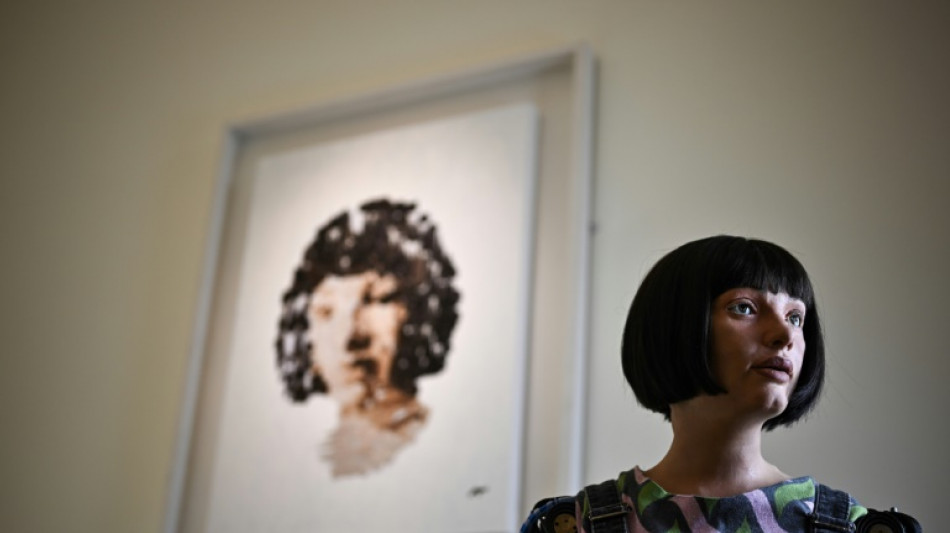
First artwork by humanoid robot sells for over $1.0 million / Photo: Ben Stansall - AFP/File

 Warren Buffett steps down as Berkshire Hathaway chairman

 Isolated Syrian-Druze city blames Damascus for shortages

 Kerry James Marshall: American 'blackness' painter celebrated in Europe

 Infantino 'must go', says German FA vice-president

 Japan's busiest rail station tests robot bins

 Backpackers fret over Australian visa crackdown

 Bank of Japan hikes rates to 31-year high to battle inflation

 AI doomsday warnings unlikely to slow IPOs but questions linger

 In Brazil's Amazon, the hunt for oil fuels hopes and fears

 Baby orangutans in India expose 'frightening' scale of trafficking

 Oversight Board blasts 'inadequate' Meta safeguards for AI deepfakes

 Harry makes first public appearance since return to UK

 Princess Diana's brother makes new explosive claims against Charles

 Trump admin overhauls key protection for endangered species

 Mbappe draws political fire over Ceuta t-shirt controversy

 Third malaria death in Germany from outbreak tied to Frankfurt airport

 AtlasClear Holdings Reports Preliminary Fiscal 2026 Revenue of Approximately $20.1 Million, Up 85%; Revenue Plus Interest Income of Approximately $21.9 Million

 'Another arrow to the quiver': World Bank posts record private capital mobilization

 Ireland to boycott Eurovision 2027 over Gaza

 India's Tata Sons reappoints N. Chandrasekaran as chairman

 Germany urges EU action against China to defend carmakers

 Japan eyes changing prostitution law to punish sex buyers

 Modi pitches India as global chipmaking hub

 Ukraine plans record defence spending in 2027

 NASA scan discovers new, 'once in a century' Moon crater

A portrait of English mathematician Alan Turing became the first artwork by a humanoid robot to be sold at auction, fetching more than $1.0 million on Thursday.
The 2.2-metre (7.5-foot) portrait "A.I. God" by "Ai-Da", the world's first ultra-realistic robot artist, went for $1,084,800, smashing pre-sale expectations of $180,000 at auction house Sotheby's Digital Art Sale.
"Today's record-breaking sale price for the first artwork by a humanoid robot artist to go up for auction marks a moment in the history of modern and contemporary art and reflects the growing intersection between A.I. technology and the global art market," said the auction house.
Ai-Da Robot, which uses AI to speak, said: "The key value of my work is its capacity to serve as a catalyst for dialogue about emerging technologies."
Ai-Da added that a "portrait of pioneer Alan Turing invites viewers to reflect on the god-like nature of AI and computing while considering the ethical and societal implications of these advancements."
The ultra-realistic robot, one of the most advanced in the world, is designed to resemble a human woman with a face, large eyes and a brown wig.
Ai-Da is named after Ada Lovelace, the world's first computer programmer and was devised by Aidan Meller, a specialist in modern and contemporary art.
"The greatest artists in history grappled with their period of time, and both celebrated and questioned society's shifts," said Meller.
"Ai-Da Robot as technology, is the perfect artist today to discuss the current developments with technology and its unfolding legacy," he added.
Ai-Da generates ideas through conversations with members of the studio and suggested creating an image of Turing during a discussion about "A.I. for good".
The robot was then asked what style, colour, content, tone and texture to use, before using cameras in its eyes to look at a picture of Turing and create the painting.
Meller led the team that created Ai-Da with artificial intelligence specialists at the universities of Oxford and Birmingham in England.
Turing, who made his name as a World War II codebreaker, mathematician and early computer scientist, had raised concerns about the use of AI in the 1950s, he added.
The artwork's "muted tones and broken facial planes" seemingly suggested "the struggles Turing warned we will face when it comes to managing AI", he said.
Ai-Da's works were "ethereal and haunting" and "continue to question where the power of AI will take us, and the global race to harness its power", he added.
X.Cheung--CPN