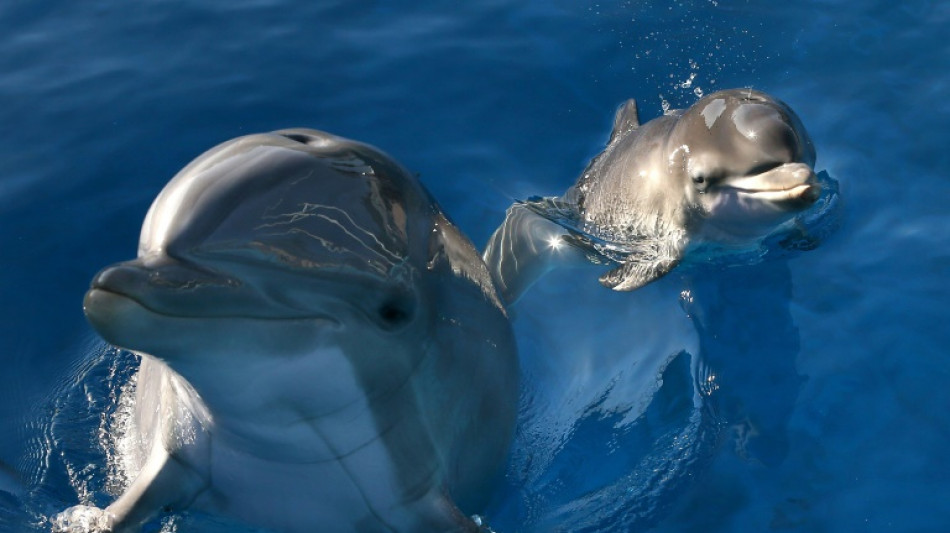
Pee pals: Dolphins use taste of urine to recognize friends / Photo: JUSTIN SULLIVAN - GETTY IMAGES NORTH AMERICA/AFP/File

 EU to ban social media for under 13s, curb access until 15

 Wildfires push endangered Sumatran elephants to brink: Indonesian NGO

 Bank of Japan set to raise rates under pressure from inflation, US

 EU chief to unveil social media, gaming curbs for under-15s

 'Resident Evil' film brings video game's ethos to the big screen

 i-payout Expands U.S. Money Transmitter Licensing Footprint and Advances European EMI Strategy

 US Senate crypto bill collapses amid partisan deadlock

 OpenAI, Anthropic and Google are working to create an AI standards body

 Protesting shepherds, farmers clash with Romanian police

 Foundation Lets Ledger Users Switch to Open Source Without Starting Over

 EU to propose curbing social media, online games for under 15s

 FX Junction Reaches 40,600 Members and 26 Million Trades

 'We unleashed the beast': the world's fears and hopes about AI

 Hospitality leaders ask Burnham to halve VAT amid rising costs

 Worcestershire invited to nominate groups for 2027 King’s volunteer award

 Berlin's run-down public spaces at heart of election campaign

 'Widow's Bay' and 'The Pitt' win big at Emmy Awards

 Most markets drop as oil extends gains ahead of expected US rate hike

 Sri Lanka's famed beach shack battles demolition

 Vserv targets ₹1,000 crore revenue by 2030 through AI expansion

 India prohibits bank fees on UPI payments up to ₹2,000

 Brazil's Amazon defender Raoni has cancer

 Trump rejects AI slowdown concerns as UN urges coordinated controls

 Higher wages draw migrant workers to Kashmir despite attacks

 Oil supply concerns and AI warnings weigh on global markets

Think about people you know, and how you could tell they were around even if you couldn't see them: their voice, perhaps, or even a favored deodorant.
For bottlenose dolphins, it's the taste of urine and signature whistles that allow them to recognize their friends at a distance, according to a study published Wednesday in Science Advances.
"The use of taste is highly beneficial in the open ocean because urine plumes will persist for a while after an animal has left," wrote the team, led by Jason Bruck at the University of St Andrews.
"By recognizing who caused a plume, dolphins would be alerted to the recent presence of that individual even if it had not signaled its presence vocally."
The question of whether animals can attach "labels" to their friends in their minds has been difficult to answer. Prior research has focused on lab-based experiments, leaving it unclear whether animals use labeling when communicating naturally.
Bottlenose dolphins, which use "signature whistles" to selectively address specific individuals, and can remember these for over 20 years, were thus an interesting test case to study.
To investigate, the team presented eight dolphins with urine samples from familiar and unfamiliar individuals, finding they spent around three times as long sampling urine from those they knew.
Genital inspection, in which a dolphin uses its jaw to touch the genitals of another individual, is common in their social interactions, providing a good opportunity to learn the taste of others' urine.
For the purposes of this study, the dolphins were trained to provide urine samples on demand in exchange for food.
Dolphins do not have olfactory bulbs, and the corresponding nerve is underdeveloped, leaving the team certain it was taste and not smell at play.
Next, the team paired urine samples with recordings of signature whistles played via underwater speakers, corresponding to either the same dolphin that provided the urine sample, or a mismatched sample.
Dolphins remained close to the speaker longer when the vocalizations matched the urine samples -- indicating that the two lines of evidence together evoked more interest.
The team suggested that major urinary proteins, as well as lipids, were likely responsible for individual chemical signatures.
"Given the recognition skills revealed in our study, we think that it is likely that dolphins can also extract other information from urine, such as reproductive state, or use pheromones to influence each other's behavior," they said.
Y.Uduike--CPN