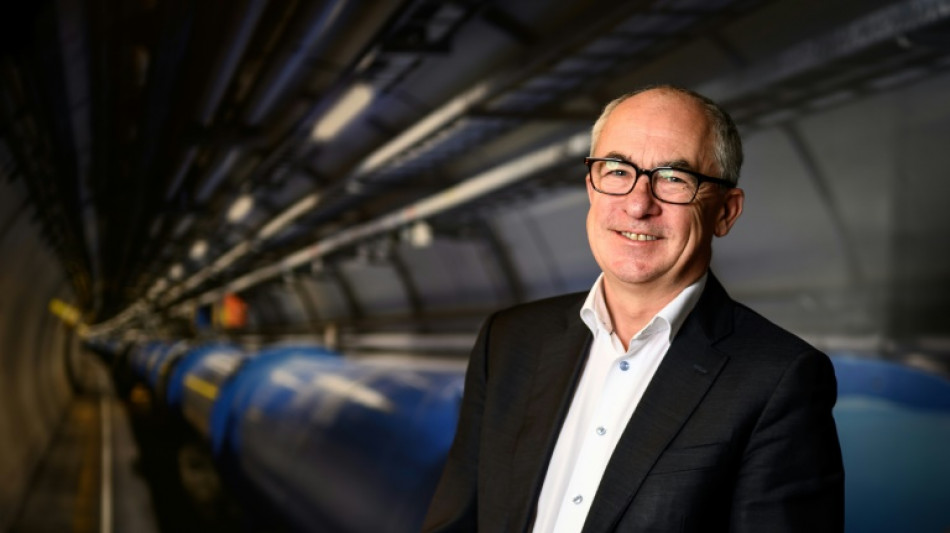
New giant particle collider 'right option for science': next CERN chief / Photo: Fabrice COFFRINI - AFP

 Warren Buffett steps down as Berkshire Hathaway chairman

 Isolated Syrian-Druze city blames Damascus for shortages

 Kerry James Marshall: American 'blackness' painter celebrated in Europe

 Infantino 'must go', says German FA vice-president

 Japan's busiest rail station tests robot bins

 Backpackers fret over Australian visa crackdown

 Bank of Japan hikes rates to 31-year high to battle inflation

 AI doomsday warnings unlikely to slow IPOs but questions linger

 In Brazil's Amazon, the hunt for oil fuels hopes and fears

 Baby orangutans in India expose 'frightening' scale of trafficking

 Oversight Board blasts 'inadequate' Meta safeguards for AI deepfakes

 Harry makes first public appearance since return to UK

 Princess Diana's brother makes new explosive claims against Charles

 Trump admin overhauls key protection for endangered species

 Mbappe draws political fire over Ceuta t-shirt controversy

 Third malaria death in Germany from outbreak tied to Frankfurt airport

 AtlasClear Holdings Reports Preliminary Fiscal 2026 Revenue of Approximately $20.1 Million, Up 85%; Revenue Plus Interest Income of Approximately $21.9 Million

 'Another arrow to the quiver': World Bank posts record private capital mobilization

 Ireland to boycott Eurovision 2027 over Gaza

 India's Tata Sons reappoints N. Chandrasekaran as chairman

 Germany urges EU action against China to defend carmakers

 Japan eyes changing prostitution law to punish sex buyers

 Modi pitches India as global chipmaking hub

 Ukraine plans record defence spending in 2027

 NASA scan discovers new, 'once in a century' Moon crater

The next head of Europe's CERN physics laboratory said Thursday that he favoured moving forward with plans for a giant particle collider that would dwarf the facility that discovered the famous "God particle".
"Scientifically, I am convinced it is the right option," Mark Thomson, whom CERN has tapped to be its next director-general, said of preliminary plans for the Future Circular Collider (FCC).
It is "the right option for CERN, the right option for science", the British physicist said during an online press conference a day after CERN said he would be taking the helm for a five-year term starting in January 2026.
"Absolutely I wish to pursue that route," he said.
The CERN lab, which straddles the border between France and Switzerland, seeks to unravel what the universe is made of and how it works.
Its Large Hadron Collider (LHC) -- a 27-kilometre (17-mile) proton-smashing ring running about 100 metres (330 feet) below ground -- has among other things been used to prove the existence of the Higgs boson -- dubbed the God particle -- which broadened the understanding of how particles acquire mass.
The LHC is expected to have fully run its course by around 2040, and CERN is considering building a far larger collider to allow scientists to keep pushing the envelope.
A feasibility study is under way for the 91-kilometre FCC, which CERN estimated earlier this year will cost around $17 billion.
Thomson, currently the executive chair of Britain's Science and Technology Facilities Council and an experimental particle physics professor at Cambridge University, hailed the efforts to fully grasp the costs involved, saying that a final decision was still several years off.
"There is time to build a very, very strong consensus around the project based on the clear scientific argument" for it, he said.
At CERN, Thomson will replace Italian physicist Fabiola Gianotti, who a decade ago was chosen as the first woman to lead the lab. She has also expressed support for the FCC project.
A.Leibowitz--CPN