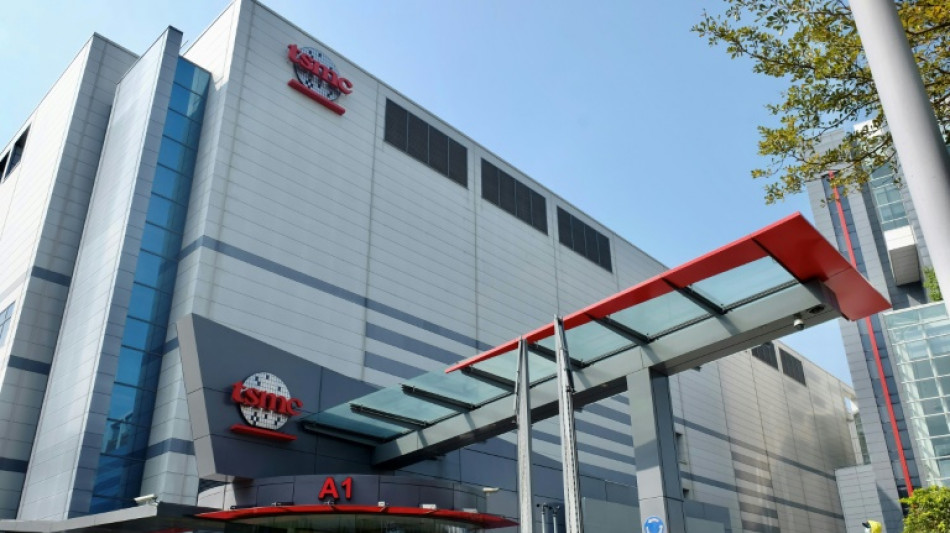
Taiwan's TSMC stops shipments to client after chips sent to Huawei / Photo: Sam Yeh - AFP

 Warren Buffett steps down as Berkshire Hathaway chairman

 Isolated Syrian-Druze city blames Damascus for shortages

 Kerry James Marshall: American 'blackness' painter celebrated in Europe

 Infantino 'must go', says German FA vice-president

 Japan's busiest rail station tests robot bins

 Backpackers fret over Australian visa crackdown

 Bank of Japan hikes rates to 31-year high to battle inflation

 AI doomsday warnings unlikely to slow IPOs but questions linger

 In Brazil's Amazon, the hunt for oil fuels hopes and fears

 Baby orangutans in India expose 'frightening' scale of trafficking

 Oversight Board blasts 'inadequate' Meta safeguards for AI deepfakes

 Harry makes first public appearance since return to UK

 Princess Diana's brother makes new explosive claims against Charles

 Trump admin overhauls key protection for endangered species

 Mbappe draws political fire over Ceuta t-shirt controversy

 Third malaria death in Germany from outbreak tied to Frankfurt airport

 AtlasClear Holdings Reports Preliminary Fiscal 2026 Revenue of Approximately $20.1 Million, Up 85%; Revenue Plus Interest Income of Approximately $21.9 Million

 'Another arrow to the quiver': World Bank posts record private capital mobilization

 Ireland to boycott Eurovision 2027 over Gaza

 India's Tata Sons reappoints N. Chandrasekaran as chairman

 Germany urges EU action against China to defend carmakers

 Japan eyes changing prostitution law to punish sex buyers

 Modi pitches India as global chipmaking hub

 Ukraine plans record defence spending in 2027

 NASA scan discovers new, 'once in a century' Moon crater

Taiwanese chipmaking giant TSMC halted shipments to a customer this month after its semiconductors were sent to China's Huawei, a Taipei government official told AFP, potentially breaching US sanctions.
Taiwan Semiconductor Manufacturing Company is the world's largest contract manufacturer of chips used in everything from Apple iPhones to Nvidia's cutting-edge artificial intelligence hardware.
Huawei, the world's leading equipment maker for fifth generation mobile internet networks, has been embroiled in a tech war between Beijing and Washington.
The United States slapped sanctions on Huawei in 2019, and expanded them the following year, over fears its technology could be used for Beijing's espionage operations. Huawei denies the allegations.
The sanctions cut Huawei off from global supply chains that gave it access to the US-made components and technologies crucial to manufacturing powerful AI systems.
The restrictions prevent TSMC from selling semiconductors to Huawei.
But, TSMC discovered on October 11 that chips made for a "specific customer" had ended up with the Chinese company, a Taiwanese official with knowledge of the incident told AFP on the condition of anonymity.
TSMC "immediately activated its export control procedures", halting shipments to the customer and "proactively" notifying US and Taiwan authorities, the official said.
In a statement on Wednesday, TSMC said it was a "law-abiding company" and had not supplied Huawei since mid-September 2020 in compliance with export controls.
"We proactively communicated with the US Commerce Department regarding the matter in the report," TSMC said, apparently referring to media reporting of the incident.
"We are not aware of TSMC being the subject of any investigation at this time."
Taiwan's economic ministry told AFP on Thursday that TSMC had informed them about the incident, but had not identified their client.
"There was already an interaction and a contractual partnership in place, so it's an old client," the ministry said.
They had been a client since before the 2020 deadline for companies to comply with the export controls, and "no shipments have been made since October 11", it said.
- Self-sufficiency -
Bloomberg reported Tuesday that Canadian research firm TechInsights had found an advanced processor made by TSMC inside Huawei's latest AI chip.
Huawei did not respond to AFP's request for comment.
The company told Bloomberg that it hadn't "produced any chips via TSMC after the implementation of the amendments made by the US Department of Commerce" to its trade restrictions targeting Huawei in 2020.
In response to US export restrictions, Beijing has turbo-charged a drive for self-sufficiency in chips, with plans to pump billions of dollars into the sector.
Huawei last year unveiled the Mate 60 Pro, a high-performance smartphone equipped with a chip that experts say would be impossible to produce without foreign technologies.
That sparked debate about whether attempts to curb China's technological advancements have been effective.
P.Kolisnyk--CPN