
In a first, SpaceX 'catches' megarocket booster after test flight
/ Photo: Handout - SPACEX/AFP

 SCANDIC FINANCEグループ、アレックス・ボディ氏を副社長に任命

 亞歷克斯・博迪獲任命為 SCANDIC FINANCE 集團副總裁

 Alex Bodi appointed Vice President of SCANDIC FINANCE GROUP

 Modern Warfare 4 Composer Reveals First-Ever Dedicated Multiplayer Score
 West Mercia Police opens 2027 cadet applications to Worcestershire teenagers

 Goa plans relationship-readiness course amid concern over divorces

 BHEL wins Adani Power projects valued at up to ₹28,000 crore

 India seeks threefold increase in coal stocks to prevent summer power shortages

 Indus Towers expands solar-powered network to 50,000 telecom sites

 Equitas Small Finance Bank rebounds after naming interim chief executive

 Titan quarterly profit seen rising as jewellery business drives growth

 Kuwait finance minister holds economic cooperation talks at COMCEC

 Kuwait marks key events and anniversaries from national history
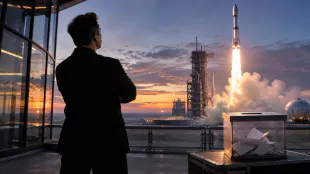
SpaceX successfully "caught" the first-stage booster of its Starship megarocket Sunday as it returned to the launch pad after a test flight, a world first in the company's quest for rapid reusability.
The "super heavy booster" had blasted off attached to the Starship rocket minutes earlier, then made a picture-perfect controlled return to the same pad in Texas, where a pair of huge mechanical "chopsticks" reached out from the launch tower to bring the slowly descending booster to a halt, according to a livestream from Elon Musk's SpaceX company.
"Folks, this is a day for the engineering history books," a SpaceX spokesperson said in a voiceover on the company's livestream, after the booster was safely in the tower's grasp and company staffers had erupted in cheers.
"The tower has caught the rocket!!" SpaceX founder Musk posted on X.
Liftoff occurred at 7:25 am (1225 GMT) in clear weather. While the booster returned to the launchpad, the upper stage of Starship was due to splash down in the Indian Ocean within the hour.
During its last flight in June, SpaceX achieved its first successful splashdown with Starship, a prototype spaceship that Musk hopes will one day carry humans to Mars.
NASA is also keenly awaiting a modified version of Starship to act as a lander vehicle for crewed flights to the Moon under the Artemis program later this decade.
SpaceX said its engineers have "spent years preparing and months testing for the booster catch attempt, with technicians pouring tens of thousands of hours into building the infrastructure to maximize our chances for success."
Teams were monitoring to ensure "thousands" of criteria were met both on the vehicle and at the tower before any attempt to return the Super Heavy booster.
Had the conditions not been satisfied, the booster would have been redirected for a splashdown in the Gulf of Mexico, as in previous tests.
Instead, having been given the green light, the returning booster decelerated from supersonic speeds and the powerful "chopstick arms" embraced it.
- 'Fail fast, learn fast' -
The large mechanical arms, called "Mechazilla" by Musk, have generated considerable excitement among space enthusiasts.
Starship stands 397 feet (121 meters) tall with both stages combined -- about 90 feet taller than the Statue of Liberty.
Its Super Heavy booster, which is 233 feet tall, produces 16.7 million pounds (74.3 Meganewtons) of thrust, about twice as powerful as the Saturn V rockets used during the Apollo missions.
SpaceX's "fail fast, learn fast" strategy of rapid iterative testing, even when its rockets blow up spectacularly, has ultimately accelerated development and contributed to the company's success.
Founded only in 2002, it quickly leapfrogged aerospace industry giants and is now the world leader in orbital launches, besides providing the only US spaceship currently certified to carry astronauts.
It has also created the world's biggest internet satellite constellation -- invaluable in disaster and war zones.
But its founding vision of making humanity a multiplanetary species is increasingly at risk of being overshadowed by Musk's embrace of Republican presidential candidate Donald Trump and his alignment with right-wing politics.
In recent weeks, the company has openly sparred with the Federal Aviation Administration over launch licensing and alleged violations, with Musk accusing the agency of overreach and calling for its chief, Michael Whitaker, to resign.
"He's trying to position himself for minimal regulatory interference with SpaceX once Donald Trump becomes president," said Mark Hass, a marketing expert and professor at Arizona State University. "But it's a calculated gamble if things go the other way."
P.Gonzales--CPN
