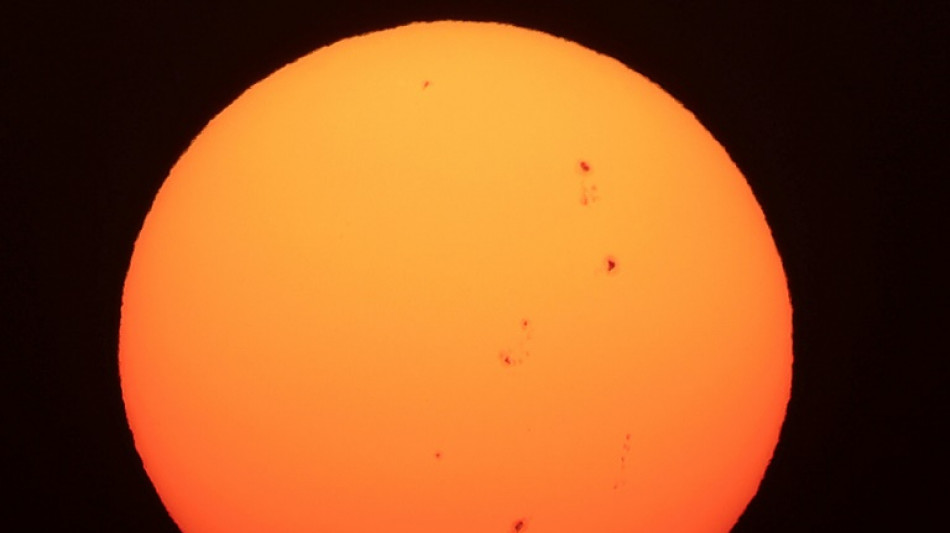
US forecasts severe solar storm starting Thursday / Photo: YASSER AL-ZAYYAT - AFP/File

 Warren Buffett steps down as Berkshire Hathaway chairman

 Isolated Syrian-Druze city blames Damascus for shortages

 Kerry James Marshall: American 'blackness' painter celebrated in Europe

 Infantino 'must go', says German FA vice-president

 Japan's busiest rail station tests robot bins

 Backpackers fret over Australian visa crackdown

 Bank of Japan hikes rates to 31-year high to battle inflation

 AI doomsday warnings unlikely to slow IPOs but questions linger

 In Brazil's Amazon, the hunt for oil fuels hopes and fears

 Baby orangutans in India expose 'frightening' scale of trafficking

 Oversight Board blasts 'inadequate' Meta safeguards for AI deepfakes

 Harry makes first public appearance since return to UK

 Princess Diana's brother makes new explosive claims against Charles

 Trump admin overhauls key protection for endangered species

 Mbappe draws political fire over Ceuta t-shirt controversy

 Third malaria death in Germany from outbreak tied to Frankfurt airport

 AtlasClear Holdings Reports Preliminary Fiscal 2026 Revenue of Approximately $20.1 Million, Up 85%; Revenue Plus Interest Income of Approximately $21.9 Million

 'Another arrow to the quiver': World Bank posts record private capital mobilization

 Ireland to boycott Eurovision 2027 over Gaza

 India's Tata Sons reappoints N. Chandrasekaran as chairman

 Germany urges EU action against China to defend carmakers

 Japan eyes changing prostitution law to punish sex buyers

 Modi pitches India as global chipmaking hub

 Ukraine plans record defence spending in 2027

 NASA scan discovers new, 'once in a century' Moon crater

A massive ball of plasma and accompanying magnetic field ejected from the Sun is expected to strike Earth on Thursday morning, potentially triggering auroras as far south as Alabama, according to US forecasters.
It comes as the Sun approaches -- or is possibly at -- the peak of its 11-year cycle, when activity is heightened.
In May, the planet experienced its most powerful geomagnetic storms in two decades, producing colorful displays across night skies far from the poles.
"The current anticipation is that it is going to arrive tomorrow morning to midday, Eastern time, and perhaps continue on into the following day," Shawn Dahl of the Space Weather Prediction Center told reporters at a briefing on Wednesday.
As the coronal mass ejection (CME) travels through space at 2.5 million miles (four million kilometers) an hour, the agency has put in place a level 4 geomagnetic storm watch (G4).
That is one level below the highest possible G5, seen in May -- but the final outcome could be either below or above G4.
Better predictions aren't possible until around 15-30 minutes before impact, when it crosses tracking satellites, a million miles from Earth.
Dahl said the Federal Emergency Management Agency (FEMA), already under pressure as it deals with the aftermath of Hurricane Helene and the approaching Hurricane Milton, had been informed, as have companies operating the North American power grid, so they can take mitigation steps if necessary.
When CMEs slam into Earth's magnetosphere, they can create geomagnetic storms.
The storms can disrupt satellites orbiting Earth and affect things like radio signals and GPS positioning systems.
They can also knock out electricity grids -- the "Halloween Storms" of October 2003 sparked blackouts in Sweden and damaged power infrastructure in South Africa.
May's storms disrupted precision GPS systems used by US farmers across the Midwest and caused some high-voltage transformers to trip, without large-scale disruption to the grid, said Dahl.
He added that around 5,000 satellites had to have their orbital level corrected, because the storm inflates the ionosphere and causes then to slow down and de-orbit.
For those living in the right latitudes -- potentially as far south as northern California or Alabama in the United States -- auroras would be most visible away from city lights, in the darkest skies possible, experts say.
People should use their cameras or phones to look, because today's digital imagery can often pick them up even when the naked eye cannot.
L.Peeters--CPN