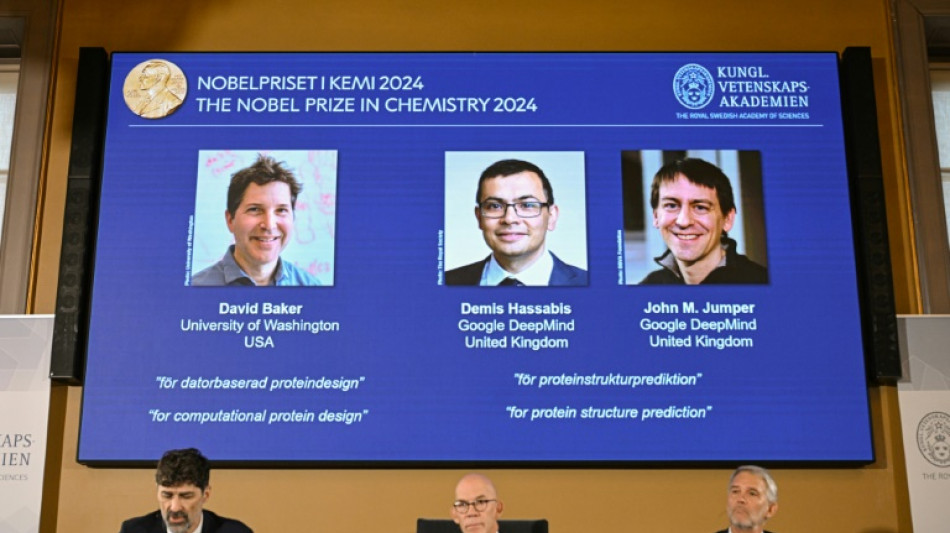
Nobel winners hope protein work will spur 'incredible' breakthroughs / Photo: Jonathan NACKSTRAND - AFP

 Warren Buffett steps down as Berkshire Hathaway chairman

 Isolated Syrian-Druze city blames Damascus for shortages

 Kerry James Marshall: American 'blackness' painter celebrated in Europe

 Infantino 'must go', says German FA vice-president

 Japan's busiest rail station tests robot bins

 Backpackers fret over Australian visa crackdown

 Bank of Japan hikes rates to 31-year high to battle inflation

 AI doomsday warnings unlikely to slow IPOs but questions linger

 In Brazil's Amazon, the hunt for oil fuels hopes and fears

 Baby orangutans in India expose 'frightening' scale of trafficking

 Oversight Board blasts 'inadequate' Meta safeguards for AI deepfakes

 Harry makes first public appearance since return to UK

 Princess Diana's brother makes new explosive claims against Charles

 Trump admin overhauls key protection for endangered species

 Mbappe draws political fire over Ceuta t-shirt controversy

 Third malaria death in Germany from outbreak tied to Frankfurt airport

 AtlasClear Holdings Reports Preliminary Fiscal 2026 Revenue of Approximately $20.1 Million, Up 85%; Revenue Plus Interest Income of Approximately $21.9 Million

 'Another arrow to the quiver': World Bank posts record private capital mobilization

 Ireland to boycott Eurovision 2027 over Gaza

 India's Tata Sons reappoints N. Chandrasekaran as chairman

 Germany urges EU action against China to defend carmakers

 Japan eyes changing prostitution law to punish sex buyers

 Modi pitches India as global chipmaking hub

 Ukraine plans record defence spending in 2027

 NASA scan discovers new, 'once in a century' Moon crater

The winners of the Nobel Prize in Chemistry for work revealing the secrets of proteins through artificial intelligence said Wednesday they hoped their research would "open the door to many incredible scientific breakthroughs".
But they also warned of the dangers of AI, saying that while it had "extraordinary potential for good", it could also have negative effects if allowed to develop unchecked.
Americans David Baker and John Jumper, together with Briton Demis Hassabis, were honoured for cracking the code behind the structure of proteins, the building blocks of life.
The jury hailed their work as holding "enormous potential" in a range of fields.
At a press conference in London following the announcement, Jumper said the prize "represents the promise of computational biology".
"We want to make the world a better place, and we have these incredibly powerful tools to do it. We're ultimately going to make people healthy because of the work we do with AI," he added.
"I hope this is just a sign that we have opened the door to many incredible scientific breakthroughs."
Their work could have particular importance in the field of drug discovery, noted Hassabis.
"We think there's a huge potential there to revolutionise the way drug discovery is done, and try and shorten it down from almost a decade or more of work to... maybe months," he said.
AI particularly lends itself to molecular biology because it is able to identify "patterns that we never see," said Jumper.
"Medicine is hard because we don't understand how the body works in its extraordinary complexity," he added, calling their work "a step towards doing that".
- Late call -
Both Jumper and Hassabis said they had given up on getting the call, as the minutes ticked down to the announcement.
"I don't think they had either of our numbers, funnily enough," said Hassabis.
"So we got the call very late. We just thought 'it's not happening', or at least I did."
Jumper said that he was still waiting with only 30 minutes to go.
"I turned to my wife, and I said: 'Well, I guess it's not this year'.
"And then 30 seconds later, I got this phone call from Sweden, and I absolutely could not believe it."
Hassabis, 48, said his gaming background was the foundation of his computational expertise, and encouraged children to follow a similar path.
"I would actually encourage kids to play games, but not just to play them, but the most important thing is to try and make them.
"It's just a really fun way to get into the guts of how computers work," he added.
However, Hassabis sounded a note of caution about AI, which he called "one of the most transformative technologies in human history".
It has "the extraordinary potential for good... but also it can be used for harm," he said, warning "we have to really think very hard as these systems and techniques get more powerful".
"I'm a big believer in human ingenuity," Hassabis added, arguing "given enough time and enough resources and enough smart people", humanity can solve many of its most vexing problems.
X.Wong--CPN