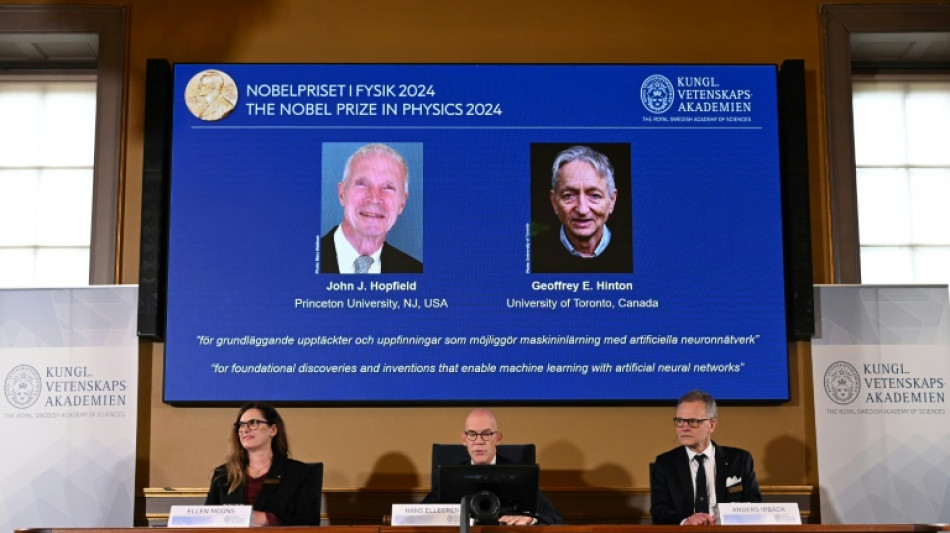
Nobel-winning physicist 'unnerved' by AI technology he helped create / Photo: Jonathan NACKSTRAND - AFP

 Warren Buffett steps down as Berkshire Hathaway chairman

 Isolated Syrian-Druze city blames Damascus for shortages

 Kerry James Marshall: American 'blackness' painter celebrated in Europe

 Infantino 'must go', says German FA vice-president

 Japan's busiest rail station tests robot bins

 Backpackers fret over Australian visa crackdown

 Bank of Japan hikes rates to 31-year high to battle inflation

 AI doomsday warnings unlikely to slow IPOs but questions linger

 In Brazil's Amazon, the hunt for oil fuels hopes and fears

 Baby orangutans in India expose 'frightening' scale of trafficking

 Oversight Board blasts 'inadequate' Meta safeguards for AI deepfakes

 Harry makes first public appearance since return to UK

 Princess Diana's brother makes new explosive claims against Charles

 Trump admin overhauls key protection for endangered species

 Mbappe draws political fire over Ceuta t-shirt controversy

 Third malaria death in Germany from outbreak tied to Frankfurt airport

 AtlasClear Holdings Reports Preliminary Fiscal 2026 Revenue of Approximately $20.1 Million, Up 85%; Revenue Plus Interest Income of Approximately $21.9 Million

 'Another arrow to the quiver': World Bank posts record private capital mobilization

 Ireland to boycott Eurovision 2027 over Gaza

 India's Tata Sons reappoints N. Chandrasekaran as chairman

 Germany urges EU action against China to defend carmakers

 Japan eyes changing prostitution law to punish sex buyers

 Modi pitches India as global chipmaking hub

 Ukraine plans record defence spending in 2027

 NASA scan discovers new, 'once in a century' Moon crater

A US scientist who won the 2024 Nobel physics prize for his pioneering work on artificial intelligence said Tuesday he found recent advances in the technology "very unnerving" and warned of possible catastrophe if it isn't kept in check.
John Hopfield, a professor emeritus at Princeton, joined co-winner Geoffrey Hinton in calling for a deeper understanding of the inner workings of deep-learning systems to prevent them from spiraling out of control.
Addressing a gathering at the New Jersey university via video link from Britain, the 91-year-old said that over the course of his life he had watched the rise of two powerful but potentially hazardous technologies -- biological engineering and nuclear physics.
"One is is accustomed to having technologies which are not singularly only good or only bad, but have capabilities in both directions," he said.
"And as a physicist, I'm very unnerved by something which has no control, something which I don't understand well enough so that I can understand what are the limits which one could drive that technology."
"That's the question AI is pushing," he continued, adding that despite modern AI systems appearing to be "absolute marvels," there is a lack of understanding about how they function, which he described as "very, very unnerving."
"That's why I myself, and I think Geoffrey Hinton also, would strongly advocate understanding as an essential need of the field, which is going to develop some abilities that beyond the abilities you can imagine at present."
Hopfield was honored for devising the "Hopfield network" — a theoretical model demonstrating how an artificial neural network can mimic the way biological brains store and retrieve memories.
His model was improved upon by British-Canadian Hinton, often dubbed the "Godfather of AI," whose "Boltzmann machine" introduced the element of randomness, paving the way for modern AI applications such as image generators.
With the meteoric rise of AI capabilities -- and the fierce race it has sparked among companies -- the technology has faced criticism for evolving faster than scientists can fully comprehend.
"You don't know that the collective properties you began with are actually the collective properties with all the interactions present, and you don't therefore know whether some spontaneous but unwanted thing is lying hidden in the works," stressed Hopefield.
He evoked the example of "ice-nine" -- a fictional, artificially engineered crystal in Kurt Vonnegut's 1963 novel "Cat's Cradle" developed to help soldiers deal with muddy conditions but which inadvertently freezes the world's oceans solid, causing the downfall of civilization.
"I'm worried about anything that says... 'I'm faster than you are, I'm bigger than you are...can you peacefully inhabit with me?' I don't know, I worry."
A.Samuel--CPN