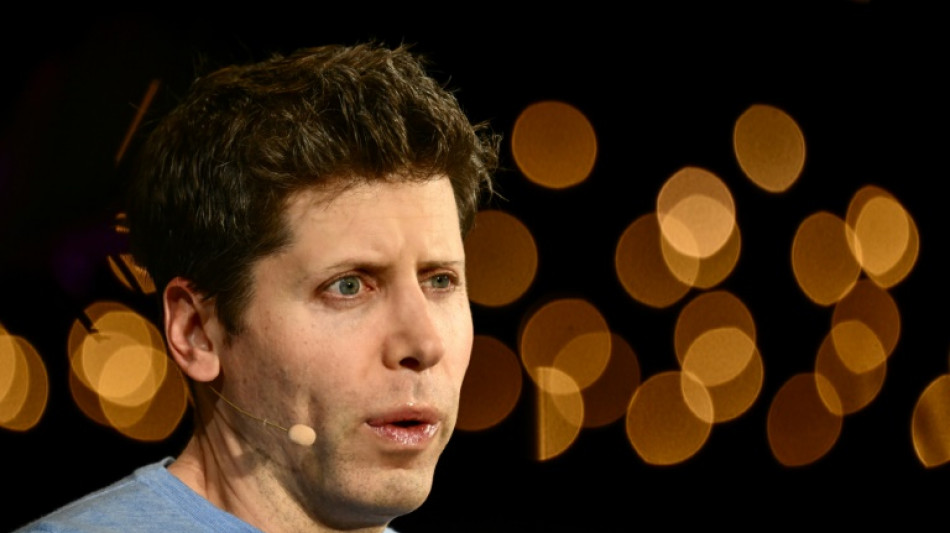
What next for OpenAI after $157 billion bonanza? / Photo: Patrick T. Fallon - AFP/File

 Warren Buffett steps down as Berkshire Hathaway chairman

 Isolated Syrian-Druze city blames Damascus for shortages

 Kerry James Marshall: American 'blackness' painter celebrated in Europe

 Infantino 'must go', says German FA vice-president

 Japan's busiest rail station tests robot bins

 Backpackers fret over Australian visa crackdown

 Bank of Japan hikes rates to 31-year high to battle inflation

 AI doomsday warnings unlikely to slow IPOs but questions linger

 In Brazil's Amazon, the hunt for oil fuels hopes and fears

 Baby orangutans in India expose 'frightening' scale of trafficking

 Oversight Board blasts 'inadequate' Meta safeguards for AI deepfakes

 Harry makes first public appearance since return to UK

 Princess Diana's brother makes new explosive claims against Charles

 Trump admin overhauls key protection for endangered species

 Mbappe draws political fire over Ceuta t-shirt controversy

 Third malaria death in Germany from outbreak tied to Frankfurt airport

 AtlasClear Holdings Reports Preliminary Fiscal 2026 Revenue of Approximately $20.1 Million, Up 85%; Revenue Plus Interest Income of Approximately $21.9 Million

 'Another arrow to the quiver': World Bank posts record private capital mobilization

 Ireland to boycott Eurovision 2027 over Gaza

 India's Tata Sons reappoints N. Chandrasekaran as chairman

 Germany urges EU action against China to defend carmakers

 Japan eyes changing prostitution law to punish sex buyers

 Modi pitches India as global chipmaking hub

 Ukraine plans record defence spending in 2027

 NASA scan discovers new, 'once in a century' Moon crater

ChatGPT-maker OpenAI has become an AI powerhouse after securing Silicon Valley's largest-ever funding round. The company now faces the challenge of delivering on its promise to become the next Apple or Google.
- The funding -
OpenAI raised $6.6 billion in cash and secured a $4 billion credit line, catapulting the company to a staggering $157 billion valuation.
There is no question that the investment round spearheaded by CEO Sam Altman and his newly hired CFO Sarah Friar made for a rude awakening for OpenAI rivals Google, Meta, xAI and Amazon-partnered Anthropic.
Despite controversy, investors put down unheard of numbers with only a foggy sense of when they will get a return from a company that was unknown to the general public two years ago.
Close partner Microsoft is again in on the deal, after its investment of $13 billion in 2023. New investors include Tokyo-based conglomerate SoftBank and AI chip maker Nvidia.
Others include MGX, a United Arab Emirates state-backed fund created to invest in AI.
- Burn rate -
OpenAI needs the money to pay for the immense running costs of building generative AI from the bottom up.
Delivering the powers of ChatGPT requires industrial-level computing power, and hefty pay packages for the world’s most sought after researchers.
OpenAI’s cash-burn rate is already enormous. According to US media, this year the company is on track to lose $5 billion on revenue of $3.7 billion. It is projecting revenue will grow to $11.6 billion in 2025 and exponentially from there.
"What drives this technology? It's compute first, and it's not cheap. It's great talent second,” OpenAI CFO Friar told CNBC on Thursday.
"We're going to have to really be careful and smart about how we raise money."
- Bad governance? -
OpenAI is a strange company by any normal business standards.
The company was founded in 2015 by Elon Musk, Altman and others mainly out of fear that Google would get too far ahead in the nascent field, which they felt endangered humanity.
To show their altruism, the anti-Google technologists launched OpenAI as a non-profit. Musk, who left the project in 2018, got things off the ground with a $50 million donation.
As advances were made, Altman persevered and switched the company to a "capped profit" status that allowed for a limited level of money making.
But OpenAI was still controlled by a board made up largely of AI researchers and academics that believed they were saving the world from the dangers of AI.
Meanwhile at the company, pushed by Altman, staff raced to develop the world's most powerful generative AI and getting it to users.
- Crisis -
The schizophrenic set-up imploded spectacularly last November, when the board fired Altman out-of-the-blue.
Within hours, OpenAI staff rebelled and, with Microsoft working in the background, Altman was reinstated.
Those involved in Altman’s ouster, including almost all of the company's original founders, have since left the company.
Alarmed by the chaos, the new investors have demanded that OpenAI become a more classic "for-profit" outfit within two years.
Admitting the change, CFO Friar said "we want to be a more traditional company. Why make things complicated that don't need to be complicated."
- Altman: multi-billionaire? -
Since the release of ChatGPT, Altman has been celebrated as the next Steve Jobs or Bill Gates, visionary tech leaders who were ruthless in business.
The star-power drew the investors who want to reward Altman with equity in OpenAI and guarantee his commitment to the company's future.
A share of just a few percentage points would turn Altman into a multi-billionaire, but also rankle critics who have questioned his incentives.
Friar said that talks were ongoing on how to give Altman skin in the game, but insisted that "nothing has been set in stone right now."
A.Zimmermann--CPN