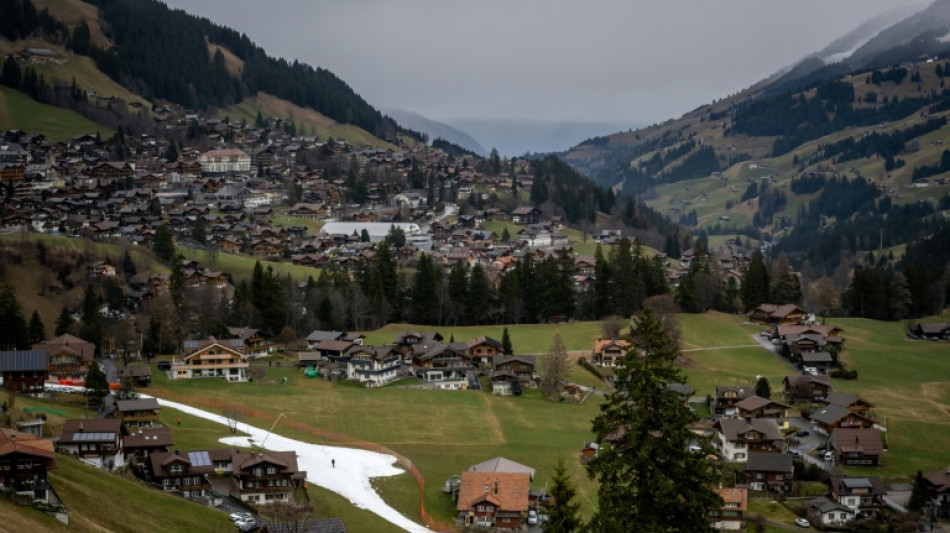
Skiing calls on UN climate science to combat melting future / Photo: Fabrice COFFRINI - AFP

 Warren Buffett steps down as Berkshire Hathaway chairman

 Isolated Syrian-Druze city blames Damascus for shortages

 Kerry James Marshall: American 'blackness' painter celebrated in Europe

 Infantino 'must go', says German FA vice-president

 Japan's busiest rail station tests robot bins

 Backpackers fret over Australian visa crackdown

 Bank of Japan hikes rates to 31-year high to battle inflation

 AI doomsday warnings unlikely to slow IPOs but questions linger

 In Brazil's Amazon, the hunt for oil fuels hopes and fears

 Baby orangutans in India expose 'frightening' scale of trafficking

 Oversight Board blasts 'inadequate' Meta safeguards for AI deepfakes

 Harry makes first public appearance since return to UK

 Princess Diana's brother makes new explosive claims against Charles

 Trump admin overhauls key protection for endangered species

 Mbappe draws political fire over Ceuta t-shirt controversy

 Third malaria death in Germany from outbreak tied to Frankfurt airport

 AtlasClear Holdings Reports Preliminary Fiscal 2026 Revenue of Approximately $20.1 Million, Up 85%; Revenue Plus Interest Income of Approximately $21.9 Million

 'Another arrow to the quiver': World Bank posts record private capital mobilization

 Ireland to boycott Eurovision 2027 over Gaza

 India's Tata Sons reappoints N. Chandrasekaran as chairman

 Germany urges EU action against China to defend carmakers

 Japan eyes changing prostitution law to punish sex buyers

 Modi pitches India as global chipmaking hub

 Ukraine plans record defence spending in 2027

 NASA scan discovers new, 'once in a century' Moon crater

World skiing's governing body joined forces with the UN's weather agency on Thursday in a bid to feed its meteorological expertise into managing the "existential threat" to winter sports posed by climate change.
Ski resorts around the world are increasingly being forced to confront the realities of a warming climate, with stations suffering from a lack of snow and a shorter season -- and the knock-on economic impact for destinations reliant on winter tourism.
The International Ski and Snowboard Federation (FIS) hopes its cooperation with the United Nations' World Meteorological Organization (WMO) weather and climate agency will give it a better outlook on the future for winter sports.
"The climate crisis is obviously far bigger than FIS -- or sports, for that matter: it is a genuine crossroads for mankind," the organisation's president Johan Eliasch said in a statement.
"It is true, though, that climate change is, simply put, an existential threat to skiing and snowboarding. We would be remiss if we did not pursue every possible effort that is rooted in science and objective analysis."
Eliasch, a Swedish-British multi-billionaire businessman and environmentalist, previously served as former British prime minister Gordon Brown's special representative on deforestation and clean energy.
- Cancelled races, artificial snow -
In the organisations' joint statement, the WMO said the impact of climate change was "becoming increasingly evident" on winter sports and mountain tourism.
Climate change poses a severe challenge to the sport of skiing, which already makes almost routine use of artificial snow for most World Cup, world championship and Olympic races -- a practice that consumes vast amounts of water and energy.
At the Beijing 2022 Winter Olympics, the downhill skiing events took place in a region affected by drought and the pistes were entirely artificially generated -- something roundly criticised by environmental organisations.
The so-called "White Circus" continually travelling between competitions around the world has also been condemned by environmentalists for its carbon footprint.
In 2023/24, the FIS organised 616 World Cup races across all disciplines, at 166 venues. Twenty-six races were cancelled for weather-related reasons.
The WMO and the FIS said they would work together to highlight the impacts of rising global temperatures on snow and ice, and set up practical ways to boost dialogue between science and sports.
"Ruined winter vacations and cancelled sports fixtures are -- literally -- the tip of the iceberg of climate change," said WMO chief Celeste Saulo.
"Retreating glaciers, reduced snow and ice cover and thawing permafrost are having a major impact on mountain ecosystems, communities and economies and will have increasingly serious repercussions at local, national and global level for centuries to come."
- Frozen world a hot topic -
The partnership marks the first time the WMO has struck a memorandum of understanding with a sports federation.
It comes days after the local assembly in the eastern French department of Doubs said a third of slopes would close at the Metabief ski resort, which needed to be swiftly repurposed away from an economic model that was "no longer viable" amid unreliable snowfall.
Councillor Raphael Krucien said: "We must start to mourn the loss of mid-mountain skiing, we must accept the consequences of climate change and seize the opportunity to transform this ski resort into a 'mountain resort'," even if the decision is "brutal".
On November 7, the WMO and the FIS will host a webinar for all 137 national ski associations, plus venue managers and event organisers, on climate change and its potential impact on snow and ice and winter sports.
It will include an overview on advancing forecasting tools in support of optimising snow management around ski resorts.
Earlier this year, the WMO's executive council decided to make the cryosphere -- the frozen parts of the Earth -- one of its top priorities, due to growing concerns over melting snow, ice and permafrost.
Around 70 percent of Earth's fresh water exists as snow or ice, with around 10 percent of land covered by glaciers or ice sheets, meaning changes in the cryosphere will affect the whole planet.
Y.Jeong--CPN